

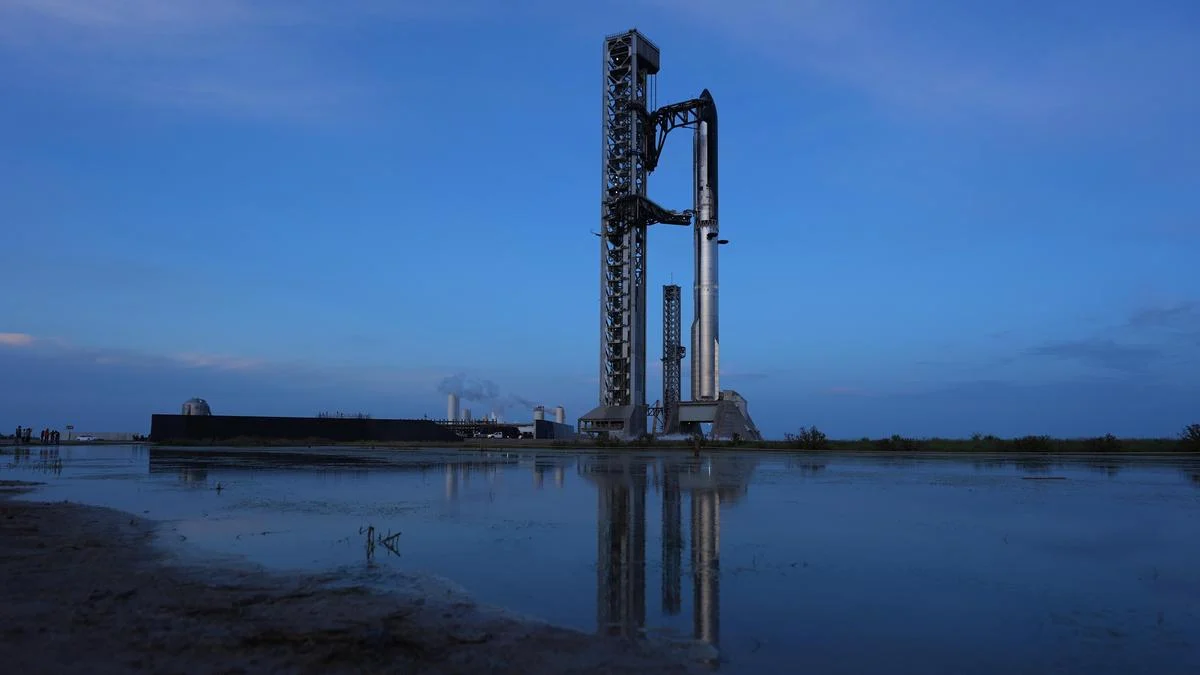
STARBASE, TEXAS – July 17, 2026 – SpaceX’s ambitious journey to revolutionize space travel faced a momentary setback today as its towering Starship mega-rocket experienced an automatic launch abort during its inaugural flight attempt since the company went public last month. The highly anticipated launch, intended to be the 13th overall for the Starship program, was abruptly halted at its Starbase facility in Texas when a critical number of its powerful Raptor engines failed to ignite on the Super Heavy booster.
The incident occurred just as the countdown reached its final moments, triggering an automatic shutdown sequence and leaving the colossal vehicle, a symbol of humanity’s deep-space aspirations, firmly anchored to its launch pad. The abort serves as a stark reminder of the immense technical challenges inherent in developing next-generation reusable rocketry, even for a company renowned for its rapid innovation and iterative development cycles.
SpaceX CEO Elon Musk swiftly confirmed the cause of the abort via his social media platform, X, stating, "Some of the engines didn’t start, triggering an automatic launch abort. Now offloading propellant." In a subsequent post, Musk provided an immediate path forward: "To be confident of a good flight, 2 Raptors will be removed and replaced. Most probable launch timing is early next week." This transparent and rapid communication has become a hallmark of SpaceX’s operational style, offering real-time insights into its complex endeavors.
This attempted flight held particular significance, marking the first major operational milestone for SpaceX since its record-setting Initial Public Offering (IPO) in June. Investors and enthusiasts alike were keenly watching, not only for the technical performance of the Starship but also for its symbolic impact on the company’s nascent public market valuation.
Chronology of the Abort and the Path to Launch
The morning at Starbase, Texas, had been charged with an almost palpable tension, a blend of excitement and apprehension that accompanies any monumental rocket launch. Engineers and technicians had been diligently working through the final pre-flight checks, ensuring every system was primed for what was intended to be a groundbreaking mission. The Starship, a fully stacked configuration comprising the Starship upper stage atop the Super Heavy booster, stood majestically on the orbital launch mount, bathed in the humid Texas air, its gleaming stainless-steel exterior reflecting the pre-dawn light.
Fueling operations, a meticulous and lengthy process involving cryogenic liquid oxygen and liquid methane, had commenced hours earlier, steadily filling the vast tanks of both the booster and the upper stage. As the countdown clock ticked inexorably towards zero, mission control communications crackled with reports of "all systems go" and "pressure stable." The anticipation reached its zenith in the final minute, a silence descending over the launch site, punctuated only by the distant hum of machinery and the rising pressure within the rocket’s propulsion systems.
At T-0, the automated sequence for engine ignition began. The ground shook momentarily, a tell-tale sign of the initial firing sequence, but the expected roaring crescendo of 33 Raptor engines igniting in unison never materialized. Instead, the distinct sound of a partial ignition, followed by an immediate cessation of activity, signaled trouble. Within moments, the flight computer, designed to detect critical anomalies and prioritize safety, initiated an automatic abort. The visual evidence from live streams confirmed the dramatic halt: plumes of exhaust and vapor that had begun to emerge from beneath the booster quickly dissipated, leaving the Starship standing silently, its mission paused indefinitely.
Elon Musk’s immediate updates on X, the social media platform he owns, quickly clarified the situation. His transparency in detailing the failure of "some" Raptor engines to ignite provided crucial context, reassuring observers that the abort was a controlled and automated response to a detected issue, not a catastrophic failure. The subsequent announcement of propellant offloading indicated the safety protocols were being meticulously followed, preparing the vehicle for inspection and necessary repairs. The swift decision to replace two Raptor engines underscores SpaceX’s aggressive approach to troubleshooting and its commitment to rapid turnaround times, aiming for a re-attempt as early as "next week."
This abort, while a disappointment, is not an isolated event in the Starship’s journey. The program has been characterized by an iterative "test, fail, fix, repeat" development philosophy, pushing the boundaries of rocket engineering at an unprecedented pace. From the early "hop tests" of Starship prototypes in Boca Chica, Texas, demonstrating vertical takeoff and landing capabilities, to the first integrated flight tests of the full stack, each mission has been a learning opportunity. The program has seen numerous test articles explode, catch fire, or encounter unexpected issues, all of which have contributed to refining the design and operational procedures. This iterative process, though often dramatic, has allowed SpaceX to accelerate development cycles that traditionally span decades.

The most recent integrated flight test in May of this year, which introduced the third-generation Starship model, was deemed "mostly successful" despite experiencing engine issues with the Super Heavy booster that necessitated a controlled crash into the Gulf of Mexico rather than a precision return. That flight achieved several key objectives, including demonstrating the structural integrity of the full stack and proving the stage separation sequence, even as it highlighted areas requiring further refinement. The current abort, therefore, is another data point in this continuous learning curve, providing engineers with critical real-world information to enhance the system’s reliability.
The timing of this abort, coming after SpaceX’s monumental decision to go public in June with a record-setting IPO, adds another layer of scrutiny. The company, once a privately held entity, now faces the quarterly expectations and market pressures of public ownership. The success of Starship is not merely a technical achievement; it is increasingly intertwined with SpaceX’s financial performance and its ability to deliver on ambitious future revenue streams.
Supporting Data and Technical Details of the Starship Program
The Starship system represents a paradigm shift in space transportation, designed from the ground up to be fully reusable, capable of transporting both cargo and humans to Earth orbit, the Moon, Mars, and beyond. Its colossal scale is immediately apparent: standing nearly 120 meters (approximately 394 feet) tall when fully stacked, it is the tallest and most powerful rocket ever built.
At its core are the innovative Raptor engines, a proprietary design by SpaceX. Unlike traditional rocket engines that burn kerosene, Raptors utilize a full-flow staged combustion cycle with liquid methane and liquid oxygen (methalox) propellants. This combination offers several advantages, including higher performance, lower cost, and the potential for in-situ propellant production on Mars. The Super Heavy booster, the first stage of the Starship system, is equipped with 33 Raptor engines, generating an astounding 7,500 metric tons (16.5 million pounds) of thrust at liftoff. The Starship upper stage, designed for orbital and deep-space maneuvers, features six Raptor engines – three optimized for sea-level operation and three for vacuum. The failure of even a few of these engines on the Super Heavy during ignition is a critical event, as the system requires a specific thrust profile and engine-out capability to ensure a safe and successful ascent.
The specific objectives for this attempted flight were ambitious and multi-faceted, building upon the lessons learned from the May mission. The primary goals included:
- Integrated Launch and Ascent: A flawless liftoff and climb through Earth’s atmosphere, demonstrating the structural and propulsion integrity of the full stack.
- Stage Separation: A clean and successful separation of the Super Heavy booster from the Starship upper stage, a complex maneuver requiring precise timing and control.
- Super Heavy Booster Operations: The booster was intended to perform a "boostback burn" to reorient itself, followed by a "landing burn" offshore in the Gulf of Mexico, aiming for a controlled, soft splashdown, a significant step towards full reusability. The previous flight’s issues with booster engines had prevented this precise return, resulting in an uncontrolled descent.
- Starship Upper Stage Orbital Insertion: The upper stage was to continue its trajectory towards a near-orbital path.
- Starlink V3 Satellite Deployment: A crucial commercial objective was the deployment of 20 Starlink V3 satellites. These next-generation satellites are vital for expanding SpaceX’s burgeoning satellite internet constellation, offering enhanced bandwidth and capabilities. Their successful deployment is directly linked to the company’s revenue growth and its future plans, including the ambitious concept of "AI data centers in space."
- In-Space Raptor Relight Test: A critical engineering objective was to test the relight capability of a Raptor engine in the vacuum of space. This capability is essential for orbital maneuvering, deep-space injection burns, and ultimately, for missions to the Moon and Mars.
- Heat Shield Upgrades Test: The Starship upper stage was also equipped with upgraded heat shield tiles, designed to endure the extreme temperatures of atmospheric re-entry. Testing these upgrades in a real-world flight environment is paramount for ensuring the safety and reusability of the vehicle for future missions.
SpaceX had indeed implemented "several modifications to hardware and software" since the May flight. These modifications likely addressed specific vulnerabilities identified during that mission, such as improvements to the engine ignition sequencing, refined thrust vector control algorithms, enhanced structural integrity of critical components, and updated flight termination systems. Each abort and subsequent modification represents a rapid iteration in design and operational protocol, aiming to incrementally improve the system’s overall reliability.
Official Responses and Industry Reaction
Following the abort, the response from SpaceX, primarily through Elon Musk, has been characterized by its typical candor and focus on problem-solving. Musk’s rapid communication on X not only provided immediate clarity on the technical issue but also outlined the specific remedial actions—replacing two Raptor engines—and a tentative timeline for the next launch attempt. This approach aligns with SpaceX’s long-standing philosophy of transparent communication, even in the face of setbacks, which has generally been well-received by both the public and the space community. The company’s official statements reiterated its commitment to safety as the paramount concern, framing the abort as a successful demonstration of its automated safety systems working as intended.
Regulatory bodies, particularly the Federal Aviation Administration (FAA), will undoubtedly be monitoring the situation closely. While an automatic abort on the pad is generally less complex to investigate than an in-flight anomaly, the FAA is responsible for ensuring public safety and compliance with launch regulations. Any future launch attempts will require FAA approval, which will hinge on SpaceX demonstrating that the root cause of the engine ignition failure has been identified, addressed, and verified. Given the ongoing development nature of Starship, the FAA has a dedicated oversight role in each test flight.
The market’s reaction to the abort was discernible, albeit nuanced. SpaceX’s stock, which had debuted with significant fanfare in June at an IPO price of $135, closed on July 16, 2026, at $131.11, already below its initial offering. While a single launch abort for a complex experimental vehicle is often anticipated by seasoned investors in the aerospace sector, it nonetheless adds pressure on a newly public company. The long-term impact on the stock will depend heavily on the swiftness of the next successful launch and Starship’s subsequent performance. Analysts suggest that while such incidents can cause short-term dips, the overall narrative for SpaceX remains compelling due to its diversified revenue streams (Starlink, Falcon launches) and its ambitious long-term goals.

Industry experts and analysts generally echoed a pragmatic view. Dr. Anya Sharma, an independent aerospace consultant, commented, "An abort is never ideal, but for a vehicle as complex and as experimental as Starship, it’s a part of the development process. What’s crucial is how quickly SpaceX diagnoses the issue and implements a fix. Their track record suggests they’ll do so rapidly." Another expert, Professor Mark Jensen from the Institute for Space Studies, added, "This is not a failure of the safety system; it’s a testament to it. The system detected an anomaly and prevented a potentially more serious issue. The real ‘failure’ would be if they ignored the data or rushed the next attempt." Competitors in the commercial space sector, while perhaps privately observing the challenges, publicly maintain a focus on their own programs, understanding the inherent difficulties in pushing the boundaries of rocket technology.
NASA, a critical partner in the Starship program through its Human Landing System (HLS) contract for the Artemis III lunar mission, has yet to issue an official statement on the abort. However, the agency has historically shown patience and understanding with its commercial partners, recognizing the inherent risks in cutting-edge development. NASA’s reliance on Starship for its lunar ambitions means that while they will monitor progress closely, they are likely to continue supporting SpaceX’s iterative approach, provided safety and reliability benchmarks are consistently addressed.
Broader Implications and Future Outlook
The abort of Starship’s 13th flight carries significant implications for SpaceX’s ambitious timeline, its commercial aspirations, and its pivotal role in NASA’s lunar exploration program. While Elon Musk’s swift declaration of a potential re-launch "early next week" demonstrates SpaceX’s characteristic agility, any delay, even minor, can ripple through a meticulously planned schedule.
For the Starship development timeline, consistent, successful flights are paramount. Each test flight is designed to collect critical data, validate design changes, and push the operational envelope. Delays, while understandable, mean less data and slower progress towards achieving the full reusability and reliability required for routine operations. This is particularly relevant for NASA’s Artemis III mission, which aims to return humans to the Moon by the late 2020s, with Starship serving as the crucial Human Landing System (HLS). NASA’s lunar timeline is aggressive, and Starship’s readiness is a critical path item. Continued aborts or significant setbacks could introduce further delays into the broader Artemis program, affecting international partners and the overall momentum of human lunar exploration.
SpaceX’s commercial ambitions are also closely tied to Starship’s success. The company’s vision extends far beyond Earth orbit, encompassing the establishment of a sustainable human presence on Mars. Starship is the indispensable vehicle for this endeavor, capable of transporting hundreds of tons of cargo and dozens of people per mission. More immediately, the successful deployment of the next generation of Starlink V3 satellites, intended for this flight, is crucial for expanding SpaceX’s global satellite internet service. Starlink is a significant and growing revenue stream for the company, and consistent launches are essential for maintaining and growing its market share, especially as competition intensifies. Furthermore, SpaceX’s "lofty ambitions for AI data centers in space" would heavily rely on Starship’s ability to deploy massive payloads to orbit efficiently and cost-effectively.
The financial implications, especially for a newly public company, are also noteworthy. While the initial market reaction might be contained, sustained technical issues could affect investor confidence. SpaceX’s record IPO was built on the promise of future growth driven by Starlink and the revolutionary capabilities of Starship. Delivering on these promises requires consistent technical progress and operational success. The ability to quickly identify and rectify issues, as demonstrated by Musk’s immediate communication, is key to maintaining investor trust.
Ultimately, this abort underscores the enduring challenges of pioneering new frontiers in space. SpaceX’s iterative development philosophy, which embraces rapid testing and learning from failures, has undeniably accelerated innovation in rocketry. While traditional aerospace companies might spend years analyzing and perfecting a design before a single flight, SpaceX often pushes hardware to its limits, accepting that some tests will not go as planned. This approach, while occasionally leading to dramatic setbacks, has allowed them to achieve unprecedented milestones, such as routine orbital reusability with the Falcon 9 and Falcon Heavy rockets.
As the Starship sits on its launch pad, undergoing inspections and engine replacements, the space community holds its breath for the next attempt. The incident is a reminder that despite technological prowess and audacious vision, the laws of physics and the complexities of engineering remain formidable adversaries. Yet, it is precisely this relentless pursuit of overcoming these challenges that defines the spirit of space exploration. The world watches, anticipating "early next week," as SpaceX prepares once again to launch its colossal Starship, continuing its determined quest to open up the cosmos for humanity.
