

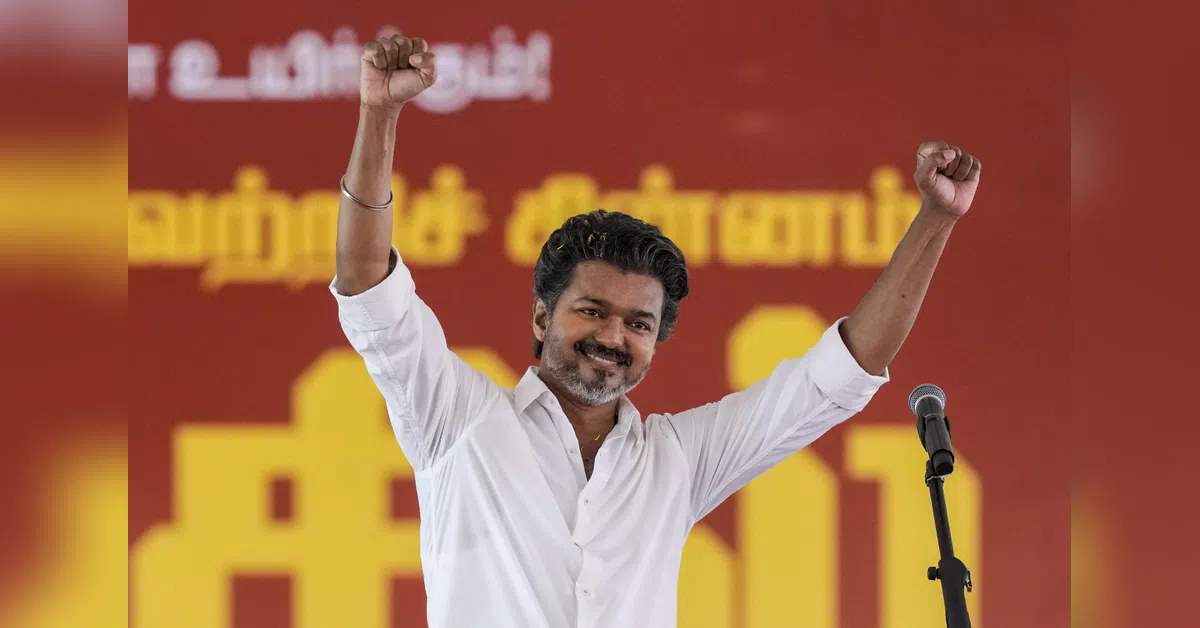
CHENNAI, Tamil Nadu – May 11, 2026 – In a dramatic turn of events that has reshaped the political landscape of Tamil Nadu, the fledgling Tamizhaga Vettri Kazhagam (TVK), led by charismatic actor-turned-politician Joseph Vijay, has successfully garnered the requisite numbers to form the next government. The breakthrough came on Saturday when the Viduthalai Chiruthaigal Katchi (VCK), a significant voice for Dalit rights and social justice, formally extended its unconditional support to the TVK-led bloc. This crucial endorsement, adding VCK’s two Members of Legislative Assembly (MLAs) to the alliance, pushes the coalition’s strength to a decisive 119 in the 234-member Tamil Nadu Assembly, surpassing the 118-seat majority mark by a comfortable margin.
The announcement marks the culmination of an intense period of post-election negotiations and political maneuvering, which saw the TVK, despite emerging as the single largest party in its debut Assembly elections, fall short of a clear majority. The path to power was paved by a strategic alliance that began with the Congress party’s unexpected pivot away from its traditional partner, the Dravida Munnetra Kazhagam (DMK), and was solidified by the subsequent backing of the Communist Party of India (CPI), the Communist Party of India (Marxist) (CPI(M)), and now the VCK. The development has not only propelled Joseph Vijay closer to the Chief Minister’s office but has also sent ripples across both state and national political arenas, particularly within the I.N.D.I.A. alliance.
The Journey to Majority: A Chronology of Political Maneuvers
The political chessboard of Tamil Nadu has been in a state of flux since the declaration of the Assembly election results, which saw a fractured mandate, defying conventional expectations of a clear victory for either the established Dravidian majors or the nascent TVK. Joseph Vijay’s Tamizhaga Vettri Kazhagam, born out of the actor’s immense fan base and long-held political aspirations, made a spectacular entry into electoral politics, securing an impressive 108 seats. This performance instantly positioned TVK as a formidable third force, challenging the decades-long dominance of the DMK and AIADMK. However, the tally of 108 seats, though significant, was precisely 10 short of the 118-seat majority required to form a government independently.
Further complicating the numbers, Joseph Vijay, true to his ‘Thalapathy’ (commander) persona, contested and won from two constituencies. While a testament to his widespread popularity, electoral rules mandate that a candidate can represent only one constituency. Vijay is expected to vacate one of these seats, which would further reduce the TVK’s effective strength in the Assembly to 107, making the task of government formation even more challenging. This shortfall immediately triggered a period of intense, behind-the-scenes negotiations, as political parties weighed their options and explored potential alliances.
The initial tremors of a major realignment were felt when the Indian National Congress, a long-standing ally of the DMK and a key constituent of the I.N.D.I.A. national alliance, made a bold and controversial decision. Following the election results, the Congress, which secured five seats, chose to abandon its pre-poll partner, the N.K. Stalin-led Dravida Munetra Kazhagam, and instead extended its support to the TVK. This move, widely perceived as a pragmatic shift towards power, ignited a firestorm of criticism from the DMK, which publicly accused the Congress of "back-stabbing." The acrimony escalated to the point where the DMK leadership formally wrote to the Lok Sabha Speaker, requesting a change in seating arrangements to distance themselves from Congress members, highlighting the deep rift created by this strategic defection.
With Congress’s five MLAs on board, the TVK-led bloc’s strength rose to 112 (107 from TVK + 5 from Congress). While a significant boost, it still left the alliance six seats short of the majority. The subsequent support from the Communist Party of India (CPI) and the Communist Party of India (Marxist) (CPI(M)), each contributing two MLAs, further bolstered the TVK’s position. These endorsements brought the alliance’s cumulative strength to 116 (112 + 2 from CPI + 2 from CPI(M)), placing it tantalizingly close to the majority mark, but still two seats shy.
It was at this critical juncture that the Viduthalai Chiruthaigal Katchi (VCK) emerged as the decisive kingmaker. On Saturday, in a widely anticipated but nonetheless impactful announcement, VCK president Thol Thirumavalavan confirmed his party’s unconditional support to the TVK. With VCK’s two MLAs, Vanni Arasu from Tindivanam and L E Jothimani from Kattumannarkoil, joining the fold, the TVK-led bloc officially reached a formidable 119 seats, comfortably crossing the 118-seat threshold required to form a government. This final piece of the puzzle effectively ended the suspense and paved the way for Joseph Vijay to assume the mantle of Chief Minister.
Confirming the pivotal development, TVK leader Adhav Arjuna addressed reporters, his voice resonating with triumph. He hailed the VCK’s decision as a "victory for the people of Tamil Nadu" and extended heartfelt gratitude to the Congress, CPI, CPI(M), and particularly to VCK president Thol Thirumavalavan, for their crucial backing. Arjuna expressed unwavering confidence that party founder Joseph Vijay would indeed become the next Chief Minister, a sentiment now widely shared across the newly formed alliance.
Supporting Data and Official Responses
The formalization of VCK’s support was meticulously documented, underscoring the seriousness and official nature of the political alignment. According to documents shared by the VCK, legislature party leader Vanni Arasu submitted a comprehensive letter to Governor Rajendra Vishwanath Arlekar. The letter unequivocally conveyed the party’s "unconditional support" to the Tamizhaga Vettri Kazhagam for the formation of the government in Tamil Nadu.
The letter, dated May 9, 2026, explicitly stated, "The Viduthalai Chiruthaigal Katchi (VCK) legislature party is hereby extending its unconditional support to the Tamizhaga Vettri Kazhagam under the leadership of its President and Legislative Party Leader, Mr. C. Joseph Vijay." This formal communication left no room for ambiguity regarding the VCK’s stance. Furthermore, the letter elaborated on the rationale behind this significant decision, asserting that the support was being extended "following the Assembly election results in the interest of stable and democratic governance for the people of Tamil Nadu." This statement aimed to frame the alliance as a move driven by public welfare rather than mere political opportunism.
To ensure absolute clarity and official record, a separate supporting document was also submitted, meticulously listing the names of the two VCK MLAs who were endorsing the move: Vanni Arasu, representing the Tindivanam constituency, and L E Jothimani, representing the Kattumannarkoil constituency. Their individual endorsements reinforced the party’s collective decision.
Further solidifying the VCK’s commitment, a separate letter, personally signed by the party’s esteemed president, Thol Thirumavalavan, was also dispatched to Governor Rajendra Vishwanath Arlekar. This letter reiterated the party’s decision to support the TVK in forming the government, adding the weight of the party’s highest authority to the declaration. The dual communication from both the legislature party leader and the party president served to unequivocally establish VCK’s position and ensure that the Governor was fully apprised of the new political configuration.
Following the securing of the numbers and the official communications, Joseph Vijay, the architect of this new political force, promptly left for Lok Bhavan to call on Governor Rajendra Vishwanath Arlekar. This meeting is a traditional and essential step in the process of government formation, where the leader of the majority bloc formally stakes his claim to form the government. Vijay’s visit signaled the immediate transition from political negotiation to the practical steps of administration, setting the stage for his imminent swearing-in as Chief Minister.
Implications: Reshaping Tamil Nadu and National Politics
The formation of a TVK-led government, underpinned by the support of Congress, CPI, CPI(M), and VCK, carries profound implications for the political landscape of Tamil Nadu and beyond.
A New Dawn for Tamil Nadu Politics?
For decades, Tamil Nadu politics has been largely defined by the duopoly of the Dravida Munetra Kazhagam (DMK) and the All India Anna Dravida Munnetra Kazhagam (AIADMK). Joseph Vijay’s meteoric rise and the TVK’s impressive debut suggest a potential paradigm shift. The actor’s massive popularity, cultivated over years in the film industry, has clearly translated into significant electoral success, indicating a public appetite for alternatives to the traditional Dravidian parties. If Vijay successfully navigates the complexities of governance and delivers on his promises, this could mark the beginning of a new political era, potentially dismantling the established two-party system. The focus will now shift to how TVK, a party with limited administrative experience, will govern and manage the expectations of a diverse electorate.
The VCK’s decision to align with TVK is particularly noteworthy. While traditionally allied with the DMK on platforms of social justice and secularism, this move demonstrates a pragmatic approach to power and an openness to new political alignments. It suggests that even ideologically driven parties are willing to shift their allegiances in a dynamic political environment, especially if it offers a more direct path to influence and representation. The VCK’s support lends a crucial dimension of social justice and Dalit representation to the nascent TVK alliance, potentially broadening its appeal and policy focus.
Fractured Alliances and National Repercussions
Perhaps the most significant and immediate implication lies in the dramatic fracture of the I.N.D.I.A. alliance in Tamil Nadu. The Congress party’s decision to "dump" the DMK, its long-time ally and a core member of the national anti-BJP front, has exposed deep fissures within the opposition bloc. The DMK’s accusations of "back-stabbing" and its unprecedented request for seating changes in the Lok Sabha underscore the severity of the fallout. This event could weaken the I.N.D.I.A. alliance’s cohesion and credibility at a national level, especially as it prepares for future electoral challenges. It raises questions about the alliance’s ability to maintain unity and present a united front against the ruling dispensation if constituent parties prioritize regional power over national solidarity.
The Congress’s move, while opportunistic in the eyes of the DMK, can also be viewed as a strategic gamble. By aligning with a rising star like Joseph Vijay, the Congress might be attempting to rejuvenate its own dwindling influence in Tamil Nadu and secure a share of power, rather than remaining a junior partner in a DMK-dominated state. However, this comes at the cost of a significant blow to inter-party trust within the national opposition.
Challenges for the New Government
While the immediate hurdle of majority formation has been cleared, the path ahead for the TVK-led government is fraught with challenges.
Firstly, managing a coalition of diverse parties – from the centrist Congress to the Left-leaning CPI and CPI(M), and the Dalit-focused VCK – will require astute political leadership and constant negotiation. Policy differences, allocation of ministries, and addressing the distinct demands of each alliance partner could test the cohesion of the new government.
Secondly, Joseph Vijay, despite his immense popularity, is an political novice. His transition from a beloved film star to an effective administrator will be closely watched. He will need to quickly demonstrate capability in governance, policy-making, and addressing the pressing issues faced by Tamil Nadu, such as economic development, social welfare, and environmental concerns. His ability to deliver on the promises made during his campaign will be crucial for the long-term sustainability of his political career and the TVK.
Thirdly, the new government will face a formidable opposition. The DMK, smarting from its loss of power and the Congress’s defection, is expected to be a vocal and aggressive opposition force. The AIADMK, though currently sidelined, will also be keen to regroup and capitalize on any missteps by the new administration.
The Future of the Dravidian Majors
For the DMK, this development represents a significant setback. After a period of relative dominance, losing power to a newcomer, especially after a crucial ally defected, will necessitate a period of introspection and strategic recalibration. The party will need to assess its leadership, its alliance strategy, and its appeal to a changing electorate. Similarly, the AIADMK faces the challenge of carving out its space in a newly defined political landscape, potentially competing with TVK for the anti-DMK vote.
In conclusion, the VCK’s unconditional support to Joseph Vijay’s Tamizhaga Vettri Kazhagam has not only ensured the formation of a new government in Tamil Nadu but has also ushered in an era of unprecedented political fluidity. The stage is now set for Joseph Vijay to embark on his journey as Chief Minister, promising a fresh chapter in the rich and complex political narrative of Tamil Nadu. The coming months will reveal whether this new alliance can translate its electoral success into stable and effective governance, and how deeply its formation will impact the broader contours of Indian politics.
