

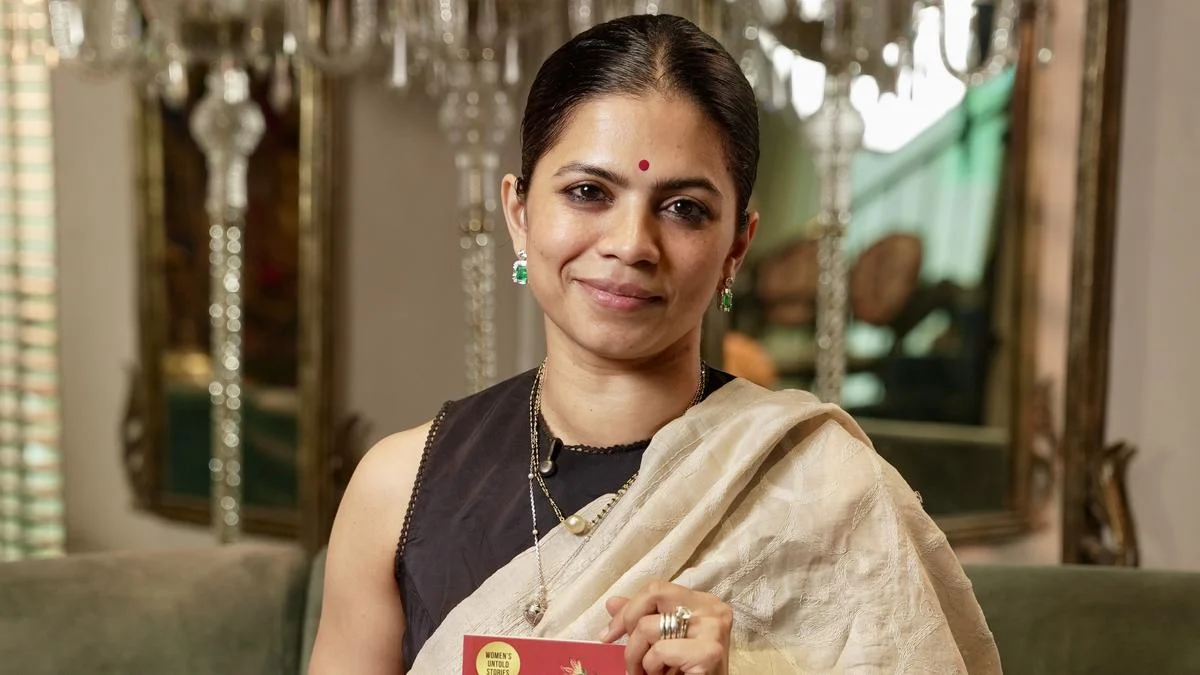
In the bustling urban landscape of Hyderabad, where the IT corridor’s glass towers and gridlocked traffic define the daily rhythm of millions, Tuljha Bhavani Reddy has spent years designing spaces. A practicing architect, furniture designer, and graphic designer, her career has been built on the tangible—wood, steel, blueprints, and structural integrity. However, with the publication of her debut book, Inheritance of Longing, Reddy has pivoted from designing the physical homes people inhabit to excavating the emotional ruins that often lie within them.
Published by Delhi-based Srishti Publishers, Inheritance of Longing is a collection of eight short stories that serve as a visceral exploration of desire, infidelity, and the quiet erosion of the modern Indian marriage. Through her prose, Reddy challenges the "happily ever after" narratives that have long dominated the Indian psyche, offering instead a non-judgmental look at human frailty and the "unsaid" that lingers in the corridors of domestic life.
Main Facts: A Literary Unpacking of the Domestic Sphere
At its core, Inheritance of Longing is an autopsy of the "perfect" marriage. Reddy’s work focuses on the internal fractures that remain invisible to the outside world—marriages that are structurally sound to the public eye but hollowed out by indifference, silence, or unfulfilled desire.
The Ecosystem of Modern Relationships
The book arrives at a time when the discourse around Indian relationships is undergoing a seismic shift. While traditional narratives often paint infidelity as a moral binary of victim and villain, Reddy’s stories navigate a gray area. She presents characters who are neither heroes nor antagonists but individuals attempting to reconcile their internal longings with societal expectations.
"Infidelity is not new. Monogamy is not for everybody," Reddy notes, emphasizing that her goal was not to moralize but to present a "case study" of the human heart. Her stories move between tenderness and despair, capturing moments where love arrives too late or where a woman mourns not a tangible loss, but the "extraordinary life" she once imagined for herself.
The Voice of the Invisible Woman
A recurring motif in the collection is the "invisible woman"—those who suffer in silence or find themselves disappearing into the roles of wife, mother, and professional. Reddy’s writing gives voice to the internal monologues that women often suppress to maintain the status quo. By focusing on the "unsaid," the book creates a space for readers to acknowledge their own unarticulated dissatisfactions.

Chronology: From Blueprints to Bookstores
The journey of Inheritance of Longing was not a calculated career move but an organic, almost "accidental" evolution of Reddy’s creative expression.
2018: The Accidental Genesis
The collection began in 2018, in the middle of a standard workday. Reddy recalls the opening of what would become "Alamer," the first story in the collection, arriving "fully formed" in her mind. It was a conversation between two women regarding the nature of love and whether the concept of "the one" is a fallacy. She scribbled the dialogue into a notebook and shelved it, returning to her architectural practice.
The Catalyst for Completion
The transition from a scribbled note to a manuscript was prompted by her business partner, Adarsh. Upon discovering her notes, he challenged her to find the "before" and "after" of the scenes she had written. This inquiry unlocked a dormant narrative drive. Over the following months, Reddy began to synthesize her observations of society—including people she had known in high school—into a cohesive set of stories.
The "Whispered" Stories
Some stories, such as "Keshava," which is set in a graveyard, were written in a feverish burst of inspiration. Reddy describes the process as if someone were "whispering on her shoulder," completing the draft in a matter of days. This chronology of creation highlights a transition from the structured, methodical world of architecture to the fluid, often unpredictable world of literary fiction.
Supporting Data: The Sociological Context of Indian Marriage
To understand the resonance of Reddy’s work, one must look at the sociological backdrop of the Indian matrimonial landscape.
The "Cinema" Instruction Manual
Reddy argues that for an entire generation, Indian cinema—specifically the romanticized portrayals by actors like Nagarjuna Akkineni and Shah Rukh Khan—served as the primary "instruction manual" for love. These films typically end at the wedding mandap or the airport reunion, leaving a vacuum of information regarding the decades of mundane reality that follow.

- The "After" Gap: Statistical trends in urban India show a rising rate of "gray divorces" and "living-apart-together" arrangements, suggesting that the cinematic "happily ever after" is failing to provide a realistic roadmap for modern couples.
- The Refusal to Settle: Unlike previous generations, modern Indian women are increasingly refusing to settle for hollow marriages. Reddy’s characters reflect this shift, showcasing an impulse to act when emotional needs are left unfulfilled.
The Architecture of the Mind
Reddy’s background in architecture significantly informs her storytelling. In architecture, the "human settlement" is the study of how people occupy space. In her writing, she applies this lens to emotional space.
- Case Study: Preetha: One of the stories, "Preetha," is inspired by a woman who lived a comfortable, "ordinary" life but felt a profound sense of grief for the "extraordinary" life she missed out on. Reddy notes that society often lacks sympathy for such characters because they lack "obvious difficulties." This highlights a data point in human psychology: the pain of the "unlived life" can be as debilitating as tangible trauma.
Official Responses and Literary Positioning
The publication of Inheritance of Longing by Srishti Publishers marks a significant entry into the "contemporary Indian fiction" category. Srishti, known for its diverse catalog ranging from commercial romance to literary explorations, has positioned Reddy as a fresh voice in the exploration of domestic realism.
A Departure from Tradition
Literary critics and early readers have noted that Reddy’s work departs from traditional "women’s fiction" by stripping away the melodrama. Instead of high-stakes betrayal, she focuses on the "hollowing out" of relationships through indifference. This subtle approach has been praised for its realism.
The Author’s Perspective on Visibility
Reddy’s transition to authorship has also been a personal journey of reclaiming space. As an assistant professor of architecture and a mother, she spent the first decade of her professional life feeling as though she was "failing" in one role or the other.
"I initially forced myself to be invisible and then grew to love being forgotten," she says of her years as an architect. However, the book forced her to become "visible," teaching her that she is "allowed to take up space and have a voice."
Implications: The Future of the Indian Short Story
The release of Inheritance of Longing has several implications for the landscape of Indian literature and the societal understanding of women’s roles.
Reclaiming the Short Story Format
In a market often dominated by long-form thrillers or mythological retellings, Reddy’s use of the short story format is a deliberate choice. It allows for a kaleidoscopic view of the Indian experience, offering eight different windows into the same core problem: the complexity of human connection.

The "Post-40" Creative Renaissance
Reddy’s success after the age of 40 serves as a powerful narrative against the youth-centric focus of the creative industries. She notes that "life after 40 is good" because one learns to "cut off unnecessary noise." This perspective suggests that some stories—particularly those dealing with the nuances of long-term commitment and domesticity—require the maturity and "thickness of skin" that only comes with age.
Challenging the Script
Ultimately, the women in Inheritance of Longing are attempting to make sense of a "script that ended before the real story began." The implication for readers is a call to honesty. By presenting these "cases" without judgment, Reddy encourages a societal dialogue about the limitations of traditional marriage and the necessity of individual fulfillment.
As Reddy continues to teach human settlements and the history of art, her literary debut stands as a blueprint for a new kind of domestic narrative—one where the "unsaid" is finally given a voice, and where the invisible women of urban India are finally seen.
Inheritance of Longing by Tuljha B. Reddy is currently available through major online retailers and at leading physical bookstores across India.
