

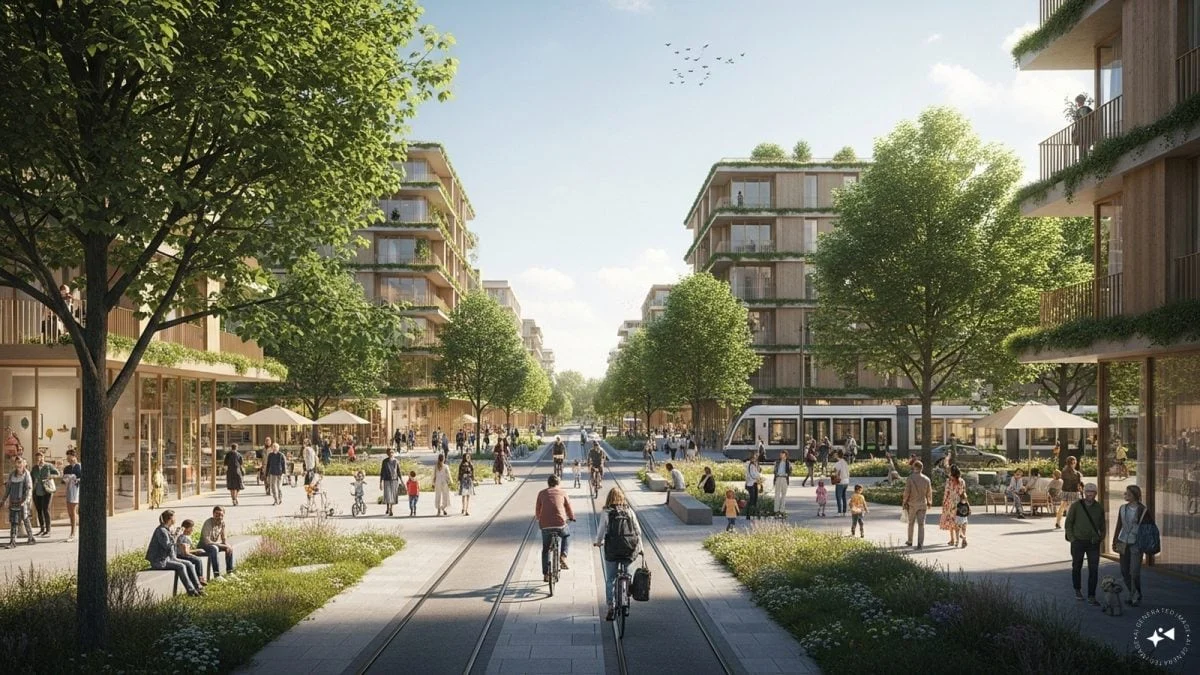
BENGALURU – In an era where urban sprawl often outpaces infrastructure, the Government of Karnataka has announced the revival of its most ambitious urban development project to date: the Greater Bengaluru Innovation and Tech City (GBIT). Designed to be India’s first integrated "AI City," this 7,481-acre township aims to redefine the relationship between technology, residency, and environmental sustainability.
By integrating high-tech workspaces with smart residential zones and sprawling green corridors, GBIT is positioned as the definitive answer to the infrastructure bottlenecks that have long plagued Bengaluru. With an estimated investment of ₹18,104 crore, the project represents a paradigm shift in how Indian cities are conceptualized—moving away from haphazard expansion toward a meticulously planned, "Work, Live, Play" ecosystem.
Main Facts: A Blueprint for the Future
The Greater Bengaluru Innovation and Tech City is not merely an industrial park; it is a self-sustaining urban entity. Located in the Ramanagara taluk of South Bengaluru, the project is designed to be a "city within a city," specifically tailored to the needs of the burgeoning Artificial Intelligence (AI) and Machine Learning (ML) sectors.
The Scale and Scope
The project encompasses approximately 7,481 acres of land, spanning nine distinct villages, including Byramangala, Hosur, and Mandalahalli. This vast area is slated to house:
- A Central Business District (CBD): A global-standard hub for AI, data analytics, and robotics companies.
- Residential Neighborhoods: Smart homes equipped with AI-enabled utilities for energy and water management.
- Educational and Healthcare Hubs: International-standard schools and multi-specialty hospitals located within walking distance of residential blocks.
- Leisure and Sports: An international cricket stadium and Olympic-grade training facilities.
The ‘Zero-Traffic’ Philosophy
Perhaps the most striking feature of GBIT is its commitment to a "zero-traffic" and "zero-carbon" model. Unlike the existing IT corridors of Whitefield and Electronic City, which suffer from extreme congestion due to the separation of work and home, GBIT utilizes a "15-minute city" design. This ensures that every essential service—be it an office, a school, or a grocery store—is accessible via walking or cycling paths, effectively eliminating the need for daily vehicular commutes.
Chronology: From Stalled Blueprint to Tech Frontier
The journey of GBIT has been one of long-standing vision met with administrative delays. To understand its current revival, one must look at the timeline of its development.
- 2009–2011: The Conceptual Phase: The idea for a massive tech-driven township in Ramanagara was first proposed during the late 2000s. It was initially envisioned as a "Knowledge City" or a specialized tech hub to ease the pressure on Bengaluru’s core.
- 2012–2023: The Stagnation Period: For nearly 15 years, the project remained largely on paper. Challenges regarding land acquisition, shifts in political priorities, and the lack of a centralized governing body for the greater metropolitan region led to the project being sidelined.
- Early 2024: The Strategic Pivot: Recognizing the global explosion in AI and the urgent need for a dedicated AI corridor, the Karnataka government decided to rebrand and revive the project. The focus shifted from a general tech park to a specialized "AI City."
- May 2024: The Revival and Authority Framework: The project was officially brought under the purview of the Greater Bengaluru Development Authority (GBDA). The government announced the allocation of funds and the commencement of a tendering process to appoint an international project management consultancy (PMC).
- Future Milestones: The government plans to begin Phase 1 of construction following the consultancy report, with a focus on core infrastructure—roads, power grids, and the initial AI incubation hubs.
Supporting Data: Infrastructure, Economics, and Sustainability
The revival of GBIT is backed by significant data points that highlight both the necessity of the project and its potential economic impact.
Land Allocation and Environmental Reserves
The master plan places a heavy emphasis on ecological balance. Out of the 7,481 acres:
- 950 Acres are dedicated exclusively to lakes, water bodies, and green buffer zones.
- 30% of the Total Area is earmarked for public open spaces and parks.
- AI-Driven Utilities: The city will utilize a smart grid system designed to reduce water wastage by 40% and electricity consumption by 30% through sensor-based monitoring.
Connectivity and Transport Data
While the interior of GBIT promotes walking, its connection to the rest of the world is robust:
- Metro Expansion: Bengaluru Metro’s Phase 3 expansion is slated to reach Bidadi, bringing GBIT within a 40-minute commute of the city center.
- Road Networks: The township has immediate access to the Bengaluru-Mysuru Expressway (NH-275), NH-209, and the Peripheral Ring Road via the NICE Road network.
- The Second Airport Factor: The state government is currently evaluating sites for Bengaluru’s second international airport. Two of the top contenders—Kanakapura Road and the Nelamangala-Kunigal corridor—are in close proximity to GBIT, which would provide the township with direct global air connectivity.
Economic Impact
The project is expected to generate:
- 500,000+ Direct Jobs in the AI, ML, and high-tech manufacturing sectors.
- ₹1.5 Lakh Crore in indirect economic activity over the next decade through real estate development, services, and hospitality.
Official Responses: A Unified Vision for Growth
State officials and urban planners have expressed a cautious but optimistic outlook on the revival of the GBIT project.
The Greater Bengaluru Development Authority (GBDA) has emphasized that GBIT is a response to the "unplanned growth" of the past. A senior official stated, "We cannot keep adding floors to a city that is already full. GBIT is about creating a new center of gravity for Karnataka. We are not just building offices; we are building a lifestyle that attracts the best global talent in Artificial Intelligence."
The Karnataka IT and BT Department highlighted the competitive necessity of the project. "With cities like Hyderabad and Noida aggressively expanding their tech footprints, Bengaluru must evolve. The AI City will serve as a ‘sandbox’ for innovation, providing startups with the infrastructure they need without the overhead costs and traffic hurdles of the CBD."
Environmental Planners, however, have urged the government to remain committed to the "Zero-Waste" promise. Independent urban consultants have noted that the success of GBIT depends entirely on the timely execution of the Metro Phase 3 and the preservation of the Byramangala lake ecosystem, which is vital to the region’s groundwater levels.
Implications: Reshaping the Landscape of Karnataka
The successful implementation of GBIT carries profound implications for the future of South India’s urban development.
1. The Southern Shift
For decades, Bengaluru’s growth has been lopsided, favoring the North (near the airport) and the East (Whitefield). GBIT will effectively shift the state’s economic momentum toward the South. This decentralization is expected to stabilize real estate prices in central Bengaluru while opening up massive investment opportunities in the Ramanagara and Bidadi regions.
2. Setting a Global Precedent for AI Cities
If GBIT achieves its "Zero-Traffic" and "AI-Integrated" goals, it will serve as a blueprint for future smart cities across the Global South. By embedding AI into the civic fabric—from automated waste sorting to intelligent street lighting—the city could become a living laboratory for the Fourth Industrial Revolution.
3. Solving the Commute Crisis
By proving that the "Work, Live, Play" model is viable on a massive scale, the Karnataka government could change the national conversation on urban planning. If successful, GBIT will demonstrate that the solution to traffic is not just wider roads, but better-integrated neighborhoods where the need for a car is rendered obsolete.
4. Real Estate and Social Infrastructure
The project is set to trigger a real estate boom in South Bengaluru. However, unlike previous booms, GBIT’s master plan mandates the inclusion of social infrastructure—schools and hospitals—as a prerequisite for residential permits. This ensures that the township does not become a "bedroom community" but remains a vibrant, self-reliant urban hub.
As the tendering process for the international consultancy begins, all eyes are on Ramanagara. The Greater Bengaluru Innovation and Tech City is more than just a project; it is a high-stakes bet on a future where technology and humanity coexist in a sustainable, traffic-free environment. For a city like Bengaluru, which has long been the "Silicon Valley of India," GBIT may well be the upgrade it so desperately needs.
