

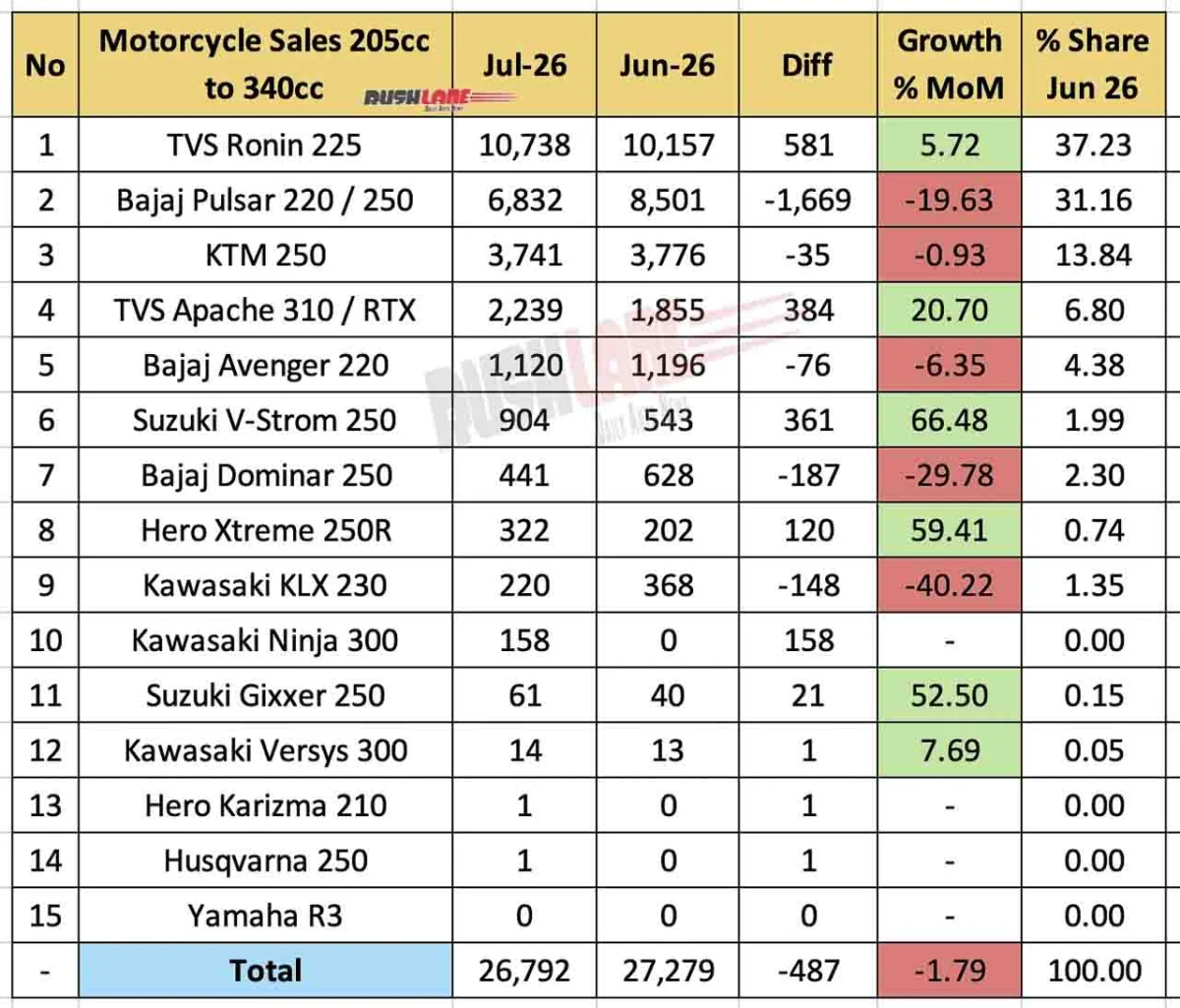
The Indian automotive landscape in July 2026 has revealed a definitive shift in consumer preference, specifically within the performance-commuter and entry-level premium categories. As the dust settles on the mid-year sales figures, the 200cc to 350cc motorcycle segment has emerged as one of the most vibrant corridors of growth for the domestic two-wheeler industry. This segment, which acts as a bridge between high-volume entry-level commuters and high-margin premium tourers, recorded a staggering year-on-year (YoY) growth of nearly 87%, signaling a maturing market where riders are increasingly prioritizing "displacement with usability."
Main Facts: A July of Exponential Growth
The month of July 2026 was a landmark period for manufacturers operating in the 200cc to 350cc bracket. Total combined sales for the models tracked in this analysis reached 26,792 units. To put this into perspective, the same period in 2025 saw sales of only 14,335 units. This massive jump indicates not just a recovery, but an expansion of the addressable market for middleweight motorcycles.
Leading the charge is TVS Motor Company, whose Ronin platform has defied initial market skepticism to become a runaway success. For the second consecutive month, the Ronin surpassed the 10,000-unit milestone, securing its position as the undisputed segment leader. Closely following is the Bajaj Group, which maintains a multi-pronged offensive through its Pulsar, KTM, Dominar, and Avenger brands. Together, TVS and Bajaj Group now control a formidable 93.73% of the segment’s market share, effectively creating a duopoly that leaves little room for competitors like Suzuki, Hero, and Kawasaki to maneuver.
While the YoY figures are celebratory, the month-on-month (MoM) performance showed a slight sequential cooling, with a marginal decline of 1.79% from June 2026’s 27,279 units. Industry analysts suggest this is a standard "breather" before the onset of the festive season, which typically begins in late August.
Chronology: The Evolution of the 200cc-350cc Sweet Spot
To understand the July 2026 numbers, one must look at the trajectory of the Indian rider over the last five years. Historically, the Indian market was bifurcated: the 100cc-150cc segment for utility and the 350cc+ (largely dominated by Royal Enfield) for status. The 200cc to 300cc space was often viewed as a "no man’s land" where bikes were either too expensive for commuters or not powerful enough for enthusiasts.
The Rise of the Ronin (2022–2026):
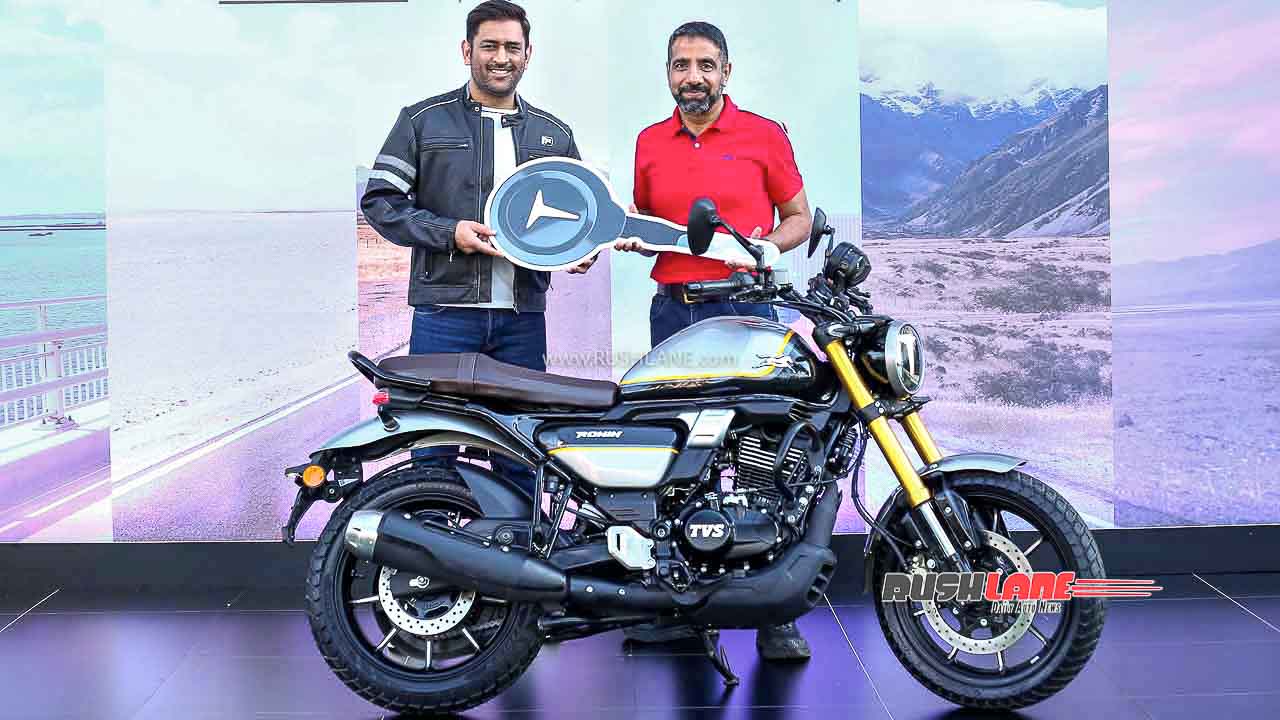
When TVS launched the Ronin in 2022, it was met with curiosity but modest sales. In its first year, volumes often hovered in the low triple digits as the market struggled to categorize its "scrambler-meets-cruiser" design. However, TVS’s persistent marketing, coupled with high-profile endorsements—including legendary cricketer MS Dhoni taking delivery of the motorcycle—slowly shifted the narrative. By early 2025, the Ronin began finding its rhythm. The July 2026 figure of 10,738 units represents the culmination of a four-year journey from a niche experimental product to a mainstream volume driver.
The Pulsar 220F’s "Second Innings":
Perhaps the most peculiar story in this chronology is the Bajaj Pulsar 220F. In 2021, Bajaj Auto attempted to phase out the aging 220F to make way for the more modern Pulsar 250 platform. However, the "Legendary 220" had a cult following that refused to migrate. After a brief hiatus, Bajaj was forced to bring the model back in 2023. In July 2026, the 220F sold 6,832 units—a testament to the fact that in the Indian market, established brand equity and "raw" mechanical feel often trump modern electronics.
The Adventure Expansion:
The last 18 months have seen the introduction of adventure-centric models like the TVS Apache RTX and the Suzuki V-Strom 250. These launches have fundamentally changed the segment’s DNA, moving it away from pure street-naked bikes toward versatile machines capable of light touring.
Supporting Data: A Granular Analysis of the Leaders and Laggards
The July 2026 data table highlights a clear divide between high-volume "lifestyle commuters" and specialized performance machines.

TVS Motor Company (The Volume King):
TVS’s total segment contribution stood at 12,977 units.
- TVS Ronin: 10,738 units (94.63% YoY growth). It now commands a 40.08% share of the entire segment.
- Apache 310 / RTX Range: 2,239 units. This sub-category saw the highest growth in the entire analysis, at 349.60% YoY. The inclusion of the RTX (adventure variant) has quadrupled the Apache’s presence in this displacement class compared to the previous year.
Bajaj Group (The Diversified Giant):
With 12,135 units, Bajaj’s strength lies in its variety.
- Pulsar 220F: 6,832 units (56.63% YoY growth). Despite its age, it remains Bajaj’s primary volume driver here.
- KTM 250 Range: 3,741 units (92.84% YoY growth). This indicates a healthy demand for premium, high-performance European engineering among younger buyers.
- Avenger 220: 1,120 units. A massive 219.09% YoY jump suggests a resurgence in the entry-level cruiser market.
- Dominar 250: 441 units. This was one of the few models to see a decline (-15.36% YoY), likely cannibalized by the newer Pulsar models and the KTM 250.
The Rest of the Field:
- Suzuki: The V-Strom 250 is the silver lining for Suzuki, with 904 units sold and a 72.19% YoY growth. However, the Gixxer 250 continues to struggle, moving only 61 units.
- Kawasaki: The Japanese giant saw a 213.60% YoY growth from a low base, driven by the KLX 230 (220 units) and the perennial Ninja 300 (158 units).
- Hero MotoCorp: The Xtreme 250R recorded 322 units, a 12% decline, suggesting that Hero is still finding it difficult to crack the premium ceiling dominated by TVS and Bajaj.
Official Responses and Manufacturer Strategy
While official press releases from the OEMs (Original Equipment Manufacturers) emphasize "customer-centric innovation," the underlying strategies are clear.
TVS Motor Company has focused on "Platform Proliferation." By using the same basic 310cc engine architecture (developed in collaboration with BMW) across the RR (Sport), RTR (Naked), and now the RTX (Adventure), they have maximized R&D efficiency. A TVS spokesperson recently noted that the Ronin’s success is attributed to its "unclassifiable" nature, appealing to riders who want a bike that fits both the office commute and a weekend cafe run.

Bajaj Auto continues to play the "Value-Performance" card. By maintaining the Pulsar 220F alongside the newer N250 and KTM 250, Bajaj ensures they don’t lose the traditionalist buyer while still courting the tech-savvy enthusiast. Their strategy is one of "Segment Saturation"—ensuring that no matter the price point or style a buyer wants in the 200cc-350cc range, there is a Bajaj-affiliated product waiting for them.
Suzuki and Kawasaki appear to be pivoting toward "Niche Excellence." Rather than fighting for 10,000-unit volumes, they are focusing on the Adventure (V-Strom, Versys) and Dual-Sport (KLX) categories, where margins are higher and brand loyalty is fiercer.
Implications: What This Means for the Future of Indian Biking
The July 2026 sales figures carry several long-term implications for the Indian automotive industry:
- The Death of the "Boring" Commuter: The 87% YoY growth in this segment suggests that the 100cc-125cc "commuter" is no longer the aspirational floor. Even first-time buyers are now looking at the 200cc+ segment as a starting point, aided by easy financing and rising disposable incomes.
- Adventure is the New Chrome: The massive growth in the Apache RTX and V-Strom numbers indicates that "Adventure Touring" is no longer a hobby for the elite. It has become a mainstream aesthetic. Manufacturers who do not have an ADV (Adventure) or Scrambler in this displacement range are likely to lose market share.
- The Squeeze on 150cc-200cc: As the price gap between a premium 160cc bike and a 220cc-250cc bike narrows, the 150cc-200cc segment is being squeezed. Consumers are increasingly deciding to "stretch" their budget by an extra ₹20,000 to ₹30,000 to jump into the 250cc category.
- Consolidation of Power: With TVS and Bajaj controlling over 93% of the segment, the barrier to entry for new players or struggling incumbents (like Yamaha, which recorded zero sales in this specific displacement bracket this month) is becoming nearly insurmountable.
As the industry heads into the Q3 festive season, the momentum in the 200cc to 350cc segment is expected to accelerate. With TVS Ronin firmly at the helm and the Pulsar 220F proving that legends never truly die, the "middleweight" category has officially become the new heart of the Indian motorcycle market.
