

VISAKHAPATNAM – As the sun rises over the Bay of Bengal, the "City of Destiny" is preparing for a transformation that promises to redefine its urban geography for the next century. The Andhra Pradesh government, in a move that signals the beginning of a new era for the state’s financial capital, has unveiled the blueprint for a 102-kilometre semi-ring road. This ambitious infrastructure project, stretching from the industrial hub of Rambilli in the south to the burgeoning Bhogapuram International Airport in the north, is set to become the structural spine of a modernized Visakhapatnam.
With the Detailed Project Report (DPR) slated for submission by the end of May 2026, the transition from conceptual vision to engineering reality is well underway. This project arrives at a critical juncture, as the city’s property markets are already experiencing a historic "re-rating" phase, driven by a convergence of industrial expansion, digital infrastructure, and global connectivity.
I. Main Facts: The Blueprint for a Megacity
The proposed 102-kilometre semi-ring road is not merely a transportation project; it is a multi-modal economic corridor designed to de-congest the existing city core while opening up thousands of acres of hinterland for development.
Technical Specifications and Connectivity
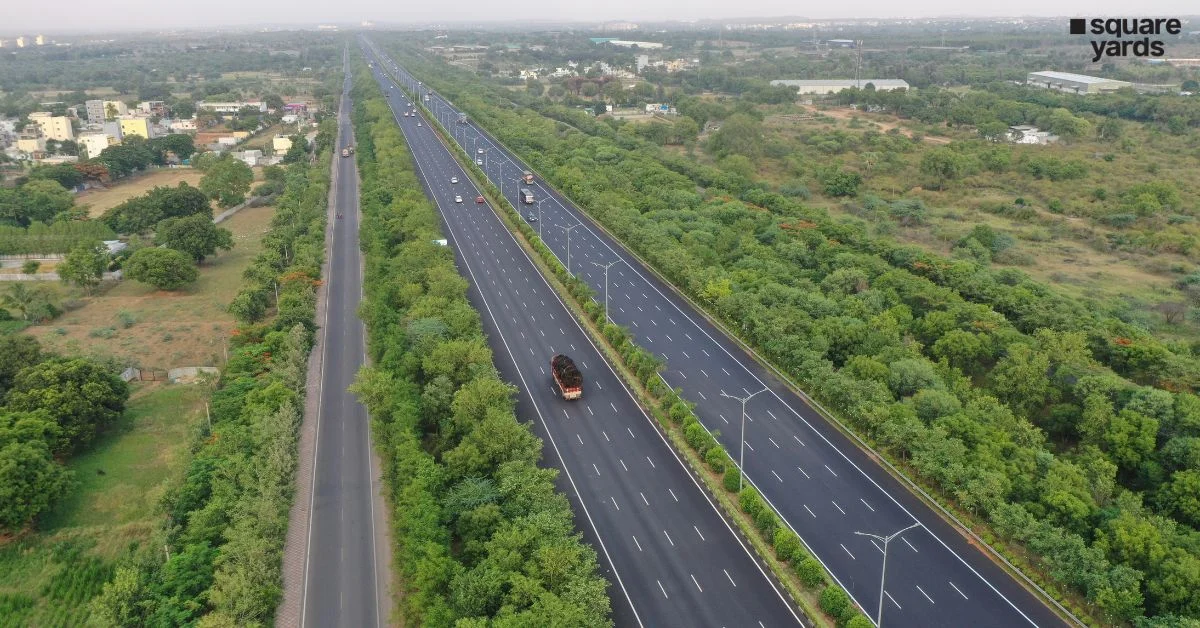
The project is being spearheaded by the Visakhapatnam Metropolitan Region Development Authority (VMRDA). According to early planning documents, the road will initially be constructed as a four-lane, access-controlled expressway. However, in a move to "future-proof" the city, the right-of-way (RoW) is being secured for an eventual expansion to eight lanes.
A key feature of the design is the inclusion of 10-metre-wide service roads in populated stretches, ensuring that local traffic does not impede the high-speed transit of goods and passengers. The road’s alignment is strategically mapped to connect several vital economic nodes:
- The Southern Anchor: Rambilli and the Atchutapuram Special Economic Zone (SEZ), which houses major manufacturing and pharmaceutical clusters.
- The Northern Anchor: The Bhogapuram Greenfield International Airport, currently under fast-track construction.
- Intermediate Links: Connectivity to the AdaniConnex Data Centre at Kapuluppada and the major logistics junctions of Anakapalle and Kothavalasa.
The Funding Innovation: Value Capture Finance (VCF)
Perhaps the most significant aspect of the project is its financial architecture. The state government is exploring the Value Capture Finance (VCF) model. This mechanism allows the government to recover some of the investment costs by tapping into the massive appreciation in land value triggered by the project itself. By implementing special development charges or betterment levies on the land parcels adjacent to the corridor, the VMRDA aims to make the project self-sustaining, reducing the burden on the state exchequer.
II. Chronology: From Master Plan to Groundbreaking
The journey toward the semi-ring road has been a multi-year effort, reflecting the changing political and economic priorities of Andhra Pradesh.
- 2021: The Master Plan Foundation: The VMRDA released its 2021 Master Plan, which first conceptualized a more integrated metropolitan region. However, the scale was initially smaller, focusing on internal city bypasses.
- 2023-2024: The Airport Catalyst: With the formal commencement of work at the Bhogapuram International Airport, the need for a high-speed link between the city’s industrial south and its new northern gateway became an urgent priority.
- Early 2025: Alignment Finalization: Surveyors and urban planners began identifying the 102-km stretch, opting for a "semi-ring" model rather than a full circle to account for Visakhapatnam’s unique coastal topography.
- May 2026: The DPR Milestone: The current phase involves the submission of the Detailed Project Report. This document will outline the exact land acquisition requirements, environmental impact assessments, and the final budget.
- Late 2026 (Projected): Following the DPR approval, the government is expected to launch the land-pooling process, mirroring the model used for the Amaravati capital project.
III. Supporting Data: The Real Estate Explosion
The announcement of the semi-ring road has acted as a catalyst for a real estate market that was already heating up. Market data suggests that the "announcement effect" is creating significant wealth for early investors.
The Surge in Land Values
According to industry benchmarks, the appreciation along the proposed corridor has been nothing short of meteoric:
- Denkada-Anandapuram Corridor: In early 2023, premium plots were valued at approximately ₹10,800 per square yard. By mid-2026, these values have surged to ₹17,100 per square yard, representing a 58% increase in less than three years.
- Bhogapuram Mandal: The immediate vicinity of the airport has seen land prices climb to ₹22,000 per square yard, driven by the anticipation of commercial hospitality and logistics demand.
- Denkada (Affordable Segment): Even the more affordable zones in Denkada, which sit just within the growth radius, have seen prices rise to the ₹14,000–₹15,000 range.
Inquiry and Transaction Volumes
Real estate consultancies report a 20-30% surge in land inquiries specifically targeting the "Semi-Ring Road Alignment." Investors are no longer looking for city-center apartments; they are seeking large land parcels in Tagarapuvalasa, Anandapuram, and the Rambilli-to-Kothavalasa stretch. Experts estimate that once the Bhogapuram airport becomes operational, areas within a 15-minute radius of the semi-ring road could see a further 25-40% appreciation.
IV. Official Responses: A Modern Approach to Governance
Government officials and VMRDA planners have emphasized that this project represents a departure from traditional "reactive" urban planning.
The VMRDA Perspective
A senior official from the VMRDA, speaking on the condition of anonymity ahead of the DPR release, stated: "We are not just building a road; we are building a city for 2050. The semi-ring road is designed to prevent the kind of urban sprawl that has choked cities like Bengaluru. By creating access-controlled corridors now, we ensure that the industrial growth in Rambilli and the aviation growth in Bhogapuram can coexist without creating traffic gridlock."
The Land-Pooling Model
To mitigate the friction often associated with land acquisition, the state government is leaning toward a land-pooling model. Under this system, landowners surrender their land to the government and receive a percentage of the developed land back, which typically carries a much higher market value due to the new infrastructure. This "partnership" approach is intended to accelerate the project timeline and ensure that the local agrarian community benefits from the transition to an urban economy.
Revision of the 2021 Master Plan
The VMRDA is simultaneously revising its 2021 Master Plan to align with the semi-ring road’s path. This includes re-zoning areas along the corridor for "Mixed-Use Development," allowing for a blend of high-tech manufacturing, residential townships, and commercial hubs.
V. Implications: The Multi-Vector Growth Narrative
The 102-km semi-ring road is the final piece of a complex puzzle that positions Visakhapatnam as a global contender. The implications of this project extend far beyond transportation.
1. The Rise of the "Data Capital"
With the AdaniConnex data centre investments and the proposed ₹14,000-crore drinking water project, Visakhapatnam is transitioning into a digital and industrial powerhouse. The semi-ring road provides the high-speed connectivity required for tech professionals to commute between the IT hills of Kapuluppada and the residential suburbs being developed in the north.
2. De-risking the Port City
Historically, Vizag’s economy was heavily dependent on its port and heavy industries like Vizag Steel. The semi-ring road facilitates a diversification into the "Blue Economy" and "Aviation Logistics." By linking the sea-port to the air-port via a high-speed corridor, Vizag becomes a "Twin-Gate" city, a rarity in South Asia.
3. The Investor’s Window
For real estate investors, the period between the DPR submission (May 2026) and the commencement of physical construction is considered the "Golden Window." Historically, infrastructure projects see their steepest value climbs twice: first upon the finalization of the alignment, and second when the project is inaugurated. The Bheemunipatnam coastal belt and the Anandapuram junction are expected to be the primary beneficiaries of this "first-mover" advantage.
4. Environmental and Social Considerations
While the economic outlook is bullish, the project faces challenges. The VMRDA must navigate the environmental sensitivities of the Bheemunipatnam coastal belt and ensure that the expansion of the "concrete jungle" does not come at the cost of the region’s natural beauty. Furthermore, the success of the VCF model depends on the government’s ability to maintain investor confidence through transparent execution.
Conclusion: The Horizon of 2030
The 102-kilometre semi-ring road is a testament to Visakhapatnam’s ambition. It is a project that bridges the gap between the city’s industrial past and its high-tech future. As the DPR reaches the final stages of approval, the message to the world is clear: Visakhapatnam is no longer just a regional port; it is an emerging metropolis with the infrastructure to match its aspirations.
For the residents of Rambilli, the commuters of Anandapuram, and the global investors eyeing Bhogapuram, the road represents more than just asphalt and service lanes. It represents a faster, more connected, and more prosperous "City of Destiny." The question for stakeholders is no longer if the city will transform, but how quickly they can adapt to the new geography being carved out by this 102-kilometre marvel.
