

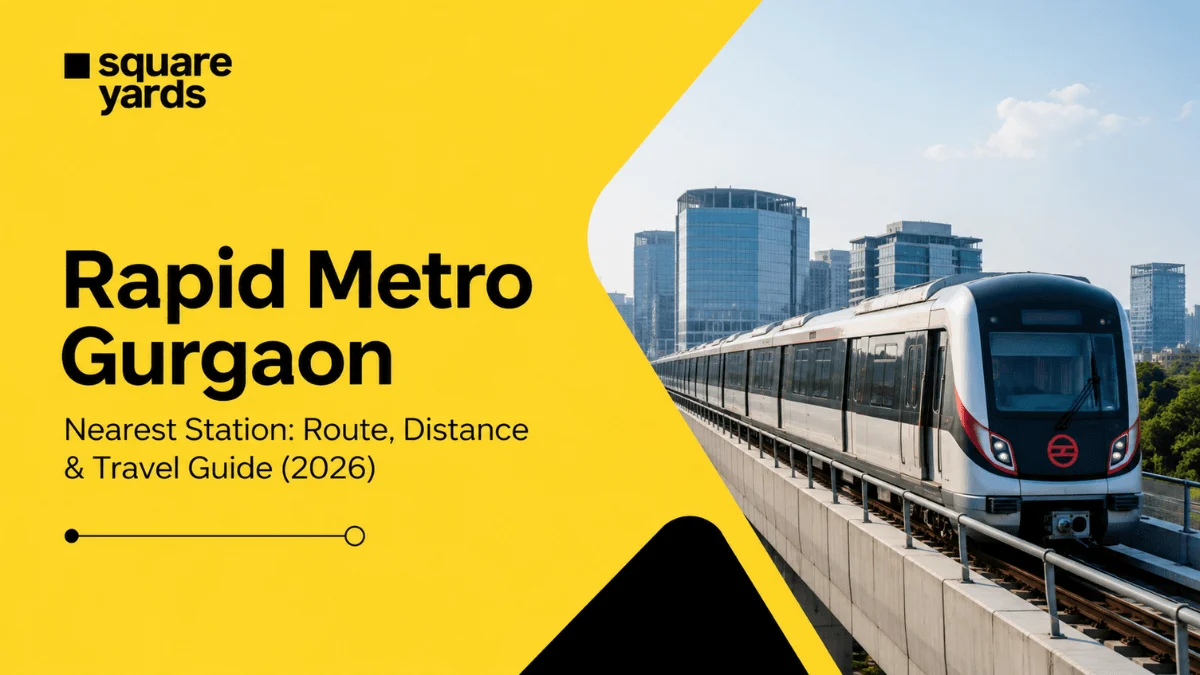
The urban landscape of Gurugram (formerly Gurgaon) is often defined by its soaring glass-and-steel skyscrapers, multinational headquarters, and luxury residential enclaves. Yet, for the thousands of professionals and residents who navigate this sprawling metropolis daily, the city’s identity is intrinsically linked to its transit infrastructure. At the heart of this movement is the Rapid Metro Gurgaon—a transit system that is less a traditional metro line and more a specialized circulatory system for the city’s most economically vital corridors.
The Rapid Metro is not merely a question of locality; it is a question of precision. With eleven strategically placed stations, the system serves as a bridge between the hyper-dense business district of Cyber City and the high-end residential stretches of Golf Course Road. To understand the Rapid Metro is to understand the evolution of Gurgaon itself: from a privately developed corporate hub to a maturing urban center grappling with the complexities of public-private infrastructure.
I. The Main Facts: A Specialized Transit Spine
The Rapid Metro Gurgaon operates as a 12.85-kilometer elevated metro system. Unlike the broader Delhi Metro Rail Corporation (DMRC) network, which connects distant suburbs to the capital’s center, the Rapid Metro was designed as a "feeder" or "loop" system. Its primary purpose was to solve the "last-mile" connectivity problem for commuters arriving from Delhi via the Yellow Line.
The Sikanderpur Nexus
The entire utility of the Rapid Metro hinges on a single geographical point: Sikanderpur. This station serves as the solitary umbilical cord connecting the Rapid Metro to the rest of the National Capital Region (NCR). Every journey within the system either originates, terminates, or transits through Sikanderpur. For commuters traveling from Central Delhi or South Delhi, Sikanderpur is the gateway to Gurgaon’s commercial nerve centers. Without this interchange, the Rapid Metro would exist as an isolated island loop, disconnected from the millions of commuters who power the NCR’s economy.
Dual-Phase Architecture
The system was developed in two distinct phases, each serving a different demographic and economic purpose:
- Phase 1 (The Corporate Loop): This 5.1-km loop serves the DLF Cyber City area. It was designed to cater to the white-collar workforce of multinational corporations.
- Phase 2 (The Residential Spine): This 7-km extension runs south along the prestigious Golf Course Road, catering to premium residential sectors including DLF Phase 1, Sector 42, and Sector 56.
II. Chronology: From Private Ambition to Public Stewardship
The history of the Rapid Metro is a unique case study in Indian infrastructure. It represents the world’s first fully privately financed metro system, a bold experiment that eventually required a government-led rescue.
2009–2013: The Birth of a Private Metro
In 2009, the project was awarded to a consortium led by DLF and Infrastructure Leasing & Financial Services (IL&FS). The vision was revolutionary: a metro system built, operated, and maintained without government funding, relying instead on ridership revenue and advertising.
- November 2013: Phase 1 officially opened to the public. It initially faced skepticism due to its limited reach, but it quickly became the primary mode of transport for Cyber City employees.
- May 2014: The Cyber City station opened, solidifying the line’s importance to the business district.
2017: Expansion and Integration
- March 2017: Phase 2 commenced operations. This extension transformed the Rapid Metro from a corporate shuttle into a genuine urban transit line, reaching deep into the residential heart of New Gurgaon along Golf Course Road.
2019: Financial Turbulence and the DMRC Takeover
By 2019, the original operator, Rapid MetroRail Gurgaon Limited (RMGL), found itself in a dire financial position. The collapse of its parent company, IL&FS, sent shockwaves through the project. Faced with the prospect of a complete shutdown, the Haryana government intervened.
- October 2019: Following a series of legal battles and negotiations, the Delhi Metro Rail Corporation (DMRC) took over the operations and maintenance of the line. While ownership remains with the Haryana Mass Rapid Transport Corporation (HMRTC), the DMRC brought its operational expertise to stabilize the system.
2026: Infrastructure Vulnerabilities (Case Study)
Even under DMRC management, the system remains tied to Gurgaon’s local infrastructure. A significant incident in May 2026 highlighted this vulnerability when a transformer explosion in Sector 72 caused a citywide power surge. This event briefly paralyzed the Rapid Metro, stranding passengers for nearly an hour. The incident served as a stark reminder that while the trains are operated by the DMRC, they rely on the Haryana power grid rather than the more insulated energy infrastructure enjoyed by the Delhi Metro.
III. Supporting Data: Stations, Fares, and Connectivity
To navigate the system effectively, one must understand the specific roles played by each of its eleven stations.
Station Profiles and Service Areas
| Station | Phase | Primary Service Area | Key Features |
|---|---|---|---|
| Sikanderpur | Phase 1 | Interchange | Link to Yellow Line; essential for Delhi commuters. |
| DLF Phase 2 | Phase 1 | Residential/Commercial | Serves DLF Phase 2 blocks. |
| Belvedere Towers | Phase 1 | Corporate | Proximity to major tech parks and Vodafone office. |
| Cyber City | Phase 1 | Business District | The busiest station; heart of the MNC hub. |
| Moulsari Avenue | Phase 1 | Retail/Commercial | Access to DLF CyberHub and retail outlets. |
| DLF Phase 3 | Phase 1 | Residential | High-density residential and PG accommodations. |
| DLF Phase 1 | Phase 2 | Luxury Residential | Serves the established villas and floors of Phase 1. |
| Sector 42-43 | Phase 2 | Golf Course Road | Access to Global Foyer and premium office spaces. |
| Sector 53-54 | Phase 2 | Residential | Near high-end condominiums like The Camellias/Magnolias. |
| Sector 54 Chowk | Phase 2 | Intersection | Vital link for commuters from Suncity and nearby sectors. |
| Sector 55-56 | Phase 2 | Southern Terminus | Gateway to the southern end of Golf Course Extension Road. |
Operational Logistics
- Hours of Operation: Approximately 6:05 AM to 10:00 PM daily.
- Fare Structure: Rationalized between ₹20 and ₹35, making it competitive with auto-rickshaws for short distances.
- Last-Mile Connectivity: The stations are hubs for secondary transport. Shared auto-rickshaws (₹30-100) and app-based cabs (₹80-250) are ubiquitous. For Cyber City employees, many corporations provide dedicated shuttle services directly from the station exits.
IV. Official Responses and Economic Context
The transition from a private entity to a government-supervised model under the DMRC was not merely an administrative shift; it was a policy statement. Officials from the Haryana Mass Rapid Transport Corporation (HMRTC) have frequently emphasized that the Rapid Metro is "critical infrastructure" that cannot be allowed to fail, regardless of its private-sector origins.
The DMRC’s involvement has improved operational reliability and integrated the ticketing system more seamlessly with the Delhi Metro. Commuters can use a single "Smart Card" for both systems, eliminating the friction of multiple ticket purchases. However, the Haryana government continues to grapple with the "legacy debt" of the project, a reminder of the risks inherent in the Private-Public Partnership (PPP) model for capital-intensive transit projects.
The GMRL Project: A New Horizon
Looking forward, the Haryana government has sanctioned a massive expansion known as the Gurugram Metro Rail Limited (GMRL) project. This 28.5-km loop will connect Millennium City Centre to Cyber City, effectively encircling the city. This project is expected to alleviate the "Sikanderpur Bottleneck" by providing a second major interchange point, further integrating the Rapid Metro into a more robust, city-wide network.
V. Implications: Real Estate and Urban Mobility
The impact of the Rapid Metro on Gurgaon’s real estate cannot be overstated. However, its influence is nuanced.
Real Estate Valuation
In the premium corridors of DLF Phase 1-5 and Golf Course Road, the presence of a metro station is viewed as a "standard amenity" rather than a luxury. Property prices in these areas remain among the highest in India:
- DLF Phase 1: ₹20,000–₹35,000 per sq. ft.
- Golf Course Road: ₹18,800–₹30,400 per sq. ft.
- Sector 55-56: ₹16,000–₹24,000 per sq. ft.
For investors, the Rapid Metro provides a "floor" for rental demand. Even during economic downturns, properties within walking distance of Phase 2 stations maintain high occupancy rates due to the demand from young professionals working in Cyber City.
The "Usability" Factor
The true value of the Rapid Metro lies in "daily usability." Gurgaon is notorious for its traffic congestion, particularly during the monsoon season or peak office hours. The Rapid Metro allows a workforce of over 100,000 people to bypass the gridlock of the Delhi-Gurgaon Expressway and the internal bottlenecks of Golf Course Road. It has transformed the "commute experience" from a stressful ordeal into a predictable, air-conditioned transit.
Conclusion: A Lesson in Urban Evolution
The Rapid Metro Gurgaon stands as a testament to the city’s ambitious, if occasionally flawed, approach to development. It began as a private luxury for the corporate elite and evolved into a public necessity for a growing urban population. While its history is marked by financial instability and infrastructure hiccups, its current role as a stabilized, DMRC-operated spine is indispensable. As the city looks toward the GMRL expansion, the Rapid Metro remains the essential first chapter in Gurgaon’s journey toward becoming a truly connected global city. For the resident or the daily commuter, the question is no longer whether the system works, but simply: "Which of the eleven stations is mine?"
