

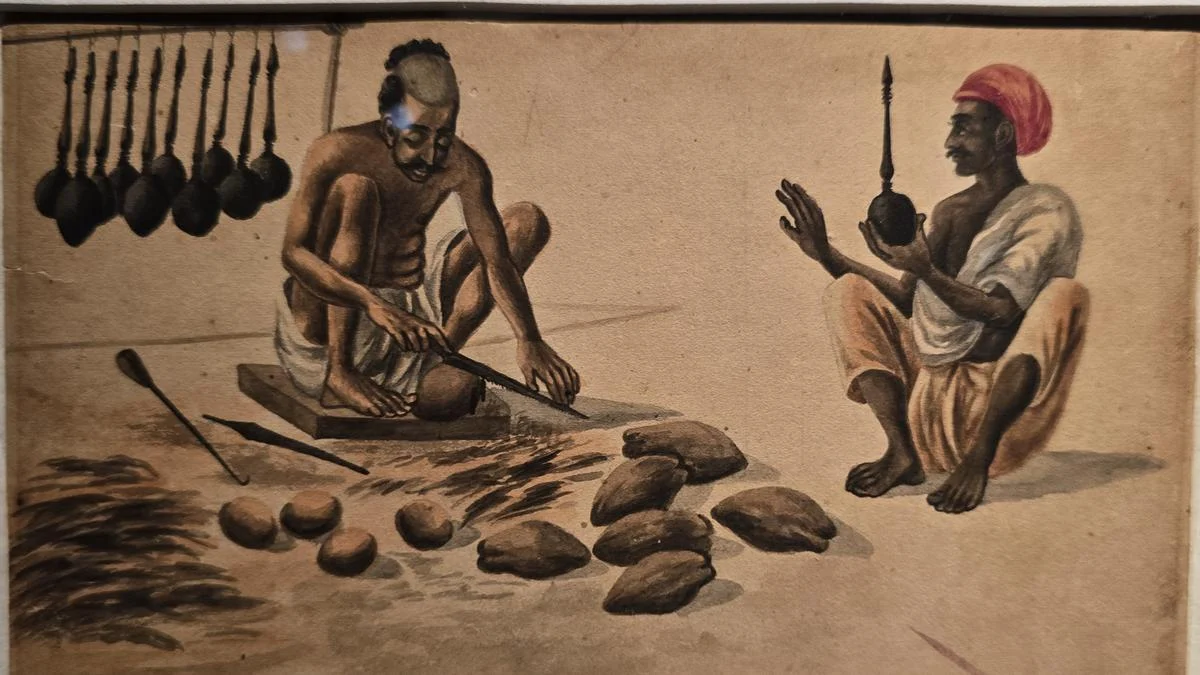
In the quiet, climate-controlled corridors of the Bihar Museum, a delicate revolution is taking place. It is a movement defined not by grand political gestures, but by the fine strokes of a squirrel-hair brush and the muted hues of watercolours on imported 18th-century paper. Here, the stark image of two men in dhotis working laboriously in a distillery stands in silent conversation with a woman in a vibrant blue-and-yellow ghaghra, caught in a perpetual dance within a palace hall.
These are the hallmarks of Patna Kalam, a painting tradition that once served as the pre-photographic soul of Bihar. For centuries, this art form documented the heartbeat of the streets—vegetable sellers, blacksmiths, and servants—before fading into the shadows of history. Today, following a renewed interest sparked by the Bihar Museum Biennale 2025 and the Patna Kalam: Ek Virasat exhibition, a vital question has emerged: Why did an art form designed to capture the vibrancy of daily life end up surviving only behind glass, and can it once again find a place in the contemporary world?

I. Main Facts: The Aesthetics of the Everyday
Patna Kalam occupies a unique niche in the firmament of Indian art. Often categorized as a subset of the "Company School of Painting," it is a hybrid style that represents a sophisticated marriage between Mughal miniature precision and European naturalism. However, unlike the opulent Mughal court paintings that focused on emperors and mythical legends, Patna Kalam was radically democratic in its subject matter.
Technical Characteristics
According to Bhairav Lal Das, the Patna chapter convenor for the Indian National Trust for Art and Cultural Heritage (INTACH), the style is defined by its "intrinsic characteristics" rooted in the city of Patna. The technique is often referred to as Kajli Syahi, where the artist paints directly with the brush without a pencil sketch, requiring immense precision and confidence.

Key features include:
- Minimalism: Unlike the highly decorative Rajasthani or Mughal styles, Patna Kalam is largely bereft of ornamentation.
- The "Bare" Background: Artists typically focused on the central figure, leaving the background pale or entirely empty to emphasize the subject’s posture and activity.
- Naturalistic Detailing: There is a distinct lack of dramatic play between light and shadow; instead, the focus remains on the realistic depiction of human anatomy and clothing.
- Diverse Media: While many works were done on paper, the tradition also utilized mica (abrak) and ivory, creating luminous "gouache on mica" pieces that featured subjects like purdah-nasheen women (women in veils) peering from red-curtained palanquins.
The Subjects
The "firka" (sets) of Patna Kalam function like a 18th-century Instagram feed of the working class. Common subjects included:

- Roadside banias (grocers) weighing pulses.
- Washermen (dhobis) at work.
- Blacksmiths forging iron.
- Musicians and dancers performing for local elites.
II. Chronology: The Migration of a Style
The history of Patna Kalam is a story of migration, survival, and eventual obsolescence. It tracks the shifting tides of political power in the Indian subcontinent.
1720–1750: The Early Seeds
While some historians link the style’s origin to the mid-18th century, Ashok Kumar Sinha of the Bihar Museum suggests that a proto-Patna Kalam existed in the city as early as 1720. As the Mughal Empire began to fracture under Aurangzeb and his successors, court artists lost their patronage in Delhi and began migrating toward provincial capitals.

1750–1760: The Murshidabad Connection
Many artists first settled in Murshidabad, West Bengal, under the patronage of the Nawabs. However, the seismic shift of the Battle of Plassey in 1757 disrupted this sanctuary. Seeking stability, these artists moved in waves toward Patna, which was then a burgeoning hub for the British East India Company.
1790–1850: The Golden Age
By the late 18th century, Patna Kalam had solidified into a distinct school. Master painters like Sewak Ram (c. 1770–1830) and Hulas Lal (c. 1785–1875) pioneered the naturalistic style that appealed to British officials and local merchants alike. The workshop tradition reached its zenith under cousins Shiva Lal and Shiva Dayal Lal between 1815 and 1840. During this era, the art was a commercial success, sold in sets to Europeans who wished to take home "snapshots" of Indian life.

1850–1947: The Decline
The downfall of Patna Kalam was precipitated by two technological and economic shifts:
- Photography: The advent of the camera rendered the meticulous, hand-painted documentation of daily life redundant.
- Lithography: The introduction of cheap, mass-produced lithographs—most notably by Charles D’Oyly—flooded the market, making hand-painted firka sets economically unviable.
By the time of India’s Independence, the tradition had largely vanished from the public eye, kept alive only by a few descendant families.

III. Supporting Data: Preservation and Comparisons
The survival of Patna Kalam today is largely due to the efforts of private connoisseurs and a handful of dedicated institutions.
The Jalan Legacy
One of the most significant repositories of this art is the "Quila House" (Jalan House) in Patna. Aditya Jalan, the great-grandson of the legendary art connoisseur Dewan Bahadur Radha Krishna Jalan, continues to manage a staggering collection.

- The Collection Strategy: Radha Krishna Jalan was so dedicated to historical preservation that he even purchased Napoleon’s bed during a 1935 trip to Europe. His son, Bal Manohar Jalan, famously exchanged colonial-era stamps to acquire rare Patna Kalam paintings.
- Public Access: While the family home remains a private landmark, the family recently opened "Planet Patna," a museum accessible to the public for a nominal fee of ₹100, ensuring these "Company Paintings" are no longer hidden behind domestic walls.
Patna Kalam vs. Tikuli Art
To understand why Patna Kalam faded while other Bihar traditions thrived, one must look at Tikuli Art.
- Origins: Both are Patna-centric and centuries old.
- Survival: Tikuli art (originally decorative bindis) was revived in the mid-20th century by adapting it to home décor, coasters, and trays.
- Stylistic Influence: According to Padma Shri awardee Ashok Kumar Biswas, Tikuli art actually draws influence from Patna Kalam, but its use of bright enamel paints and hard surfaces made it more commercially adaptable than the fragile watercolours of Patna Kalam.
IV. Official Responses: The Institutional Push for Revival
In recent years, the Bihar state government and cultural organizations have recognized that Patna Kalam is a cornerstone of the region’s heritage.

The Bihar Museum Initiative
Anjani Kumar Singh, Director General of the Bihar Museum, has expressed a commitment to moving the art beyond archival storage. "We have plans for dedicating a gallery to exhibit Patna Kalam paintings permanently," Singh stated. He highlighted the success of the Vaidehi Sita exhibition (2024) as a blueprint for how Patna Kalam could be toured across Indian states and abroad to build international awareness.
INTACH’s Educational Outreach
Since 2023, INTACH’s Patna Chapter has organized nine intensive workshops. These sessions are designed to bridge the gap between historical appreciation and contemporary practice. Bhairav Lal Das notes that the organization plans to provide financial incentives for budding artists and create a "bank" of new Patna Kalam works to be promoted and sold, effectively attempting to restart the commercial engine that once drove the style.

Academic Integration
At Patna University’s College of Arts and Crafts, there is a push to make original works—currently locked in administrative trunks—more accessible to students. Professor Jitendra Mohan, who conducts these workshops, observed a surprising trend: young Fine Arts students often perform better at capturing the human figures and precise measurements of Patna Kalam than traditional folk artists (such as those from the Madhubani tradition), suggesting the style has a natural affinity with modern academic art training.
V. Implications: Can a 300-Year-Old Style Survive the 21st Century?
The revival of Patna Kalam faces significant hurdles in a modernized, chaotic world. The very conditions that allowed the art to flourish—peace, slow-paced observation, and specific patronage—have vanished.

The Time-Value Conflict
Architect and urban sketcher Aditya Kumar Singh points out a modern dilemma: "Sketching a contemporary building takes half an hour; a Patna Kalam painting takes three days of full dedication." In an era of digital art and instant gratification, finding artists willing to commit to the slow, painstaking process of Kajli Syahi is a challenge.
Modern Adaptations
However, there is hope in "Contemporary Patna Kalam." Some artists and designers are moving away from mere copying toward incorporating modern elements:

- Textile Integration: Designer Sunita Prakash, through her company Bandhani, has successfully trained women to apply Patna Kalam motifs to fabric, bringing the art out of the frame and onto wearable textiles.
- Urban Sketching: Younger artists like Rachana Priyadarshini are experimenting with "freehand" Patna Kalam, observing modern architecture and modern people through the lens of the 18th-century style.
Conclusion: A Legacy Reclaimed
The journey of Patna Kalam—from the royal courts of Delhi to the bustling bazaars of Patna, and finally to the sterile safety of museum glass—is a testament to the resilience of Bihar’s cultural identity. While it may never again be the primary method of documenting daily life, the current groundswell of interest from the government, private collectors like the Jalans, and a new generation of students suggests that Patna Kalam is undergoing a vital transformation.
By moving from the "locked trunk" to the textile loom and the public gallery, Patna Kalam is proving that the "ordinary" lives of the 18th century still have much to teach the artists of the 21st. The preservation of this art is not merely about saving old paper; it is about reclaiming a visual language that found beauty in the mundane and dignity in the daily hustle of the common man.
