

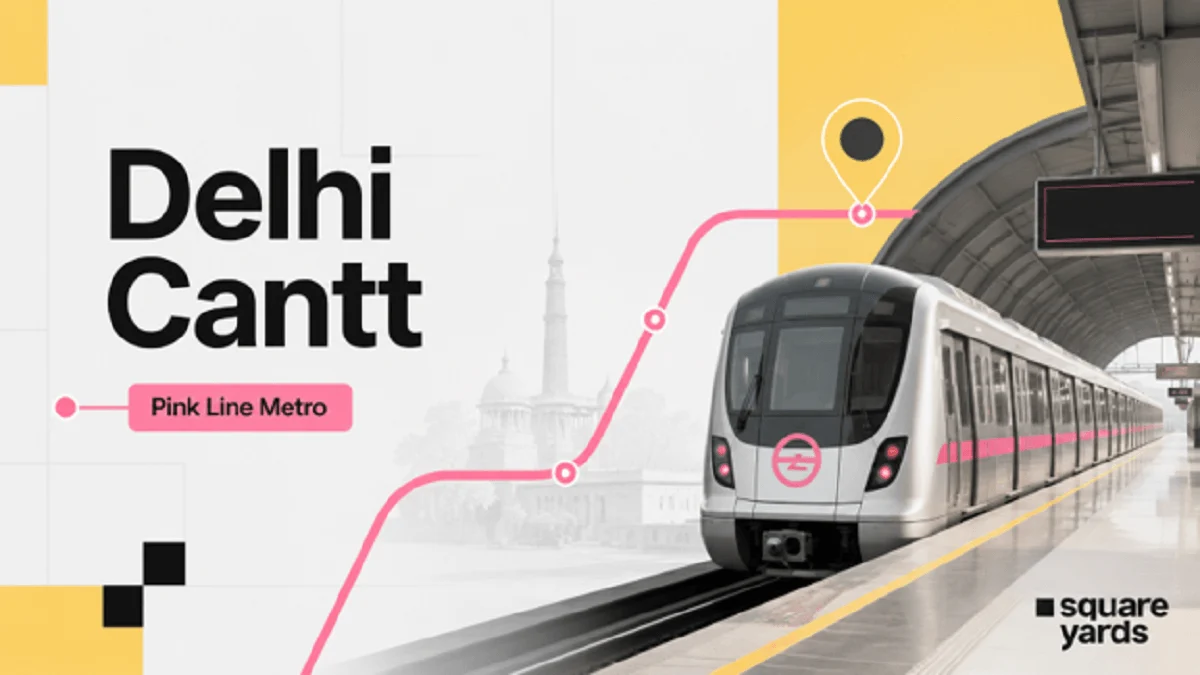
Introduction: The Evolution of Delhi’s Military Heartland
Delhi Cantonment, colloquially known as Delhi Cantt, has long stood as a serene, low-density "green lung" amidst the frantic urbanization of India’s capital. Established in 1914 by the British Raj, this sprawling 10,400-acre district was designed as a self-contained military enclave. For decades, its identity was defined by its restricted access, manicured boulevards, and the prestigious Delhi Cantonment Railway Station. However, this isolation often translated into a "connectivity gap" for its 1.1 lakh residents and the thousands of defense personnel who call it home.
The landscape changed irrevocably with the arrival of the Delhi Metro’s Pink Line (Line 7). What was once a secluded zone is now a pivotal node in the city’s transit network. This report explores the nuances of Delhi Cantt’s metro integration, the technical specifications of its surrounding stations, and the profound socio-economic implications for the region’s real estate and infrastructure.
1. Main Facts: The Infrastructure of Connectivity
Delhi Cantonment is unique in its administration. Unlike the rest of the capital, which falls under the Municipal Corporation of Delhi (MCD), the Cantt is governed by the Delhi Cantonment Board (DCB), a statutory body under the Ministry of Defence. This administrative distinction has preserved the area’s heritage but also necessitated a specialized approach to public transport.
The cornerstone of the area’s modernization is the Delhi Cantt Metro Station. Situated on the Pink Line, this station serves as the primary gateway for the locality.
Key Technical Specifications:
- Line: Pink Line (Line 7), also known as the "Ring Road Line."
- Location: Near Brar Square, strategically positioned off NH-48 (Delhi-Jaipur Expressway).
- Accessibility: Two primary gates. Gate 1 provides proximity to the Army College of Medical Sciences, while Gate 2 serves the Brar Square and residential corridors.
- Proximity to Rail: The metro station is located approximately 2.4 km from the Delhi Cantonment Railway Station, a vital stop for Rajasthan-bound trains like the Rajdhani and Shatabdi Express.
While the Delhi Cantt Metro Station is the primary hub, the locality is bolstered by a "constellation" of nearby stations, including Naraina Vihar, Durgabai Deshmukh South Campus, Dhaula Kuan, and Mayapuri. Each serves a distinct demographic and transit purpose, creating a multi-modal ecosystem.
2. Chronology: From Seclusion to the "Ring Metro" Era
The journey of Delhi Cantt’s connectivity can be divided into four distinct eras:
- 1914–1947 (The Colonial Foundation): Delhi Cantt was established as a garrison for British Indian Army troops. Infrastructure was limited to internal military roads and the railway line, with minimal integration into the "civilian" city.
- 1947–2002 (Post-Independence Stagnation): As Delhi expanded, the Cantonment remained an island. While the Delhi Cantonment Railway Station became a major stop for the Indian Railways, residents relied heavily on private vehicles or the limited DTC (Delhi Transport Corporation) bus services.
- 2018 (The Pink Line Revolution): The opening of the Majlis Park–Durgabai Deshmukh South Campus section of the Pink Line marked the first time the metro pierced the Cantonment’s periphery. This provided the first real alternative to road-based commuting.
- 2021–2026 (The Completion of the Ring): By 2026, the Pink Line achieved its status as India’s first "Ring Metro," a 73.49 km circular loop. This milestone is critical; it allows a resident of Delhi Cantt to reach any corner of the city—from the industrial hubs of the North-West to the commercial centers of East Delhi—with minimal interchanges.
3. Supporting Data: A Comparative Analysis of Transit Hubs
To understand the transit efficiency of the region, we must analyze the proximity and utility of the five nearest metro stations.
Table 1: Metro Station Proximity and Utility Matrix
| Metro Station | Line | Distance from Cantt | Travel Time (Auto) | Strategic Advantage |
|---|---|---|---|---|
| Delhi Cantt | Pink Line | 2.4 km | 8–12 mins | Direct access to Railway Station & Brar Square |
| Naraina Vihar | Pink Line | 2.8 km | 9–13 mins | Access to high-end residential & West Delhi markets |
| South Campus | Pink Line | 3.2 km | 10–15 mins | Gateway to Airport Express via Travelator |
| Dhaula Kuan | Airport Express | 3.5 km | 12–18 mins | Fastest route to IGI Airport & New Delhi RS |
| Mayapuri | Green Line | 4.2 km | 14–20 mins | Connectivity to North-West industrial belts |
Operational Data: The Pink Line Pulse
The Pink Line is the longest line in the Delhi Metro network. For Delhi Cantt commuters, this translates to high-frequency service.
- First Train: 06:00 AM (Monday–Saturday)
- Last Train: 11:00 PM (Daily)
- Interchange Potential: The Pink Line intersects with every other major line, including the Yellow Line (INA), Blue Line (Rajouri Garden), and Red Line (Netaji Subhash Place).
4. Official Responses: Strategic Planning and Last-Mile Integration
The development of the Delhi Cantt metro corridor has been a collaborative effort between the Delhi Metro Rail Corporation (DMRC) and the Delhi Cantonment Board (DCB).
DMRC’s Vision:
Officials from the DMRC have highlighted that the Delhi Cantt station was engineered to handle "dual-purpose traffic"—serving both the daily local commuter and the long-distance railway passenger. The inclusion of Gate 1 near the Army College of Medical Sciences was a deliberate move to support the defense medical fraternity.
The Cantonment Board’s Role:
The DCB has focused on maintaining the "Green Zone" status while facilitating last-mile connectivity. Unlike the chaotic exits of stations in Old Delhi, the exits at Delhi Cantt are designed for controlled traffic flow. The Board has authorized specific e-rickshaw zones to prevent congestion near Brar Square.
The "Travelator" Innovation:
A significant official achievement is the foot-overbridge (FOB) connecting Durgabai Deshmukh South Campus to Dhaula Kuan. Spanning 1.2 km and equipped with travelators, this engineering feat allows Delhi Cantt residents to transition from the Pink Line to the Airport Express Line without exiting the metro system, a move officials say has reduced travel time to the airport by 25 minutes.
5. Implications: Real Estate, Economy, and Lifestyle
The "Metro Effect" on Delhi Cantt and its fringes has been profound, particularly in the real estate sector.
The Real Estate Boom
Data from Square Yards indicates a steady appreciation in property values in the localities surrounding the Cantonment.
- Naraina Vihar: Positioned just one stop away, property prices have surged to over ₹11,000 per sq. ft.
- Delhi Cantt Proper: While much of the land is government-owned, the "Civil Areas" and surrounding private colonies have seen a spike in rental demand. Defense personnel on study leave or families of officers posted in field areas increasingly prefer this corridor due to the safety of the Cantt combined with the mobility of the Pink Line.
Economic Diversification
The metro has transformed Delhi Cantt from a "residential garrison" into a accessible hub for education and healthcare. The Army College of Medical Sciences (ACMS) and the Base Hospital now draw students and staff from across the NCR, who previously found the commute daunting.
Lifestyle and Environment
The shift from private vehicles to the metro has a latent environmental benefit. By providing a viable public transit alternative, the DMRC has helped preserve the low-pollution status of the Cantonment. For residents, the "Ring Metro" means that weekend destinations like Lajpat Nagar (Shopping), Sarojini Nagar (Market), and INA (Food) are now within a 25-minute air-conditioned ride.
6. Practical Navigation: A Guide for Commuters
For those navigating to or from Delhi Cantt, the following routes are recommended based on current DMRC operational data:
- To IGI Airport: Board the Pink Line at Delhi Cantt towards Shiv Vihar. Disembark at Durgabai Deshmukh South Campus. Take the travelator to Dhaula Kuan and board the Airport Express. Total time: ~30 minutes.
- To Connaught Place: Board the Pink Line towards Shiv Vihar. Change to the Yellow Line at Dilli Haat-INA. Exit at Rajiv Chowk. Total time: ~40 minutes.
- To East Delhi (Anand Vihar): A direct, no-interchange ride on the Pink Line. Total time: ~50 minutes.
Last-Mile Options at Delhi Cantt Station:
- E-Rickshaws: Best for short hops to Brar Square (₹20–40).
- Auto-Rickshaws: Plentiful at Gate 1; use these for the 2.4 km trip to the Railway Station (₹50–80).
- App-Based Cabs: Highly reliable in this area due to the proximity to NH-48.
Conclusion: A Model for Urban Integration
The integration of the Pink Line into the fabric of Delhi Cantonment represents more than just an infrastructure project; it is a successful case study in urban planning within a sensitive military zone. By bridging the "connectivity gap," the Delhi Metro has ensured that the residents of Delhi Cantt are no longer isolated from the capital’s economic and social heart.
As the Pink Line continues to evolve as a complete ring, the strategic importance of the Delhi Cantt corridor will only grow. For investors, it remains a robust market; for defense personnel, a convenient home; and for travelers, a vital gateway to the rest of India. The transformation from a secluded colonial garrison to a modern, connected hub is now complete.
