

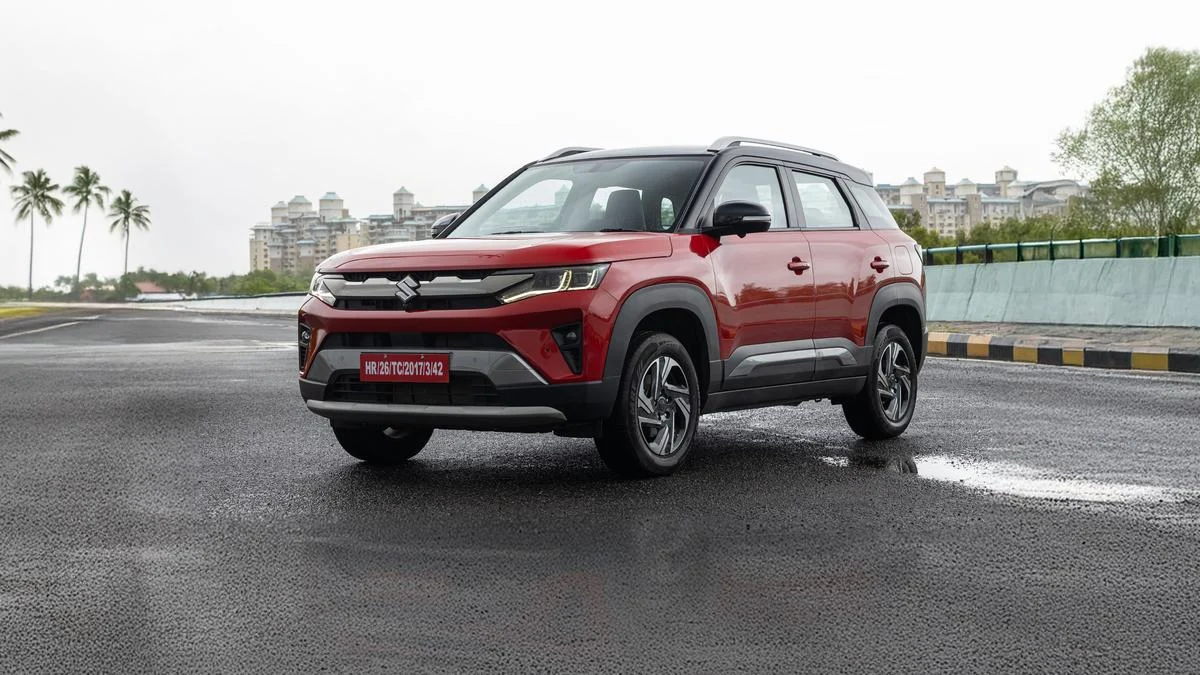
The Indian automotive landscape is currently witnessing one of its most aggressive competitive cycles in history, particularly within the sub-four-meter compact SUV segment. For years, the Maruti Suzuki Brezza has stood as a pillar of the company’s Arena portfolio—a reliable, high-volume workhorse that transitioned Maruti from a hatchback specialist to a serious contender in the SUV space. However, as consumer expectations have shifted from mere fuel efficiency to performance, safety, and high-tech features, the "sensible" choice was in danger of being perceived as "dated."
In a strategic move to fortify its dominance, Maruti Suzuki has introduced the 1.0-litre Boosterjet turbo-petrol engine to the Brezza lineup. This isn’t just a mechanical update; it is a calculated response to a market that has become increasingly sophisticated and demanding.
1. Main Facts: The Boosterjet Revolution and Pricing Strategy
The centerpiece of the updated Brezza is the 1.0-litre, three-cylinder Boosterjet turbo-petrol engine. While Maruti has experimented with this powertrain in the past (most notably in the Baleno RS), its integration into the Brezza marks a turning point for the brand’s SUV strategy.
Performance Metrics
The new engine delivers a healthy 110.12 PS of power and 170 Nm of peak torque. On paper, these figures might not seem to shatter class records, but the delivery of that power tells a different story. Paired exclusively with a six-speed manual gearbox, the turbo-petrol unit provides a "mid-range punch" that the aging 1.5-litre naturally aspirated engine lacked. This results in a vehicle that feels more urgent, capable of effortless highway overtakes and better gradient climbing.

Price and Positioning
Maruti Suzuki has maintained its reputation for value-based pricing, ensuring the turbo variants remain accessible to the mass market.
- Base Variant (LXi Turbo): Starts at ₹7.40 lakh (ex-showroom, Delhi).
- Top-Spec Variant (ZXi+ Dual-Tone Turbo): Reaches up to ₹11.31 lakh.
- Full Range: The broader Brezza portfolio, including the 1.5-litre variants, extends up to ₹13.55 lakh.
By starting the turbo range at such a competitive price point, Maruti is effectively challenging the entry-level variants of the Hyundai Venue and Tata Nexon, offering "more engine" for the money.
2. Chronology: The Journey from Diesel Dominance to Turbocharged Ambition
To understand the significance of the 1.0 Turbo, one must look at the Brezza’s lineage.
- 2016 – The Inception: The Vitara Brezza was launched as a diesel-only model. It utilized the legendary Fiat-sourced 1.3-litre Multijet engine. It was an instant hit, lauded for its ruggedness and frugality.
- 2020 – The Petrol Pivot: With the onset of BS6 emission norms, Maruti Suzuki made the bold (and controversial) decision to exit the diesel market entirely. The Brezza was refreshed with a 1.5-litre K15B naturally aspirated petrol engine. While smooth, critics argued it lacked the "torque-heavy" feel of the old diesel.
- 2022 – The Tech Overhaul: Maruti launched the second-generation Brezza (dropping the "Vitara" prefix). This version focused on "premiumization," adding a sunroof, 360-degree cameras, and a heads-up display (HUD).
- 2024/2025 – The Performance Correction: Recognizing that rivals like the Kia Sonet and Mahindra XUV 3XO were winning over younger buyers with turbocharged performance, Maruti finally introduced the 1.0 Boosterjet to the Brezza, completing the SUV’s transition from a utility vehicle to a lifestyle performance choice.
3. Supporting Data: Engineering, Safety, and Interior Sophistication
Maruti’s "course correction" isn’t limited to what is under the hood. The data suggests a holistic improvement in the vehicle’s build and feature set.

Safety: The Five-Star Milestone
Perhaps the most significant data point for the new Brezza is its safety certification. The SUV has earned a five-star rating from Bharat NCAP. This rating is a monumental shift for Maruti Suzuki, which has historically faced criticism regarding the structural integrity of its "Heartect" platform-based cars.
- The certification, initially based on the 1.5-litre automatic test vehicle, also applies to the 1.0 Turbo variants.
- This puts the Brezza on equal footing with the Tata Nexon and Mahindra XUV 3XO, both of which have marketed safety as their primary USP.
The Digital Cockpit
The interior has undergone a significant digital transformation to meet the "connected car" trend:
- Infotainment: A new 10.1-inch SmartPlay Pro+ touchscreen infotainment system replaces the older 7-inch and 9-inch units. It offers high-definition graphics and seamless wireless smartphone integration.
- Comfort Features: For the first time, higher variants receive ventilated front seats, a feature once reserved for luxury segments but now a necessity in India’s tropical climate.
- Convenience: Wireless charging, ambient lighting, and an upgraded acoustic system bring the Brezza’s cabin quality closer to the benchmarks set by the Kia Sonet.
Dynamics and Handling
Despite the engine change, the Brezza retains its suspension tuning, which is optimized for Indian road conditions. With a ground clearance that remains competitive and a suspension that absorbs "pothole-ridden" urban roads with aplomb, the vehicle maintains its identity as a practical family mover.
4. Official Responses and Market Strategy: The "Arena" Philosophy
While Maruti Suzuki officials have traditionally focused on "Total Cost of Ownership" (TCO) and "Fuel Efficiency," their recent strategy reflects a shift toward "Aspirational Value."

The company’s decision to keep the 1.0 Turbo as a manual-only offering (for now) is a calculated move. Data suggests that driving enthusiasts in the compact segment still prefer the control of a manual gearbox when paired with a turbocharger. Conversely, the 1.5-litre naturally aspirated engine continues to be offered with a six-speed torque converter automatic, catering to the urban commuter who prioritizes smoothness over spirited driving.
Competitive Benchmarking
Maruti’s internal strategy appears to be a "Middle Path" approach. They are not trying to out-spec the Mahindra XUV 3XO in raw power, nor are they trying to out-gadget the Kia Sonet. Instead, they are leveraging their unmatched service network.
- Network Reach: With over 4,000 touchpoints across India, Maruti ensures that a Brezza owner in a remote Himalayan village has the same access to parts as an owner in South Delhi.
- Reliability: By using the Boosterjet—a global engine—Maruti is reassuring buyers that "turbocharged" doesn’t have to mean "high maintenance."
5. Implications: What This Means for the Indian Consumer
The introduction of the Brezza 1.0 Turbo has several far-reaching implications for the industry and the consumer.
The End of the "Boring Maruti" Narrative
For years, Maruti was the default choice for the "rational" buyer, while rivals were the choice for the "emotional" buyer. The 1.0 Turbo blurs these lines. By adding "personality" and "attitude" to the Brezza, Maruti is successfully attracting a younger demographic that previously might have overlooked the brand in favor of more "exciting" European or Korean alternatives.

Pressure on Rivals
The aggressive pricing of the Brezza Turbo (starting at ₹7.40 lakh) puts immense pressure on competitors.
- Tata Nexon: Must now rely on more than just its safety rating to maintain its lead.
- Hyundai/Kia: May need to re-evaluate their pricing structures for mid-spec turbo variants.
- Skoda Kylaq: As a new entrant, the Kylaq will find it difficult to compete with the Brezza’s combination of performance and widespread serviceability.
The Hybrid vs. Turbo Debate
This move also signals Maruti’s multi-pronged powertrain strategy. While the brand is heavily invested in Strong Hybrids (like the Grand Vitara), the Brezza Turbo shows that Maruti still sees a long future for high-efficiency internal combustion engines (ICE) in the smaller segments where hybrid costs might be prohibitive.
Conclusion: A Balanced Masterstroke
The Maruti Suzuki Brezza 1.0 Turbo is not a reinvention; it is a refinement. It acknowledges that the modern Indian buyer is no longer satisfied with just "good mileage." They want a car that feels premium, keeps their family safe, and provides a bit of a thrill when the traffic clears.
By combining a 5-star safety rating, a punchy Boosterjet engine, and the most extensive service network in the country, Maruti has created a package that is difficult to ignore. It may not lead the segment in every individual category—it isn’t the fastest, nor the most feature-rich—but as a holistic ownership proposition, it is arguably the most sensible and now, surprisingly, one of the most spirited choices in the compact SUV market.

The message from Maruti Suzuki is clear: the king of the segment has no intention of stepping down, and it now has the "boost" required to stay ahead of the pack.
