

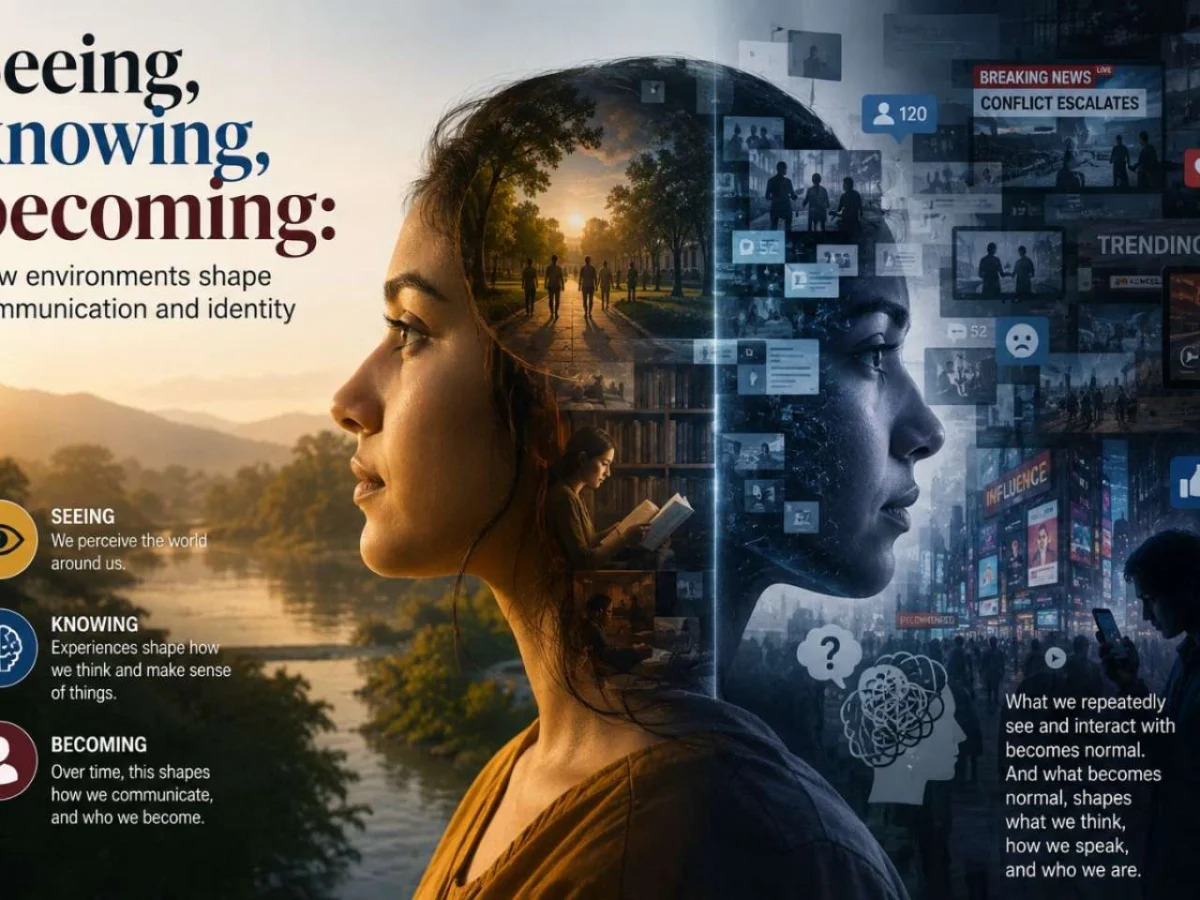
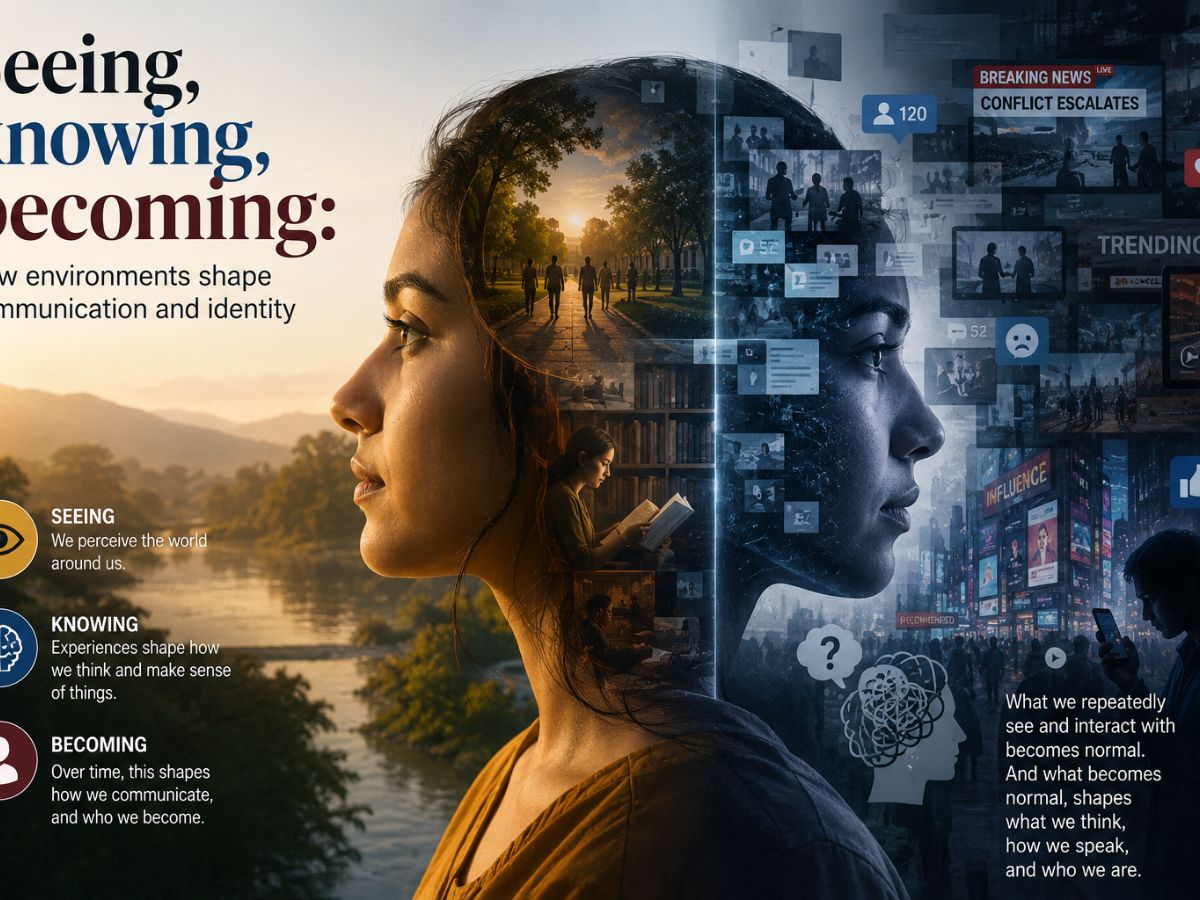
In an era defined by relentless digital streams and curated realities, the very essence of who we are and how we express ourselves is undergoing a profound transformation. Far from being solely internal constructs, our communication styles and personal identities are deeply and continuously shaped by the environments we inhabit. This concept, echoing ancient philosophical wisdom, has gained an unprecedented urgency in our media-saturated world, where constant exposure subtly but powerfully molds our perceptions, reasoning, and ultimately, our sense of self.

The Genesis of Self: Ancient Roots in a Modern World
The notion that our external surroundings profoundly influence our internal landscapes is not a recent revelation. Philosophers across various traditions have long grappled with this intricate interplay. In the West, thinkers like John Locke posited the mind as a tabula rasa, a blank slate upon which experience writes. Eastern philosophies, however, offer even more nuanced frameworks for understanding this dynamic.
)
Classical Indian thought, particularly the Nyaya and Yoga Sutras, provides a remarkably prescient lens through which to examine how our environments shape our cognitive and communicative faculties. The Nyaya Sutra, a cornerstone of Indian logic and epistemology, places perception (pratyaksha) at the forefront of knowledge acquisition. It posits that valid knowledge begins with the direct contact between our senses and the external world. What we see, hear, and experience forms the raw material upon which we build our understanding, make inferences, and formulate judgments. This establishes a fundamental sequence: sensory stimulus precedes cognition, and cognition, in turn, informs articulation.

The Yoga Sutra further elaborates on this by delving into the nature of the mind. It defines the mind as a collection of vrittis, or mental fluctuations, which arise from the impressions formed through sensory engagement and lived experiences. The text famously states, "yogahchittavrittinirodhah" (Yoga Sutra 1.2), meaning the cessation of the fluctuations of the mind is yoga. These fluctuations are not random; they are deeply influenced by what we repeatedly encounter. Over time, this sustained exposure leaves indelible samskaras, or imprints, which cultivate our tendencies, preferences, and habitual patterns of response. Consequently, our identity, from this perspective, is not a static, self-generated entity but rather an accumulation of these imprinted experiences.
)
The Amplifying Power of the Contemporary Media Landscape
While the philosophical underpinnings of environmental influence are ancient, the contemporary media environment has amplified this effect to an unparalleled degree. We are no longer passive recipients of limited, local stimuli. Instead, we are immersed in a constant, often algorithmically curated, deluge of information. Digital platforms, social media feeds, and endless streams of content create an environment that is dense with stimuli, and crucially, these environments are not neutral.
)
These digital ecosystems are designed to capture and retain our attention, and in doing so, they inevitably prioritize certain forms of expression, amplify specific linguistic patterns, and normalize particular ways of perceiving and framing the world. This constant exposure to a select set of stimuli has a profound impact on both how we communicate and how we understand ourselves.
)
The Standardisation of Language and the Shifting Sands of Identity
One of the most visible manifestations of this environmental influence is the increasing standardization of language across platforms. Words, phrases, and entire expressions can now circulate with astonishing speed, rapidly acquiring shared meaning and serving as powerful markers of belonging. What might have once been a mere description of a preference or an activity can, through repeated exposure and social reinforcement, evolve into a defining aspect of personal identity. Terms that once signified a hobby or a lifestyle choice can now function as fundamental self-definitions, signaling allegiance to particular groups and ideologies.
)
This linguistic assimilation is not an incidental consequence of digital communication; it is a direct reflection of the power of repeated exposure. Certain linguistic patterns become so pervasive that they begin to feel natural, expected, and even essential for meaningful participation within these digital spaces. The pressure to conform to these dominant linguistic norms can subtly steer individuals towards adopting the vocabulary and, by extension, the associated worldviews.
)
The Narrowing of Perspective and the Contraction of Thought
Beyond language, the influence extends to the formation of opinions and perspectives. When individuals are consistently exposed to a narrow range of viewpoints, it can create a powerful illusion of consensus. The constant engagement with specific narratives, whether political, social, or cultural, can shape what is considered credible, legitimate, and even true.
)
The Nyaya emphasis on perception as the genesis of knowledge is particularly relevant here. If the range of what is perceived is artificially narrowed by our media consumption habits, then the scope of what can be reasoned and understood also contracts. As the saying goes, thought follows exposure. When our informational diet is limited, our capacity for critical analysis and nuanced understanding can be significantly diminished.
)
The Deepening Imprints: Samskaras in the Digital Age
The Yoga Sutra’s concept of samskaras—deepening imprints from repeated experiences—finds a potent analogue in the digital realm. A single exposure to an idea or a piece of information might offer a fleeting insight, but sustained engagement with specific content, narratives, or online communities leaves far deeper cognitive and emotional residues. These residues subtly influence our behavior, shape our preferences, and ultimately, solidify our sense of self.
)
What begins as a preference, perhaps influenced by algorithmic recommendations or peer group reinforcement, can, over time, start to feel intrinsic. The origins of these preferences become obscured by the sheer weight of accumulated exposure, leading to the perception of a stable and self-derived identity, even when that identity is in a constant state of subtle, ongoing construction.
)
Institutional Responsibility: The Architects of Our Environments
This pervasive environmental influence places a significant responsibility on institutions, particularly those involved in education and communication. If our thoughts and expressions are indeed shaped by the environments we inhabit, then the deliberate design and cultivation of these environments become paramount. What is made visible, what is emphasized, and what is repeatedly presented will have a profound impact not only on what individuals know but, more importantly, on how they think and how they articulate that thinking.
)
Higher education institutions, for instance, traditionally focus on content delivery and the acquisition of specific skills. However, the communicative environment within which this learning takes place is often overlooked. If exposure shapes cognition, then the quality of discourse, the intentional fostering of diverse perspectives, and the nature of intellectual engagement become central to the educational process itself. A sterile or ideologically uniform learning environment, no matter how rich in content, risks producing individuals whose capacity for critical thought and nuanced expression is stunted.
)
Similarly, media organizations and public communicators face a critical challenge. The ongoing trend towards compressing complex information into short, easily digestible formats, while potentially increasing accessibility, also carries the risk of reducing complexity and nuance. When exposure is limited to oversimplified representations, the capacity for deep, critical thinking can diminish. Communication might become more efficient, but it may also become less substantive and less capable of fostering genuine understanding.
)
Navigating the Unseen Influence: Cultivating Awareness and Deliberate Design
The challenge, therefore, is not to eliminate environmental influence altogether, for that is an impossible and perhaps even undesirable feat. Instead, the imperative is to cultivate awareness of this influence. It is to recognize that what is seen repeatedly will inevitably shape what is thought, and what is thought will, in turn, shape what is said.
)
In a world where our environments are increasingly mediated and deliberately curated, this awareness is not merely a philosophical curiosity; it is an essential tool for navigating the complexities of modern life. Communication and identity do not emerge in a vacuum. They are forged at the intricate intersection of exposure, interpretation, and repetition. The fundamental question is not whether we are influenced by the environments that surround us. The crucial question is whether we are attentive to the mechanisms of that influence and whether we are deliberate in shaping the environments that, in turn, shape us.
)
This requires a conscious effort to diversify our information sources, to critically evaluate the narratives we consume, and to engage with perspectives that challenge our own. It also demands that institutions and individuals alike take responsibility for the communicative environments they create and participate in. By fostering spaces that encourage open dialogue, intellectual diversity, and critical engagement, we can begin to counteract the homogenizing forces of our media-saturated world and cultivate a richer, more nuanced, and more authentic sense of self and community. The architects of our environments, whether intentional or unintentional, are the unseen sculptors of our minds; it is time we became more conscious of their work.
