

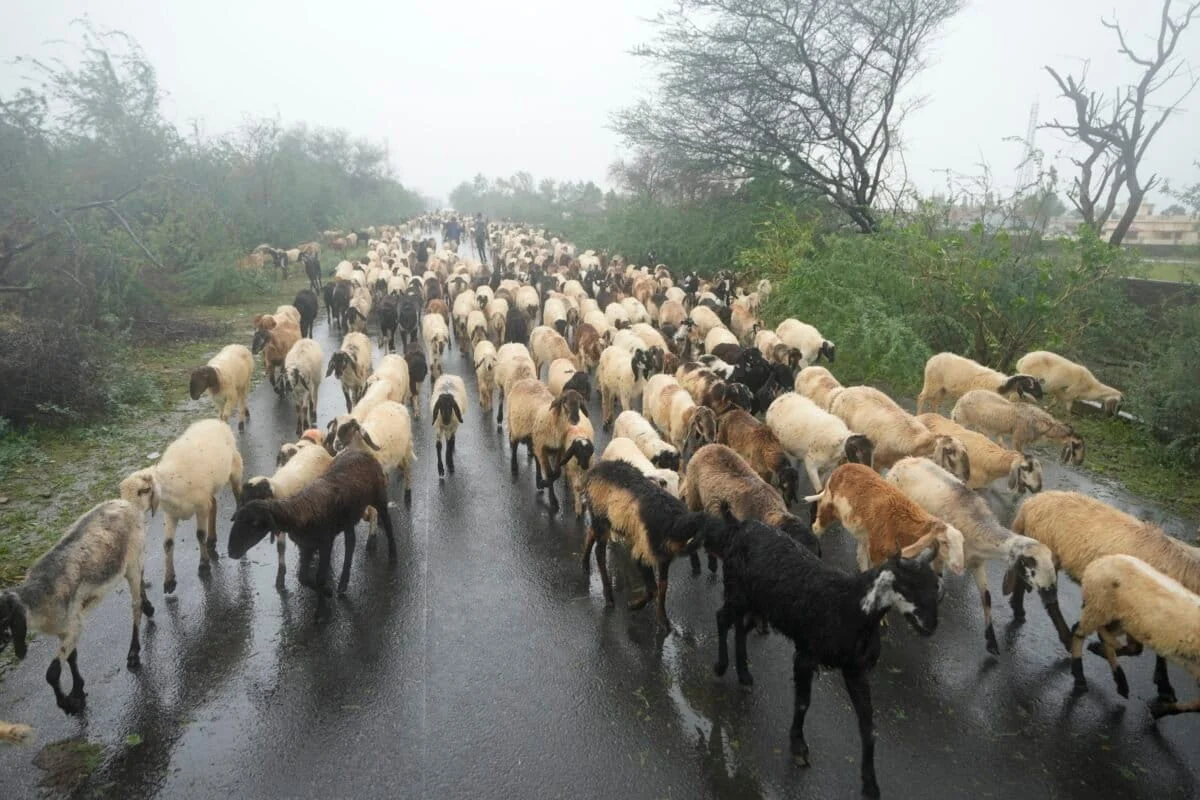
KACHCHH, GUJARAT — In the parched, sun-bleached expanse of the Kachchh district, where the horizon is often a blur of white salt and sandy brown earth, Nasibi Shermamad Jat, 55, represents a living bridge to a fading ecological heritage. A member of the pastoralist Maldhari community in the village of Dhragavandh, Nasibi’s life has been defined by the rakhal—a traditional system of protected grasslands that has sustained both the livestock and the culture of this arid region for centuries.
“I remember walking to the rakhal with my mother as a child,” Nasibi recalls, her eyes scanning the thorny landscape near the India-Pakistan border. “We would take the buffaloes for grazing, and I would spend my days plucking imli (tamarind) from the trees and collecting grass during the lean months of drought.”
Today, however, the rakhals are under unprecedented pressure. Once the crown jewels of the Princely State of Kachchh’s conservation efforts, these savannah-like landscapes are now caught in a tug-of-war between state-led conservation policies, invasive species, and the relentless march of industrialization.
I. Main Facts: Defining the Rakhal Ecosystem
A rakhal is a unique land-use category specific to the arid and semi-arid regions of Kachchh. Characterized by sparse tree cover, hardy shrubs, and a variety of indigenous grasses, these areas function as micro-oases in an otherwise hostile environment. Historically, they served as ecological insurance policies—protected zones where grazing was regulated to ensure that fodder remained available even during the region’s frequent and devastating droughts.

According to a recent landmark study conducted by botanists from the Maharaja Sayajirao (MSU) University of Baroda, these areas are far from the "wastelands" they are often labeled as in official records. The research, led by Kavi Oza and Vinay M. Raole, documented more than 100 plant species within just five rakhals in the Mandvi region.
“There is a common misconception that desert areas lack diversity,” says Kavi Oza. “Our study proved the opposite. These rakhals are biodiversity hotspots that provide medicinal plants, food, firewood, and fodder to the local communities.”
The most prevalent species identified include Azadirachta indica (Neem), Cocos nucifera (Coconut), and Acacia nilotica (Babul). However, the study also highlighted the alarming spread of Prosopis juliflora, an invasive species known locally as Gando Baval (the "mad tree"), which is rapidly altering the ecological balance of the region.
II. Chronology: From Royal Preserves to State Control
The history of the rakhals is a testament to the sophisticated traditional ecological knowledge of the Kachchh rulers.
- The 1880s: The Royal Initiative: The rakhals were established in the late 19th century by the Maharaos (rulers) of the Princely State of Kachchh. Originally designed as grass preserves, their primary purpose was to ensure a steady supply of fodder for the horses and animals used by the royal court for hunting and transport. Even then, strict conservation laws were in place; the cutting of trees was strictly prohibited, and grazing was a privilege granted only under specific conditions.
- The Pre-Independence Revenue Model: The royal court recognized the economic value of these lands. They earned revenue by leasing grazing rights to the Maldharis, the traditional pastoralists. This created a symbiotic relationship where the community protected the land because their livelihoods depended on its health.
- Post-1947: State Takeover: Following India’s independence and the subsequent merger of princely states, the management of rakhals was transferred to the Gujarat State Forest Department. The department categorized them into "superior" and "inferior" rakhals. Superior rakhals were maintained as emergency fodder reserves for the state, while inferior ones were leased to local village panchayats for community grazing.
- The Modern Era: The Sanctuary Conflict: In recent decades, many rakhals have been absorbed into larger protected areas, such as the Narayan Sarovar Sanctuary. While this was intended to bolster wildlife conservation—specifically for the Chinkara (Indian Gazelle)—it has inadvertently criminalized the traditional grazing practices of the Maldharis, leading to a breakdown in the community-led conservation model.
III. Supporting Data: The Ecological and Ethnobotanical Value
The MSU Baroda study, conducted between 2020 and 2023, utilized field interviews and ethnobotanical indices to quantify the importance of these lands. The researchers focused on five specific rakhals: Sherdi, Vanothi, Pyaka, Godhara, and Hamla-Manjal.

Key Findings:
- Medicinal Utility: Over 60% of the plant species identified in the rakhals have documented medicinal uses. For the Maldharis, who often live far from urban medical centers, these plants are the first line of defense against ailments for both humans and livestock.
- The Guggul Crisis: The study highlighted the "steep decline" of Commiphora wightii (Guggul), a source of highly valued medicinal resin. Between 1985 and 1995, mature Guggul trees were decimated due to over-extraction and habitat loss. Today, only young saplings remain in most rakhals, threatening the long-term survival of the species.
- The Prosopis Paradox: Prosopis juliflora (Gando Baval) now dominates the landscape. While ecologists view it as a threat to native biodiversity, the study found that local communities have adapted to its presence. Nasibi’s family, for instance, relies on it for firewood. "It has spread everywhere," she says. "It crowds out the native babul, but it is what we have left to cook with."
- Habitat Heterogeneity: Ecologist Arun M. Dixit notes that the rocky, uneven terrain of the rakhals creates "microhabitats." This heterogeneity allows rarer, less competitive species to survive in the shadows of dominant plants, provided that the land is managed through controlled grazing rather than total exclusion or overgrazing.
IV. Official Responses and Management Challenges
The management of rakhals today is a complex administrative challenge. The Forest Department maintains that strict regulations are necessary to prevent the total degradation of the grasslands. In "superior" rakhals, the department harvests grass, stores it, and distributes it to farmers at subsidized rates during droughts.
However, the transition of these lands into National Parks and Sanctuaries has created a legal impasse. Under the Wildlife Protection Act, 1972, grazing is often restricted or prohibited in core areas of sanctuaries.
"The forest department has threatened us with legal action if we take our camels into the rakhals within the Narayan Sarovar Sanctuary," Nasibi explains. This creates a paradox: the rakhals were created for grazing, but their success in maintaining biodiversity has led to their classification as sanctuaries, which then bans the very grazing that helped maintain them for over a century.
Officials from the forest department, speaking on condition of anonymity, suggest that while they recognize the traditional rights of the Maldharis, they are bound by federal laws aimed at protecting endangered wildlife. They point to the "People’s Biodiversity Registers" (PBRs) as a potential solution. Under the Biological Diversity Act, 2002, every local body is required to maintain a PBR to document local biological resources and associated traditional knowledge.

V. Implications: The Future of Kachchh’s Pastoral Heritage
The decline of the rakhal system has implications that reach far beyond the borders of Kachchh.
1. Loss of Traditional Ecological Knowledge (TEK):
As the younger generation of Maldharis moves toward urban centers or is forced out of traditional pastoralism due to restricted land access, centuries of ecological wisdom are being lost. Kavi Oza warns that "the younger generation is losing touch with their roots." While Nasibi’s grandson, Hussain, uses his smartphone to map the rakhals, the deep, intuitive understanding of plant cycles and soil health is harder to transmit via a screen.
2. Climate Resilience:
Kachchh is one of India’s most climate-vulnerable regions. Rakhals act as carbon sinks and prevent desertification. The MSU Baroda study recommends that these areas be formally recognized as "Critical Biodiversity Zones" in local policy. This would allow for a management model that prioritizes species of high cultural and ecological importance, such as the Guggul and native Babul, over invasive species.
3. The Need for Inclusive Conservation:
The study concludes that conservation cannot be a top-down process that excludes the human element. The most biodiverse rakhals are those where "restricted grazing" is practiced—a middle path between the "open-access" degradation of common lands and the "total exclusion" of state sanctuaries.
For Nasibi Shermamad Jat, the stakes are personal. Her family of eight depends on their 30 camels and six buffaloes. If the rakhals are closed to them, a way of life that survived the era of kings and the turmoil of independence may finally succumb to the pressures of the 21st century.

"Our parents taught us about the rakhals, and we teach our grandchildren," Nasibi says, watching her grandson scroll through his phone. "They take an interest because they have their own small herds. But interest is not enough if there is no land left for the animals to eat."
As Gujarat looks toward a future of renewable energy expansion and industrial growth, the humble rakhal stands as a reminder that true sustainability may lie in the ancient, thorny gardens of the past.
