

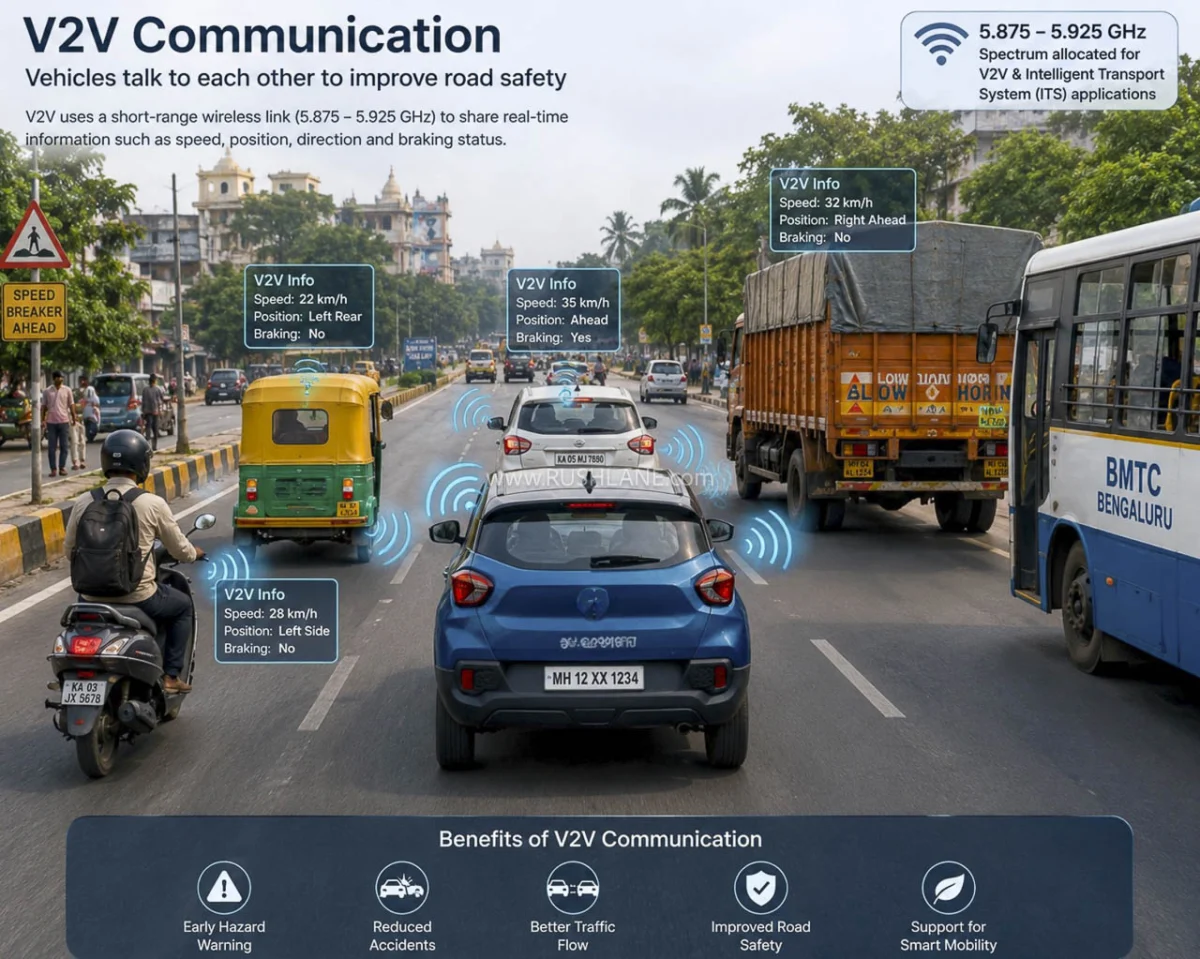
In a move that could redefine the global automotive landscape, the Government of India has proposed a landmark regulation that would make Vehicle-to-Vehicle (V2V) communication technology mandatory for nearly all new vehicles starting in 2028. This ambitious initiative, spearheaded by the Ministry of Road Transport and Highways (MoRTH), positions India as a potential world leader in the deployment of connected vehicle technology, aiming to drastically reduce the country’s high rate of road fatalities through real-time, wireless data exchange.
Main Facts: A New Era of Connected Mobility
The Ministry of Road Transport and Highways recently issued a draft notification proposing significant amendments to the Central Motor Vehicles Rules (CMVR), 1989. The core of this proposal is the integration of V2V communication systems into the standard safety suite of vehicles manufactured in India.
Scope of the Mandate
The proposed regulation is remarkably broad, covering a vast spectrum of vehicle types. Unlike pilot programs in other nations that focus primarily on high-end passenger cars, India’s mandate targets:
- Category L: Two-wheelers and three-wheelers (the backbone of Indian last-mile connectivity).
- Category M: Passenger vehicles, including cars, SUVs, vans, and buses.
- Category N: Goods vehicles, ranging from light commercial vehicles (LCVs) to heavy-duty trucks.
Technical Foundation
V2V technology allows vehicles to "talk" to one another. Using dedicated short-range communication or cellular-based protocols, vehicles continuously broadcast their speed, position, heading, and braking status to other vehicles within a specific radius (typically up to 300–500 meters). This creates a 360-degree awareness of the surrounding traffic environment, even when objects are obscured by buildings, heavy rain, or other large vehicles.
Spectrum Allocation
Crucially, the infrastructure for this technology is already being prepared. The Department of Telecommunications (DoT) has allocated the 5.875 GHz to 5.925 GHz frequency band specifically for Intelligent Transportation Systems (ITS). This dedicated spectrum ensures that safety-critical messages are not delayed by commercial cellular traffic, providing the low-latency communication required for split-second emergency responses.
Chronology: The Roadmap to 2028
The implementation of V2V technology is designed as a phased rollout to ensure the automotive ecosystem—comprising manufacturers, software developers, and sensor suppliers—has sufficient time to stabilize the technology.
Phase 1: Standardization for Early Adopters (October 2027)
Vehicles that are already equipped with V2V or V2X (Vehicle-to-Everything) technology—currently found in a few premium models or experimental fleets—must comply with the newly prescribed government standards by October 1, 2027. This phase ensures that early implementations are interoperable, meaning a Mahindra vehicle must be able to communicate seamlessly with a Maruti or a Tata vehicle.
Phase 2: Universal Mandate (October 2028)
The most critical deadline is October 1, 2028. From this date forward, every new vehicle produced under categories L, M, and N must be factory-fitted with V2V communication systems. This represents one of the fastest and most comprehensive nationwide rollouts of connected tech planned by any major economy.
Historical Context
This move follows a decade-long push by the Indian government to upgrade vehicle safety. From the mandatory inclusion of Anti-lock Braking Systems (ABS) and airbags to the recent push for Bharat NCAP (New Car Assessment Program), the V2V mandate is viewed as the "final frontier" in preventative safety, moving from passive safety (protecting during a crash) to active safety (preventing the crash entirely).
Supporting Data: The Case for V2V in India
India accounts for roughly 11% of global road accident deaths, despite having only 1% of the world’s vehicles. According to MoRTH’s annual reports, over 1.5 lakh people die on Indian roads every year. Data suggests that a significant portion of these accidents are caused by human error, poor visibility, and "unseen" hazards.
Beyond the Limits of ADAS
Current Advanced Driver Assistance Systems (ADAS) rely on "line-of-sight" sensors:

- Cameras: Limited by fog, heavy rain, and darkness.
- Radar/LiDAR: Limited by physical obstructions (e.g., a car hidden behind a large truck).
V2V technology provides "non-line-of-sight" capabilities. Supporting data from international trials (such as those conducted by the US NHTSA) suggests that V2V could potentially address up to 80% of multi-vehicle crashes involving unimpaired drivers. In the Indian context, this technology could be life-saving in specific scenarios:
- Intersection Collisions: Warning a driver of a vehicle approaching a blind intersection at high speed.
- Chain Reactions: Alerting a driver that a vehicle five cars ahead has slammed on its brakes, allowing for earlier intervention than a radar could provide.
- Foggy Conditions: In Northern India’s winter "smog," V2V acts as a digital eye, pinpointing the location of other vehicles when visibility is near zero.
Official Responses: Government and Industry Perspectives
The Government’s Vision
MoRTH officials have emphasized that this is not merely a technological upgrade but a public health necessity. A spokesperson for the ministry noted, "The proposed framework will significantly improve vehicle situational awareness. By facilitating timely safety warnings, we are strengthening a connected mobility ecosystem that prioritizes human life above all else."
The Department of Telecommunications has echoed this sentiment, highlighting that the allocation of the 5.9 GHz band is a strategic move to align India with global ITS standards, ensuring that Indian-made vehicles are "future-proof" for international markets.
Industry Reaction
While the Society of Indian Automobile Manufacturers (SIAM) has yet to release a formal collective statement on the draft, individual manufacturers have expressed a mix of optimism and concern.
- Innovation Opportunities: Tech-forward companies see this as an opportunity to lead in software-defined vehicles.
- Cost Concerns: Entry-level two-wheeler manufacturers are wary of the cost implications. Adding V2V hardware (transceivers and antennas) to a budget scooter could increase the retail price significantly, potentially impacting sales in price-sensitive segments.
Implications: Privacy, Policy, and the Future
The move toward V2V is not without its complexities. As vehicles become "nodes" on a network, several critical issues arise.
1. The Privacy Debate
The draft notification clarifies that V2V broadcasts will not include personal identifiers such as names, phone numbers, or Vehicle Identification Numbers (VIN). However, privacy advocates remain skeptical. If a vehicle’s location and speed are broadcast continuously, sophisticated data harvesting by roadside units (RSUs) could theoretically be used to "fingerprint" a vehicle and reconstruct its travel history. The government will need to implement robust encryption and "anonymization" protocols to prevent surveillance.
2. The Insurance Evolution
The availability of real-time crash data could revolutionize the insurance industry. In the event of an accident, V2V logs could provide an indisputable record of who was at fault, what the speeds were, and whether safety warnings were ignored. While this could lower premiums for safe drivers and reduce insurance fraud, it raises questions about how much control third-party corporations should have over personal driving data.
3. Infrastructure Requirements
For V2V to reach its full potential, it must eventually transition to V2X (Vehicle-to-Everything). This requires the government to invest in "smart" road infrastructure—traffic lights that tell cars when they will turn red, and sensors on bridges that warn of icing or structural issues. The 2028 mandate is a massive first step, but its effectiveness will depend on the parallel development of smart highways.
4. Global Leadership
If successful, India will join an elite group of nations. While China currently leads in Cellular-V2X (C-V2X) deployment and Japan has integrated V2X into its production cars for years, India’s mandate is unique in its scale and the inclusion of two-wheelers. By mandating this tech, India is effectively creating the world’s largest laboratory for connected vehicle data.
Conclusion
The 2028 V2V mandate is a bold gamble on technology as a solution to India’s road safety crisis. By transforming vehicles from isolated machines into a cooperative network, the Ministry of Road Transport and Highways is attempting to skip a generation of safety evolution. While challenges regarding cost, data privacy, and infrastructure remain, the potential reward is a future where the "unseen" hazard no longer exists, and the tragic toll of road accidents is significantly diminished. As the industry moves toward the October 2028 deadline, all eyes will be on India to see if it can successfully navigate the transition to a truly connected mobile society.
