

BANGALORE – Toyota Kirloskar Motor (TKM), a dominant force in the Indian automotive landscape, has released its comprehensive sales data for September 2026, revealing a multifaceted performance profile. While the company continues to maintain a strong growth trajectory on a year-to-date (YTD) basis, the figures for the third quarter and the month of September specifically indicate a cooling period characterized by both domestic and export-side contractions.
As the Indian automotive industry prepares for the peak of the festive season, Toyota’s latest performance serves as a barometer for shifting consumer sentiments and the logistical challenges facing global manufacturers. The data highlights a paradox: a robust nine-month growth story tempered by a significant sequential and annual decline in the most recent month of trade.
1. September 2026: A Month of Contraction
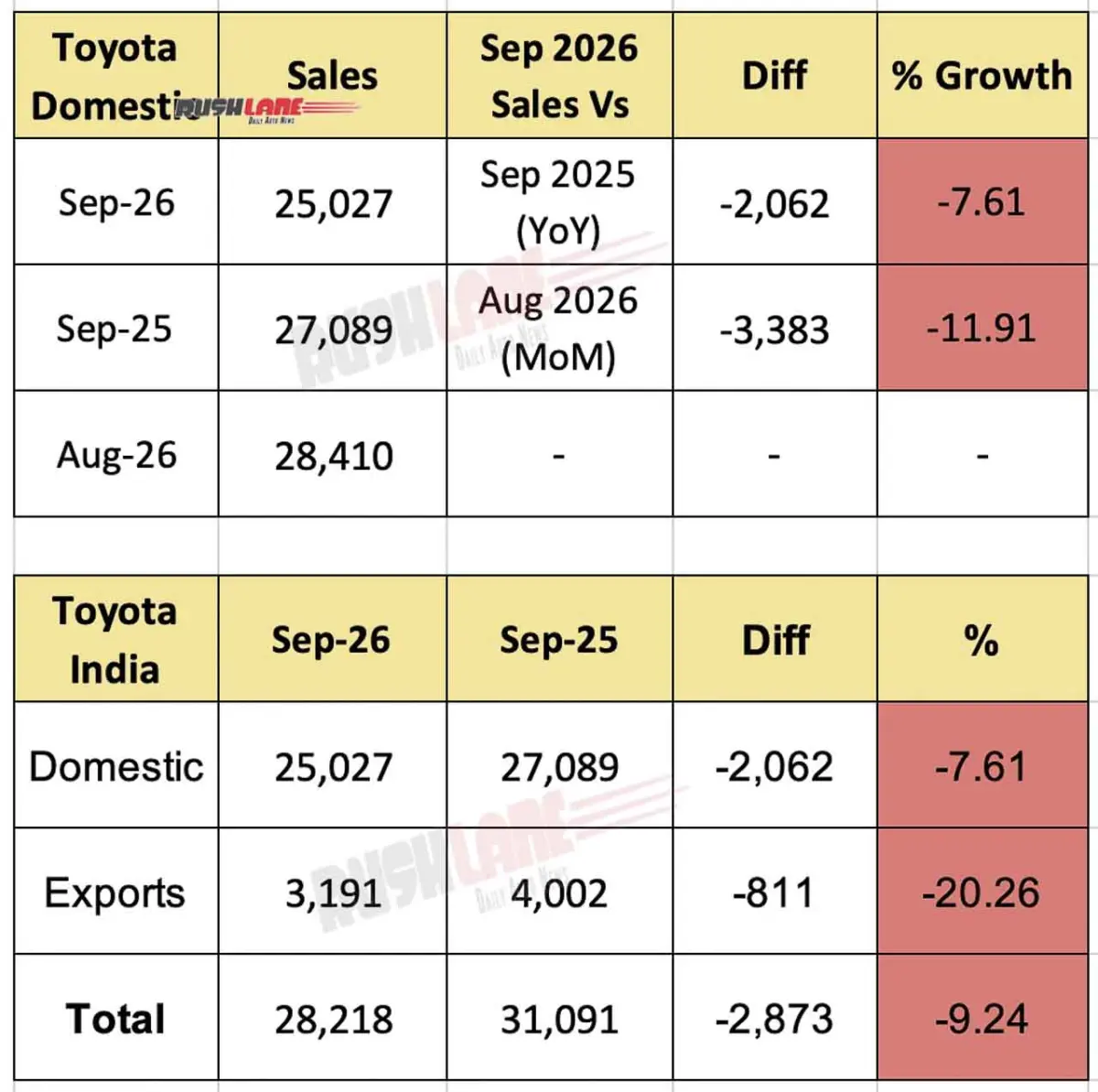
In September 2026, Toyota Kirloskar Motor recorded a domestic sales volume of 25,027 units. This represents a 7.61% decline compared to the 27,089 units sold in September 2025. The contraction is even more pronounced when viewed sequentially; compared to August 2026’s domestic sales of 28,410 units, the company saw an 11.91% drop, translating to a reduction of 3,383 vehicles in just thirty days.
The downturn was not limited to the domestic market. Toyota’s export operations, which have historically been a secondary but stable pillar for the Indian arm, faced a sharp decline. Overseas shipments for September 2026 stood at 3,191 units, a 20.26% fall from the 4,002 units exported in the same month the previous year.
Total Combined Volumes
When combining domestic sales and exports, Toyota’s total volume for September 2026 reached 28,218 units. This is a 9.24% decrease from the 31,091 units recorded in September 2025. Of the total shortfall of 2,873 units, the domestic market was responsible for roughly 72% of the decline, while the remaining 28% was attributed to the slump in exports.
2. Third Quarter Analysis (July–September 2026)
The performance in September capped off a challenging third quarter (Q3) for TKM. During the July–September 2026 period, the company moved 93,576 vehicles across both domestic and international markets. This figure marks a 4.42% decline from the 97,902 units sold during the corresponding quarter in 2025.
The Export Factor in Q3
A deeper dive into the quarterly data reveals that the export sector was the primary drag on overall performance.
- Q3 2026 Exports: 9,623 units
- Q3 2025 Exports: 12,352 units
- Percentage Change: -22.09%
The reduction of 2,729 export units accounted for approximately 63% of the total quarterly shortfall. This suggests that while domestic demand showed signs of softening, the external global markets—potentially impacted by supply chain reorientations or shifting demand in emerging markets—posed a more significant challenge for Toyota’s Indian manufacturing hubs during the monsoon months.

3. The Broader Perspective: Year-to-Date (YTD) Resilience
Despite the recent monthly and quarterly setbacks, the cumulative data for the first nine months of 2026 paints a far more optimistic picture for the Japanese automaker. Between January and September 2026, Toyota Kirloskar Motor achieved total sales of 2,94,914 units.
Compared to the 2,72,824 units sold during the same period in 2025, this represents an 8.10% growth. This YTD resilience is driven almost entirely by the strength of the Indian domestic market earlier in the calendar year.
YTD Domestic vs. Export Breakdown
- Domestic YTD: Sales rose by 9.12%, reaching 2,69,619 units (up from 2,47,081 in 2025). This indicates an addition of 22,538 vehicles to the Indian roads over the nine-month span.
- Export YTD: Overseas shipments totaled 25,295 units, a marginal decline of 1.74% compared to the 25,743 units in the previous year.
The fact that YTD domestic growth remains near double digits suggests that the core appeal of the Toyota brand—anchored by stalwarts like the Innova Hycross, Fortuner, and the Urban Cruiser Hyryder—remains intact despite the recent September "speed bump."
4. Official Response and Festive Season Strategy
Addressing the sales performance, Sabari Manohar, Executive Vice President of Sales-Service-Used Car Business at Toyota Kirloskar Motor, maintained a positive outlook. He emphasized that the brand continues to see sustained interest from consumers across various segments, largely due to Toyota’s reputation for Quality, Durability, and Reliability (QDR).
Manohar noted that the company is currently focused on optimizing its dealer network and enhancing customer engagement strategies as India enters the high-stakes festive season. This period, which includes major festivals like Dussehra and Diwali, typically accounts for a significant portion of annual automotive sales in India.
"We are working closely with our dealer partners to ensure that we are meeting the evolving requirements of our customers," Manohar stated. "Our focus remains on delivering a seamless ownership experience and ensuring that our product lineup remains the preferred choice for Indian families and businesses alike."
5. Market Implications and Future Outlook
The recent dip in sales performance raises several questions about the current state of the Indian automotive market and Toyota’s specific positioning within it.
The Hybrid and SUV Dominance
Toyota’s strategy in India has shifted heavily toward hybrid technology and SUVs. The Innova Hycross and the Urban Cruiser Hyryder have been instrumental in driving the YTD growth. However, high waiting periods for these popular models may be causing some "order book fatigue" among consumers, leading them to explore alternatives if delivery timelines are too extended.

The Role of Strategic Partnerships
A significant portion of Toyota’s volume in India comes from its global partnership with Suzuki. Models like the Glanza and the Hyryder (shared platforms with Maruti Suzuki) allow Toyota to maintain a presence in high-volume segments. The upcoming launch of the updated Glanza on October 14th is expected to provide a much-needed boost to October’s numbers. The Glanza, which will receive updates mirrored by its sibling, the Baleno, is a critical entry-point model for attracting younger, first-time Toyota buyers.
Competitive Pressures
The 7.61% domestic decline in September also reflects a broader trend of inventory management across the industry. With several manufacturers reporting high stock levels at dealerships, Toyota may be calibrating its dispatches to ensure a healthy "demand-supply" balance ahead of the festive rush. Furthermore, the entry of new competitors in the SUV and MPV spaces has intensified the battle for market share, requiring Toyota to lean harder on its service reputation and resale value.
Export Vulnerability
The 20% drop in September exports is a point of concern for Toyota’s role as a global manufacturing hub. Factors such as fluctuating demand in Middle Eastern and African markets, or logistical bottlenecks at major ports, could be contributing to this volatility. For Toyota to maintain its 8.10% annual growth rate, stabilizing the export arm will be as crucial as stimulating domestic demand.
6. Conclusion: A Pivot Toward a Stronger Q4?
Toyota Kirloskar Motor finds itself at a crossroads as it enters the final quarter of 2026. While the September and Q3 figures suggest a period of cooling, the massive 2.94 lakh units sold YTD prove that the brand’s foundation in India is stronger than ever.
The upcoming weeks will be telling. If the updated Glanza launch and the festive season marketing blitz can convert high customer interest into actual deliveries, Toyota is well-positioned to end 2026 with record-breaking annual figures. However, the company must remain vigilant regarding its export volumes and domestic inventory levels to ensure that the September slump remains a temporary outlier rather than a long-term trend.
For now, the industry’s eyes are on October 14th, as the new Glanza arrives to test whether Toyota can recapture its momentum and steer back toward the high-growth lane.
