

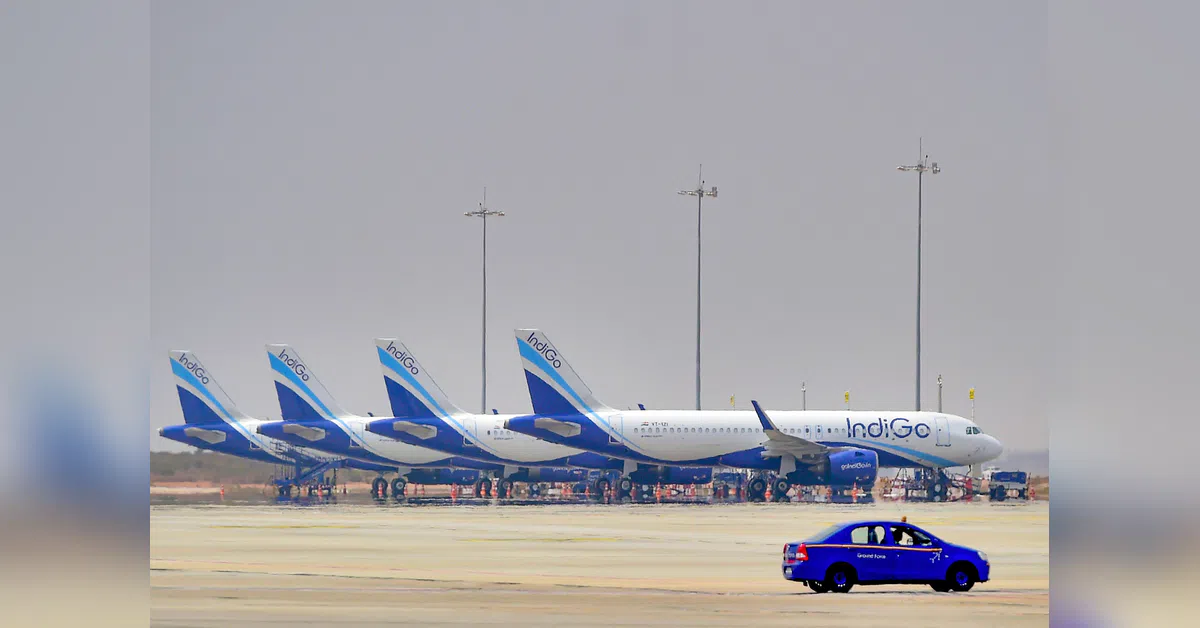
NEW DELHI — InterGlobe Aviation Ltd, the parent company of India’s dominant low-cost carrier IndiGo, has reported a significant financial setback for the fourth quarter of the 2025-26 fiscal year. Despite maintaining a lion’s share of the domestic market and seeing a modest increase in total income, the airline swung to a net loss of ₹2,536.9 crore for the quarter ending March 31, 2026.
This result stands in stark contrast to the same period in the previous fiscal year (Q4FY25), when the airline posted a robust profit of ₹3,067.5 crore. The dramatic reversal highlights the volatility of the aviation sector, where operational efficiency is frequently at the mercy of currency fluctuations, regulatory shifts, and global supply chain pressures.
The Core Financials: A Paradox of Growth and Loss
The financial results for Q4FY26 present a complex picture of an airline that is growing in scale but struggling with bottom-line sustainability due to external factors.
Revenue and Income Trends
IndiGo’s total income for the January-March 2026 quarter rose to ₹23,830.7 crore, representing a 3.2% increase compared to the ₹23,097.5 crore reported in the year-ago period. This growth suggests that demand for air travel remains resilient and that IndiGo’s aggressive capacity expansion is successfully capturing passenger interest.
The Profitability Gap
However, the rise in revenue was entirely overshadowed by a surge in expenses and non-operational hits. The net loss of ₹2,536.9 crore (approximately ₹25.37 billion) was primarily attributed to an "exceptionally sharp" depreciation of the Indian Rupee against the US Dollar. In the aviation industry, a significant portion of costs—including aircraft leases, maintenance contracts, and fuel—are denominated in dollars, making the bottom line highly sensitive to exchange rate volatility.
Full-Year Performance
For the entirety of the 2025-26 fiscal year (FY26), the airline’s capacity grew by 9.5%, and total income increased by over 6%. Perhaps the most telling statistic provided by the management was the "normalized" profit: excluding the impact of foreign exchange and exceptional items, IndiGo would have delivered a profit of ₹7,500 crore (₹75 billion). This indicates that the airline’s core business model remains profitable, even as external "black swan" events erode its actual earnings.
Chronology of a Turbulent Fiscal Year
The 2025-26 fiscal year was far from a smooth flight for India’s largest carrier. To understand the Q4 loss, one must look at the sequence of events that shaped the year.
- Q1 & Q2 FY26: The Expansion Phase: The year began with high hopes as IndiGo continued its international expansion, adding new destinations in Central Asia and Southeast Asia. Capacity growth was steady, and the airline continued to take delivery of new Airbus A320neo family aircraft.
- Q3 FY26: The Regulatory Shift: Midway through the year, the Indian aviation sector faced significant changes in labor laws, particularly concerning Flight Duty Time Limitations (FDTL) for pilots and cabin crew. These changes, aimed at reducing fatigue and enhancing safety, required airlines to increase their crew strength and adjust schedules, leading to higher personnel costs and operational complexities.
- Q4 FY26: The Perfect Storm: The final quarter saw the convergence of several negative factors. The Indian Rupee hit record lows against the Dollar, while global geopolitical tensions kept jet fuel prices volatile. Additionally, the "challenging operating environment"—a term often used to describe airport congestion and supply chain delays for engine parts—reached a crescendo in the March quarter.
Supporting Data: Operational Metrics and Market Position
Despite the financial loss, IndiGo’s operational metrics continue to dwarf its competitors, solidifying its position as the "Goliath" of Indian skies.
Market Share Dominance
As of March 2026, IndiGo’s domestic market share stood at a commanding 63.3%. This level of dominance is almost unprecedented in a major global aviation market, effectively creating a "near-monopoly" or a "duopoly" environment alongside the consolidated Air India group (including Vistara and Air India Express).
Yields and Load Factors
While specific yield data (revenue per passenger kilometer) for the quarter was not fully detailed in the preliminary release, the 3% rise in total income against a backdrop of increased capacity suggests that yields may have come under pressure. High competition on trunk routes and the necessity to fill increased seat capacity often lead to aggressive pricing, which can thin out margins.
Stock Market Reaction
The investor community reacted swiftly to the news. Shares of InterGlobe Aviation fell 3.27% on the BSE, closing at ₹4,418.40. Analysts suggest that while the market was aware of the rupee’s weakness, the scale of the loss—exceeding ₹2,500 crore—surprised many who had expected the airline’s scale to provide a better hedge against such losses.
Official Responses: Management’s Perspective
Rahul Bhatia, the Managing Director of IndiGo, remained pragmatic in his assessment of the year’s performance, emphasizing the distinction between operational success and macroeconomic misfortune.

"FY26 was marked by an exceptionally challenging operating environment, which materially impacted its profitability," Bhatia stated in the official release. He highlighted that the fundamental machinery of the airline is functioning well, as evidenced by the 9.5% capacity growth.
Bhatia’s focus on the ₹7,500 crore profit (excluding FX and exceptional items) serves as a message to shareholders that the airline’s strategy of aggressive growth and cost-plus-efficiency is still working. The loss, in the management’s view, is an accounting and macroeconomic reality rather than a failure of the business strategy itself.
"Exceptionally sharp rupee depreciation, changes in labour laws, and a challenging operating environment offset the operational profit," the company release added, further clarifying that the loss was driven by factors largely outside the airline’s immediate control.
Implications for the Indian Aviation Industry
The financial health of IndiGo is often seen as a bellwether for the entire Indian aviation sector. A loss of this magnitude for the market leader carries several broader implications.
1. The Cost of Regulatory Compliance
The mention of "changes in labor laws" as a contributing factor to the loss is significant. As India aligns its aviation safety standards with global best practices, the cost of human capital is rising. For an airline that operates over 2,000 flights a day, even a minor increase in crew requirements per aircraft translates into hundreds of crores in additional annual expenditure.
2. The Rupee Vulnerability
IndiGo’s results underscore the extreme vulnerability of Indian carriers to the US Dollar. Until Indian airlines can generate a significantly higher portion of their revenue in foreign currencies (through international expansion), they will remain at the mercy of the USD-INR exchange rate. This likely explains IndiGo’s recent push toward long-haul international flights and the order for wide-body aircraft like the Airbus A350.
3. Supply Chain Fragility
The "challenging operating environment" likely refers to the ongoing global crisis regarding aircraft engines. IndiGo has had dozens of aircraft grounded due to issues with Pratt & Whitney engines. While the airline receives compensation from the engine makers, the loss of potential revenue and the cost of leasing "wet-lease" aircraft (hiring planes along with crew) to fill the gap are expensive stop-gap measures.
4. Competitive Landscape
With IndiGo posting a loss despite a 63% market share, the financial situation for smaller players is likely even more precarious. This could lead to further consolidation in the industry or a shift in pricing strategies across the board. If the market leader cannot turn a profit under current conditions, ticket prices may need to rise significantly in the coming quarters to offset operational costs.
Conclusion: Navigating the Headwinds
IndiGo’s Q4FY26 results are a stark reminder that in the airline business, operational excellence is only half the battle. The other half is fought in the treasury departments and through the management of macroeconomic risks.
While the ₹2,536.9 crore loss is a heavy blow, the airline’s massive cash reserves and its "Ex-FX" profitability suggest it is well-positioned to weather the storm. The focus for the next fiscal year will likely be on "natural hedging"—increasing international revenue to balance dollar-denominated costs—and continuing to optimize the fleet to mitigate the impact of labor law changes.
For now, the "Cool Blue" carrier remains the undisputed king of Indian airspace, but it is a king that must now navigate a much more expensive and volatile kingdom. As the industry moves into FY27, all eyes will be on whether IndiGo can translate its massive market share into the consistent profitability that investors have come to expect.
