

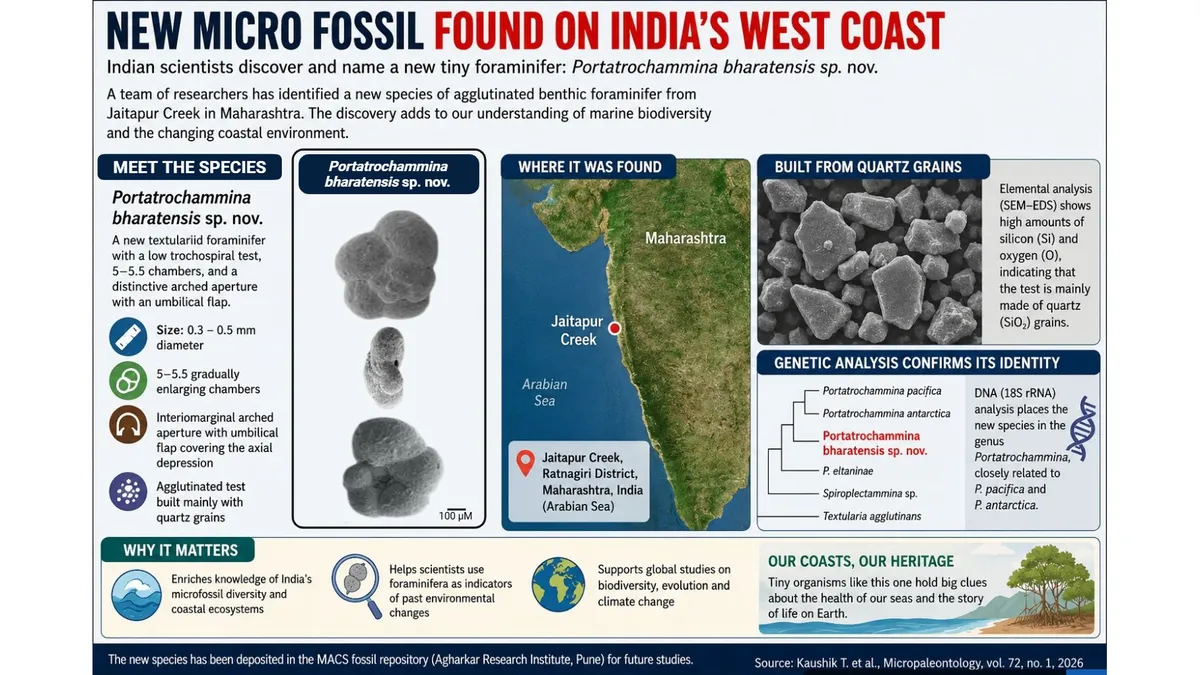
PUNE, MAHARASHTRA – In the quiet, sediment-rich waters of Jaitapur Creek along the Konkan coast, a discovery has been made that bridges the gap between ancient evolutionary history and modern environmental science. A research team from the Agharkar Research Institute (ARI) in Pune has identified a previously unknown species of foraminifera—a group of single-celled organisms that have survived five mass extinctions.
The new species, named Portatrochammina bharatensis, serves as a testament to the hidden biodiversity of India’s maritime borders. Measuring less than half a millimeter, these microscopic "architects" construct sophisticated shells from grains of sand, providing scientists with a window into the health of coastal ecosystems and the history of our planet’s climate.
Main Facts: An Architect in a Grain of Sand
Foraminifera, or "forams," are among the most resilient and abundant organisms on Earth. While they are single-celled protists, they are far from simple. The newly discovered Portatrochammina bharatensis belongs to a specific category known as "agglutinated" foraminifera. Unlike species that secrete calcium carbonate to form shells, P. bharatensis acts as a master mason, physically scavenging mineral grains from its environment and cementing them together to create a protective housing called a "test."
The discovery, led by Dr. Tushar Kaushik, a prominent scientist at the ARI’s Biodiversity & Palaeobiology Group, highlights several key characteristics of the species:
- Size: Between 0.3 and 0.5 millimeters (300 to 500 microns).
- Composition: Primarily quartz-based armor, selected for its chemical stability and physical hardness.
- Habitat: Benthic (bottom-dwelling) sediments in the Jaitapur Creek, Ratnagiri district.
- Etymology: The name bharatensis is derived from "Bharat," the ancient Sanskrit name for India, marking its status as a unique find within the nation’s territorial waters.
Chronology of the Discovery
The journey toward the description of P. bharatensis began in the field and concluded in the high-tech laboratories of Pune.

January 2023: The Field Expedition
The initial samples were collected in early 2023. Dr. Tushar Kaushik and PhD researcher Ms. Vaishnavi Dixit traveled to Jaitapur Creek, an estuary characterized by its dense mangrove forests and complex tidal patterns. Using specialized sampling equipment, the team extracted marine sediment from approximately six meters below the water’s surface.
Jaitapur was chosen not only for its natural beauty but for its ecological sensitivity. As the site of a proposed major nuclear power project, establishing a baseline of the existing microorganisms is critical for future environmental impact assessments.
Mid-2023 to Late 2024: Laboratory Analysis and "Cryptic Diversity"
Upon returning to the ARI, the team began the painstaking process of sorting through thousands of sand grains. Foraminifera are often indistinguishable from the sediment they inhabit. Under the microscope, the researchers noticed a specific coiled structure that did not match known local species.
However, the team faced the challenge of "cryptic diversity"—a phenomenon where two different species look nearly identical under a standard microscope. To overcome this, the researchers spent months conducting molecular analysis and high-resolution imaging to confirm that this was indeed a new branch on the tree of life.
June 2026: Formal Announcement
After rigorous peer review and genetic mapping, the findings were officially published, introducing Portatrochammina bharatensis to the global scientific community.

Supporting Data: The Science of the "Quartz Shield"
The ARI team utilized a multi-disciplinary approach to validate their discovery, combining traditional taxonomy with cutting-edge technology.
Genetic Barcoding
The most definitive evidence came from the sequencing of the 18S ribosomal RNA gene. In the world of microbiology, this gene acts as a "biological barcode." By comparing the genetic sequence of the Jaitapur specimens with global databases, the researchers found a distinct signature.
Phylogenetic trees—computational models that map evolutionary relationships—revealed that while P. bharatensis is a unique species, it shares a common ancestry with Portatrochammina pacifica (found in the Pacific Ocean) and Portatrochammina antarctica (found in the frigid waters of the Southern Ocean). This genetic link suggests a fascinating evolutionary journey across hemispheres over millions of years.
Scanning Electron Microscopy (SEM-EDS)
To understand how the organism builds its home, the team used Scanning Electron Microscopy (SEM) combined with Energy-Dispersive X-ray Spectroscopy (EDS). This allowed them to see the shell at a magnification of thousands of times and determine its elemental composition.
The analysis revealed that P. bharatensis is highly selective. Despite a variety of minerals being available in the Jaitapur sediment, the organism predominantly chooses quartz grains. Quartz is incredibly hard and chemically inert. By gluing these grains together with an organic "cement," the foram creates a suit of armor capable of withstanding the high-energy environment of the Indian monsoon and the fluctuating salinity of an estuarine creek.

Official Responses and Researcher Perspectives
The discovery has been met with enthusiasm within the Indian scientific community, as it underscores the need for continued investment in "small-scale" biology.
Dr. Tushar Kaushik, the lead scientist, emphasized the philosophical and practical weight of the find. "This diminutive creature, no bigger than a grain of sand, yet equipped with a quartz shield and a genome that tells an evolutionary story spanning millions of years, serves as a powerful reminder," Kaushik stated. "Some of nature’s most remarkable innovations are hiding in plain sight, right beneath the waves."
Ms. Vaishnavi Dixit, a PhD student at ARI and a key member of the study, highlighted the environmental importance of the research. "Understanding what lives in our coastal sediments is essential for environmental monitoring, pollution assessment, and conservation planning," Dixit noted. She pointed out that foraminifera are "bio-indicators"—their presence, absence, or shell deformities can alert scientists to changes in water quality or the presence of heavy metals long before larger animals show signs of distress.
Implications: Why a Tiny Shell Matters for the Future
The discovery of Portatrochammina bharatensis carries significant implications for several fields of study, ranging from climate change to industrial development.
1. Environmental Monitoring at Jaitapur
As Jaitapur is the designated site for a massive nuclear power installation, the documentation of P. bharatensis provides a crucial "Time Zero" data point. Should the local environment change due to industrial activity, temperature shifts in the water, or sediment disruption, scientists can use the population of this new species as a metric to measure ecological impact.

2. Paleoclimatology and Oil Exploration
Foraminifera shells are essentially "time capsules." When they die, their shells sink and become part of the fossil record. Geologists use these fossils to reconstruct what the Earth’s climate was like millions of years ago. Furthermore, because certain species of forams are only found in specific geological conditions, they are used by the petroleum industry to identify the age of rock layers and locate potential oil reserves. The identification of a new species adds a new tool to the geologist’s kit for dating Indian coastal sediments.
3. Protecting the "Invisible" Biodiversity
India possesses a coastline of over 7,500 kilometers, yet much of its microscopic life remains uncatalogued. Most conservation efforts focus on "charismatic megafauna" like tigers or dolphins. However, the discovery of P. bharatensis reminds the public and policymakers that the foundation of the marine food web consists of these microscopic organisms. They recycle nutrients and serve as a primary food source for larger marine life.
4. Advancing Modern Taxonomy
The study serves as a model for modern taxonomic research in India. By integrating morphological study (how it looks) with molecular biology (its DNA) and chemical analysis (what it’s made of), the ARI team has set a high standard for how new species should be described in the 21st century.
Conclusion
The discovery of Portatrochammina bharatensis along the Konkan coast is more than just the addition of a name to a biological catalog. It is a reminder of the complexity of the natural world and the resilience of life. In an era of rapid climate change and industrial expansion, the work of Dr. Kaushik and his team at the Agharkar Research Institute highlights the vital importance of looking closer—down to the very grains of sand—to understand the past, monitor the present, and protect the future of our oceans.
As researchers continue to explore the mudflats and estuaries of Maharashtra, it is almost certain that P. bharatensis is only the first of many microscopic wonders waiting to be brought into the light of science.
