

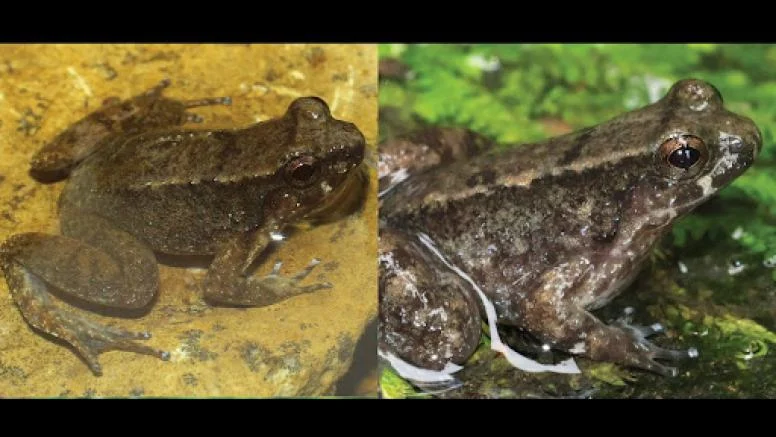
MEGHALAYA — In the dense, emerald canopies of Northeast India, where the monsoon rains feed a thousand hidden streams, a significant biological secret has been unveiled. A dedicated researcher has identified a new species of amphibian, the Western Trickle Frog (Ingerana occidens), lurking in the Garo and Khasi Hills of Meghalaya. This discovery, emerging from a rigorous two-year study, underscores the profound role that geography plays in the evolution of life and highlights how much of India’s biodiversity remains shrouded in mystery.
The discovery, led by R. S. Naveen, a researcher from Australia’s Griffith University, challenges previous taxonomic assumptions. For decades, the frog populations in this region were grouped with their northern cousins. However, through a combination of traditional field tracking and modern genomic sequencing, the veil has been lifted, revealing a distinct evolutionary lineage that has been hiding in plain sight.
Main Facts: The Identification of Ingerana occidens
The Western Trickle Frog, scientifically christened Ingerana occidens, belongs to a group of amphibians known for their preference for the "trickling" water of forest floors and rocky stream margins. The identification of this species is not merely the addition of a name to a list; it is a correction of a long-standing geographical oversight.
Until recently, scientists believed that the populations of Ingerana frogs spanning the regions of Northeast India belonged to a single, widespread species known as Ingerana borealis. However, the new study proves that the populations found south of the Brahmaputra River—specifically in the Garo and Khasi Hills—are genetically and morphologically distinct.
Key Distinguishing Features
The Western Trickle Frog is characterized by several unique physical traits that set it apart from its northern relative:
- Diminutive Size: The species is notably smaller than I. borealis. Adult females reach a maximum length of approximately 26 millimeters, making them tiny inhabitants of the leaf litter.
- Skin Texture: Unlike the heavily wrinkled and corrugated skin of the northern species, I. occidens possesses relatively smooth skin with only localized, mild wrinkling.
- Visible Tympanum: One of the most striking anatomical differences is the eardrum, or tympanum. In I. occidens, the eardrum is clearly visible and protruding, topped by a prominent fold of skin. In contrast, the eardrum of the northern species is nearly invisible to the naked eye.
- Lateral Stripe: The new species features a distinct stripe of contrasting color running down its side, a visual marker that helps distinguish it during field surveys.
Chronology: From a Geographic Hunch to Genomic Confirmation
The journey toward this discovery began not in a lab, but with an observation of the map. R. S. Naveen’s research was driven by a fundamental principle of biogeography: the "River Barrier Hypothesis."
The 2024-2025 Field Surveys
Between 2024 and 2025, Naveen conducted extensive field surveys across the rugged terrain of Meghalaya. These expeditions often required nocturnal treks into the heart of the Garo and Khasi Hills, as these frogs are most active under the cover of darkness and the humidity of the night.
The primary focus was to collect specimens from the southern banks of the Brahmaputra. The Brahmaputra is one of the world’s largest rivers, and for small, moisture-dependent creatures like frogs, it represents a nearly impassable wall. Over millions of years, such barriers can lead to "allopatric speciation," where isolated populations evolve independently because they can no longer interbreed with their counterparts on the other side.
The Laboratory Breakthrough
Once the specimens were collected, the research shifted to Griffith University in Australia. Here, Naveen employed molecular phylogenetics—the study of evolutionary relationships among biological entities—to analyze the frogs’ DNA.
The results were staggering. The genetic analysis revealed an 18% difference in the mitochondrial DNA between the southern frogs and the "topotypic" Ingerana borealis (frogs from the original location where the species was first described) found north of the river. In the world of herpetology, a genetic gap of 3% to 5% is often enough to suggest a new species; an 18% divergence indicates a deep, ancient separation that likely occurred millions of years ago.

Supporting Data: The Science of Speciation
The discovery of Ingerana occidens is supported by two primary pillars of evidence: morphology (physical form) and molecular biology.
Genomic Divergence
The 18% genetic distance is the "smoking gun" of this study. This level of divergence suggests that the Brahmaputra River has functioned as a stable barrier for a vast geological timeframe. While birds might fly over it and large mammals might occasionally swim across, the trickle frog—which relies on specific micro-habitats and is sensitive to the salinity and turbulence of major waterways—remained trapped in the hills of Meghalaya.
Comparative Morphology
In addition to DNA, the study utilized detailed measurements (morphometrics). Researchers compared the ratio of limb length to body size, the shape of the snout, and the structure of the digits.
- Ingerana borealis (Northern): Large, robust, heavily wrinkled, hidden tympanum.
- Ingerana occidens (Southern): Small, slender, smooth skin, prominent tympanum, distinctive lateral coloration.
The name occidens is derived from Latin, meaning "west." This refers to the species’ geographic position as the westernmost known representative of its genus in this specific ecological corridor.
Official Responses and Expert Perspectives
While the discovery has been met with excitement in the scientific community, it also brings a sense of urgency regarding the conservation of the Indo-Burma biodiversity hotspot.

The Researcher’s View
R. S. Naveen has noted that the discovery emphasizes the "taxonomic vacuum" that exists in Northeast India. In public statements following the identification, the researcher highlighted that finding a widespread and distinct species in a region already subjected to decades of study suggests that our current inventory of life is woefully incomplete.
Academic Significance
Experts in Indian herpetology have pointed out that Meghalaya is a "biodiversity gateway." The state serves as a bridge between the Himalayan foothills and the Southeast Asian tropics. The identification of I. occidens provides crucial data for those studying how the collision of the Indian tectonic plate with Asia created the unique drainage basins that drive evolution in the region.
Griffith University officials have lauded the study as a prime example of international collaboration, utilizing Australian genomic facilities to solve biological puzzles in the Indian subcontinent.
Implications: Conservation and the Future of the Indo-Burma Hotspot
The discovery of the Western Trickle Frog has profound implications for environmental policy and conservation strategy in Meghalaya and beyond.
Redefining Conservation Zones
Prior to this discovery, conservationists might have assumed that protecting Ingerana frogs in the north was sufficient to preserve the entire lineage. We now know that the frogs in the Garo and Khasi Hills are a unique evolutionary treasure. If the habitat in Meghalaya is destroyed, we lose a species that exists nowhere else on Earth.

Threats to the Habitat
The Garo and Khasi Hills face significant environmental pressures:
- Limestone Mining: Meghalaya is rich in minerals, and mining operations can alter the "trickle" streams these frogs depend on.
- Deforestation: The expansion of agriculture and timber harvesting reduces the canopy cover, leading to the drying out of the forest floor.
- Climate Change: As a species highly sensitive to moisture and temperature, I. occidens is a "canary in the coal mine" for the impacts of global warming on mountain ecosystems.
The "Biodiversity Paradox"
This discovery highlights a paradox: we are discovering new species at the same time we are losing habitats at an unprecedented rate. The fact that a distinct species was found in a "heavily explored" area suggests that many other amphibians, insects, and plants may go extinct before they are ever given a name.
Future Research Directions
The identification of I. occidens opens new doors for research. Scientists are now interested in studying the frog’s specific call—the bioacoustics—which often differs between species and serves as a primary mechanism for mate selection. Understanding the breeding cycle and the tadpole stage of the Western Trickle Frog will be the next step in ensuring its long-term survival.
Conclusion
The Western Trickle Frog is more than just a small amphibian in a remote forest; it is a testament to the resilience and complexity of nature. Its discovery reminds us that the mighty Brahmaputra is not just a provider of water and life, but a sculptor of evolution, carving the biological destiny of the species on its banks.
As R. S. Naveen and the team at Griffith University continue their work, the story of Ingerana occidens serves as a call to action. It beckons scientists, policymakers, and the public to look closer at the world around them. In the "Abode of Clouds," beneath the ferns and beside the quiet trickling streams, there are still wonders waiting to be found—provided we protect the stage upon which they play their part in the grand theater of life.
