

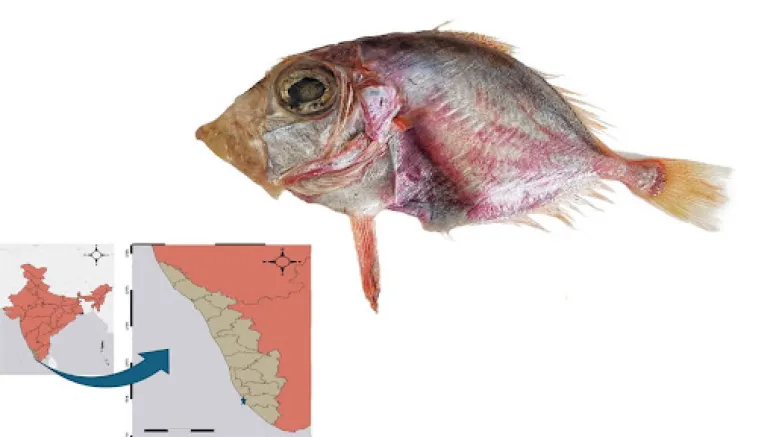
The deep oceans have long been considered the final frontier of biological discovery on Earth. Beneath the sunlit waves of the surface lies the "Twilight Zone"—a region of perpetual gloom where pressure is immense and temperatures hover just above freezing. It is in this mysterious realm, off the southwest coast of India, that marine scientists have recently unveiled a secret: a new species of deep-sea fish that has remained hidden from science until now.
Researchers from the ICAR-Central Marine Fisheries Research Institute (CMFRI) have officially identified Cyttopsis indica, commonly referred to as the Indian Dory. This discovery, centered in the waters of the eastern Lakshadweep Sea, serves as a poignant reminder of the staggering biodiversity that resides within India’s Exclusive Economic Zone (EEZ) and highlights the critical importance of deep-sea research in the 21st century.
Main Facts: The Emergence of Cyttopsis indica
The Indian Dory is a member of the family Parazenidae, a group of fish known for their distinctive, somewhat flattened bodies and large eyes adapted for the low-light conditions of the mesopelagic and bathypelagic zones. While dories are found in various oceans across the globe, the identification of Cyttopsis indica marks a significant milestone for Indian ichthyology.
The species was discovered during routine biodiversity monitoring at the Sakthikulangara Fisheries Harbour in Kollam, Kerala. These surveys are part of an ongoing effort by CMFRI to document the marine life brought in by commercial fishing vessels. The specimens were retrieved from depths ranging between 350 and 500 meters along the continental slope. This depth represents the upper reaches of the deep sea, where the last vestiges of sunlight fade into total darkness.
Physically, Cyttopsis indica is a striking creature. It possesses a uniform rosy to silvery-pink hue, lacking the prominent dark spots that characterize some of its Pacific relatives. It is a relatively small fish, but its discovery carries heavy weight in the scientific community, as it represents a "cryptic species"—one that looks remarkably similar to known species but is genetically and morphologically distinct.

Chronology: From the Ocean Floor to the Laboratory
The journey to the official naming of Cyttopsis indica began not in a high-tech submersible, but on the bustling docks of a Kerala fishing harbor.
The Initial Collection
In late 2023 and early 2024, commercial deep-sea trawlers operating out of Sakthikulangara returned from the Lakshadweep Sea with unusual catches. These trawlers, equipped to handle the rugged terrain of the continental slope, often inadvertently collect "bycatch"—species that are not the primary commercial target but are of immense value to scientists.
Field Identification
During a routine inspection, CMFRI researchers noticed a group of dories that didn’t quite fit the description of the Cyttopsis rosea (the Rosy Dory) or Cyttopsis cypho (the Little Dory). While the differences were subtle, the keen eyes of the marine biologists noted variations in coloration and body proportions. The specimens were preserved and transported to the CMFRI laboratories for a more rigorous examination.
The Laboratory Phase
Over several months, the research team conducted a two-pronged investigation. First, they performed a detailed morphological analysis, counting scales, measuring fin spines, and comparing body ratios against historical records of dories from the Atlantic and Pacific Oceans. Second, they moved into the realm of molecular biology, extracting DNA to see if the genetic code told a different story than the physical appearance.
Formal Recognition
After verifying that the genetic divergence was significant and the physical traits were consistent across multiple specimens, the team prepared their findings for peer review. The species was officially named Cyttopsis indica, a tribute to the Indian Ocean, and the discovery was published in July 2026, adding a new leaf to the tree of life.

Supporting Data: The Science of Integrated Taxonomy
The identification of Cyttopsis indica was made possible through "integrated taxonomy," a modern approach that combines traditional physical observation with cutting-edge genetic sequencing.
Morphological Distinctions
The researchers identified several key physical markers that set the Indian Dory apart:
- Fin Structure: The species possesses two hard spines in its anal fin, a configuration that differs from several other members of the Parazenidae family.
- Scale Count: A definitive characteristic was the lateral line scale count. Cyttopsis indica features between 68 and 78 scales along this sensory organ, a specific range that distinguishes it from its closest relatives.
- Cranial Features: The fish has a wider space between its eyes (interorbital width) and a shorter post-orbital length (the area of the head behind the eyes) compared to the Atlantic Rosy Dory.
- Coloration: Unlike the Pacific Little Dory, which often displays a conspicuous black spot on its flank, the Indian Dory maintains a consistent rosy-pink or silvery sheen across its body.
Genetic Evidence (DNA Barcoding)
The most definitive proof came from the DNA. By analyzing a specific mitochondrial gene used for DNA barcoding, the researchers compared Cyttopsis indica to its global cousins. The results were conclusive:
- The genetic distance between the Indian Dory and its closest relatives ranged from 4.6% to 11%.
- In the world of ichthyology, a genetic divergence of this magnitude is a "smoking gun" for the designation of a new species. It proves that the Indian Dory has been evolutionarily isolated from the Atlantic and Pacific populations for millions of years.
Official Responses: CMFRI and the Future of Indian Marine Science
The discovery has been met with enthusiasm by the leadership at ICAR-CMFRI and the broader Indian scientific community. Officials emphasize that this find is not merely a taxonomic curiosity but a vital piece of the puzzle in understanding India’s marine wealth.
"The discovery of Cyttopsis indica is a testament to the richness of our deep-sea ecosystems," stated a senior researcher involved in the study. "It underscores the fact that we have only scratched the surface of what lies in the Indian Ocean’s twilight zone. Our harbors are often the first point of contact with these mysterious species, and our integrated taxonomic approach allows us to identify them with unprecedented accuracy."

CMFRI officials have also noted that such discoveries are crucial for the "Blue Economy" initiative. As India looks toward the ocean for sustainable resources, knowing exactly what species inhabit these waters is the first step toward effective management. The "Indica" moniker was chosen intentionally to assert the importance of the Indian Ocean as a unique biological province that requires its own dedicated conservation strategies.
Implications: Why the Indian Dory Matters
The discovery of a new fish species in 2026 might seem like a small win in the face of global environmental challenges, but its implications are profound.
1. Understanding Cryptic Diversity
The Indian Dory is a classic example of cryptic diversity—where different species are "hidden" under a similar appearance. Without DNA barcoding, Cyttopsis indica might have been dismissed as a mere regional variation of a known fish. Recognizing these differences is vital for biodiversity tallies; if we don’t know a species exists, we cannot track its population or protect it from extinction.
2. The Vulnerability of the Deep Sea
The fact that these fish were collected by commercial trawlers at depths of 500 meters highlights the increasing reach of human activity. The deep sea is a slow-growing, low-energy environment. Species living here often take longer to mature and have lower reproductive rates than surface fish. The discovery of Cyttopsis indica reminds us that deep-sea fishing could be impacting species we haven’t even named yet.
3. Climate Change and Range Shifts
As ocean temperatures rise, many marine species are shifting their ranges toward the poles or into deeper, cooler waters. Documenting the current distribution of species like the Indian Dory provides a baseline. Future scientists will use this data to determine how deep-sea communities are responding to the warming of the Indian Ocean.

4. Strengthening India’s Maritime Heritage
By naming the fish indica, the researchers have anchored this species to the national identity of India’s natural history. It encourages a sense of stewardship over the Lakshadweep Sea, an area that is increasingly becoming a focal point for both tourism and scientific exploration.
Conclusion: The Unfinished Map of the Deep
The discovery of Cyttopsis indica by the scientists at ICAR-CMFRI is a victory for meticulous, boots-on-the-ground (or fins-in-the-water) science. It highlights the incredible value of monitoring commercial fisheries as a way to peek into the deep ocean without the multi-million-dollar cost of deep-sea submersibles.
As the sun sets over the Sakthikulangara Fisheries Harbour, the work continues. For every Cyttopsis indica identified, there are likely dozens more species waiting in the dark, cold waters of the continental slope. This discovery is a call to action for continued investment in marine biology and a reminder that the "Twilight Zone" is not a void, but a vibrant, living part of the Indian landscape that we are only just beginning to understand.
The Indian Dory now swims in the annals of science—a rosy-hued ghost from the depths, finally given a name and a place in the story of our planet.
