

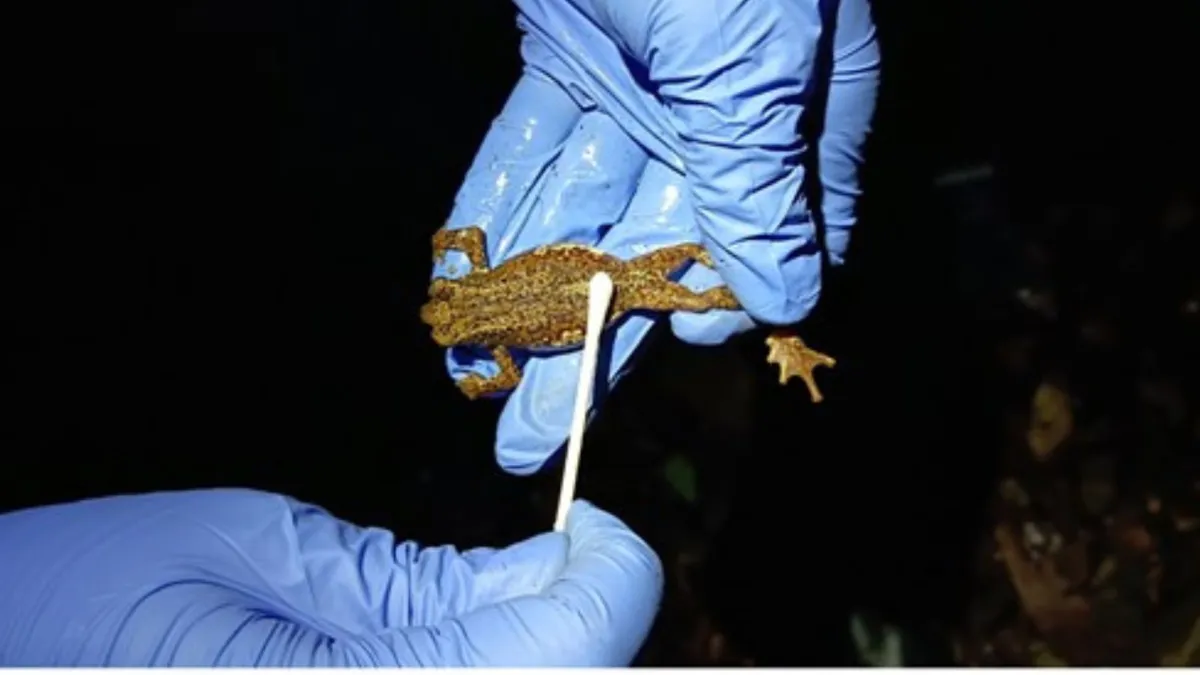
BENGALURU — In the dense, humid undergrowth of the Western Ghats and the fragmented green patches of urban India, a silent crisis is unfolding. Nearly half of India’s amphibian species are currently teetering on the edge of extinction, victims of habitat loss, climate change, and the devastating spread of fungal diseases. For decades, the very scientists dedicated to saving these creatures have faced a profound ethical dilemma: to study and protect them, they often had to hurt them.
However, a breakthrough study led by a collaborative team of researchers in Bengaluru is set to transform the landscape of genetic conservation. By demonstrating that a simple cotton swab rubbed gently over a frog’s skin can yield high-quality genomic data, the team has pioneered a non-invasive, ethical, and cost-effective alternative to traditional, often traumatic, tissue sampling.
The Main Facts: A Breakthrough in Genetic Monitoring
The research, a joint effort by the Srishti Manipal Institute of Art, Design & Technology, the Manipal Institute of Technology (MAHE), and the Ashoka Trust for Research in Ecology and the Environment (ATREE), provides a definitive protocol for collecting amphibian DNA without the need for surgery or amputation.
Traditionally, geneticists have relied on "toe-clipping" (removing a digit) or "tail-clipping" (in tadpoles) to obtain the tissue necessary for DNA extraction. While these methods are effective for gathering large amounts of genetic material, they raise significant welfare concerns, potentially causing stress, infection, or reduced survival rates in the wild.
The new study proves that by applying 60 gentle strokes of a sterile cotton swab across an amphibian’s back, belly, and limbs, researchers can collect enough sloughed-off skin cells to map the animal’s genetic code. The team tested this method on 88 individuals across seven distinct groups of frogs and toads, representing a wide range of sizes and skin textures.

The results were staggering: over 86% of the swab samples successfully produced DNA copies through Polymerase Chain Reaction (PCR), and 67% were clear enough for high-fidelity sequencing. This success rate demonstrates that the "skin-swabbing" method is not just a humane alternative, but a scientifically robust one.
Chronology: From Ethical Dilemma to Scientific Standard
The journey toward this protocol began in early 2024, born out of a shared discomfort with invasive sampling techniques. When Vaibhavi G joined the Srishti Manipal Institute for her PhD, the conversation around animal welfare in research was already reaching a tipping point.
"In 2024, the topic of skin swabbing started as a discussion between Dr. Gururaja KV, my supervisor, Dr. Priti Hebbar, and I," recalls Vaibhavi G, the lead researcher. "Dr. Gururaja was firmly against collecting thigh muscles, tadpole tail-tips, or eggs for our studies."
Prof. Gururaja KV, a renowned expert in Indian amphibians, had long advocated for a shift in how field biology is conducted. In a reflection shared on social media, he noted that the team held "lengthy discussions and deliberations" to find an alternative that wouldn’t compromise the integrity of the living specimen. The decision to pursue skin swabs was a calculated risk, as previous attempts in tropical climates had often yielded low-quality DNA due to environmental degradation.
The middle months of 2024 were defined by rigorous field visits and laboratory trials. The team spent weeks in the field, carefully handling delicate specimens and refining the swabbing technique. However, the laboratory phase proved to be the greatest hurdle.

"Post field visits, sample collection and DNA processing came one of the challenges: the Polymerase Chain Reaction step," Vaibhavi G explains. PCR is the process of amplifying a tiny fragment of DNA into millions of copies so it can be analyzed. For weeks, the samples failed to amplify. "We finally saw a promising result after a month-long trial and error," she adds. This persistence allowed the team to standardize a protocol that works specifically for the humid, challenging conditions of the Indian tropics.
Supporting Data: Technical Success and Logistics
To ensure the method’s practicality for researchers working in remote areas, the study delved deep into the logistics of DNA preservation and extraction. They compared several variables to find the most efficient "field-to-lab" pipeline:
1. Storage Conditions: Dry vs. Wet
One of the most significant findings was that swabs stored "dry" actually outperformed those stored in alcohol. Traditionally, tissue samples are submerged in ethanol for preservation. However, the researchers discovered that dry swabs provided higher DNA purity. This is a game-changer for field biologists who previously had to carry heavy, flammable bottles of chemicals into remote jungles.
2. Extraction Methods: Professional Kits vs. Salt Extraction
The team compared expensive, professional laboratory kits with a cheaper, "home-brew" salt extraction method. While both methods yielded similar quantities of DNA, the professional kits produced cleaner samples. This data allows researchers to choose a method based on their budget and the complexity of their downstream analysis.
3. Versatility Across Size and Species
The study was uniquely rigorous in its inclusion of various body sizes. While previous international studies struggled to get DNA from very small amphibians, this team found success even with the Microhyla genus—frogs as small as 13 millimeters (about the size of a fingernail). They also tested "warty" species like the Malabar tree toad, finding that skin texture plays a role in how many skin cells are shed, suggesting that 60 strokes is an ideal baseline for most species.

4. Animal Welfare Observations
Perhaps the most heartening data point was the behavioral observation of the animals post-sampling. Unlike toe-clipped frogs, which often show signs of trauma, the swabbed frogs were observed croaking almost immediately after being released. This suggests that the physiological stress of the procedure is negligible, allowing the animals to return to their natural behaviors instantly.
Official Responses: A New Vision for Conservation
The researchers involved believe this study marks a turning point for Indian herpetology. By aligning with the global "3Rs" framework—Replace, Reduce, and Refine—this research sets a new ethical standard for the country.
Dr. Priti Hebbar, from the Manipal Institute of Technology, emphasizes the broader impact on biodiversity: "This minimally invasive genetic method has the potential to identify new or cryptic species, advance our understanding of genetic diversity, and contribute to amphibian conservation without killing the individuals. The study can enhance our understanding of India’s amphibian diversity without compromising animal welfare."
The collaborative nature of the project was also highlighted as a key to its success. Vaibhavi G credited a wider team, including Aravind CK, Shashank K Borkar, and Sona Maria Sebastian, as well as Pavan Kumar Thunga from ATREE, for their roles in refining the protocol.
"We hope this standardized skin-swabbing protocol encourages wider adoption of minimally invasive genetic sampling for amphibians," Vaibhavi G says. The team’s goal is for this to become the "gold standard" for all future amphibian research in South Asia.

Implications: Bio-indicators and the Future of the Ecosystem
The implications of this breakthrough extend far beyond the laboratory. Amphibians are considered "bio-indicators"—they are the "canaries in the coal mine" for the environment. Because they breathe through their skin and live in both water and on land, they are the first to react to pollution, habitat degradation, and climate shifts.
By providing a way to monitor these animals more humanely and cost-effectively, the research allows for:
- Rapid Species Identification: In a region like the Western Ghats, where new species are discovered every year, this method allows for quick genetic confirmation without needing to sacrifice "type specimens."
- Disease Tracking: The skin-swabbing method is particularly effective for detecting the Batrachochytrium dendrobatidis (Bd) fungus, a chytrid pathogen that has wiped out amphibian populations globally.
- Population Genetics: Understanding how isolated frog populations are related is crucial for creating "wildlife corridors" and planning protected areas.
However, the researchers are careful to note the method’s limitations. While skin swabbing is perfect for species identification and basic genetic mapping (using the 16S rRNA gene), more complex genomic studies—such as full genome sequencing—may still require the larger quantities of DNA found in traditional tissue samples. They recommend that future researchers conduct small-scale pilot studies on their specific target species to determine the optimal number of swab strokes.
As India continues to grapple with the loss of its natural heritage, the work of the Srishti Manipal and ATREE teams offers a beacon of hope. It proves that in our quest to understand and save the natural world, we do not have to cause suffering to the very creatures we seek to protect. Through a simple cotton swab and a commitment to ethics, the future of India’s amphibians looks a little brighter—and much more humane.
