

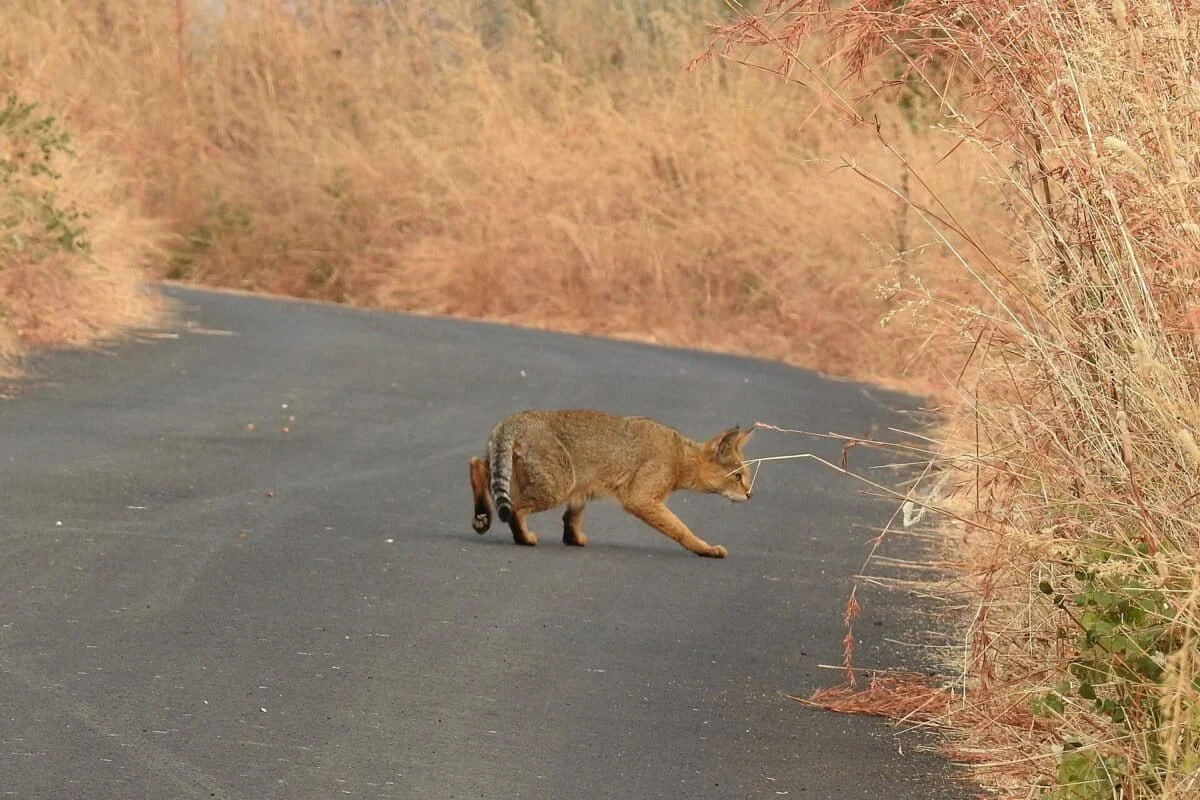
NEW DELHI — In the shadow of the charismatic megafauna that dominates India’s conservation narrative—the Royal Bengal tiger and the Indian leopard—lives a smaller, more elusive predator that has long been overlooked by science. The jungle cat (Felis chaus), despite being one of the most widely distributed small felids in the country, has remained a biological enigma for decades.
However, a landmark nationwide study has finally brought this "common" cat into the scientific spotlight. The research, recently published in the prestigious journal Scientific Reports, reveals that India possesses the potential to support a population of more than 300,000 jungle cats. By mapping habitat suitability across the subcontinent, researchers have identified over 545,000 square kilometers of territory where these lean, long-legged hunters can thrive.
“We didn’t know much about jungle cats—their habitat associations, population status, interactions with tigers and leopards, or their role in the illegal wildlife trade until this study,” says Kathan Bandyopadhyay, the study’s lead author. The findings represent a paradigm shift in how India views its "non-forest" biodiversity, moving away from a tiger-centric model to a more inclusive ecological understanding.
Main Facts: A Population Hidden in Plain Sight
The study, which utilized a massive dataset of more than 6,000 verified records, offers the most comprehensive look at the species to date. While the term "jungle cat" suggests a preference for dense tropical rainforests, the research confirms that the name is something of a misnomer. In reality, Felis chaus is a creature of the open sun.
Key Findings at a Glance:
- National Population Estimate: Approximately 308,000 individuals (though researchers acknowledge a wide margin of uncertainty due to the species’ elusive nature).
- Habitat Identification: Roughly 545,000 square kilometers of suitable habitat have been mapped across India.
- Geographic Strongholds: The states of Madhya Pradesh, Rajasthan, Odisha, Chhattisgarh, Maharashtra, and Gujarat emerged as the primary landscapes likely to support the largest populations.
- Habitat Preferences: The species shows a marked preference for warm, semi-arid regions with moderate rainfall, agricultural mosaics, and scrublands.
- Conservation Paradox: Despite being listed as "Least Concern" on the IUCN Red List, the species faces intense localized threats from infrastructure development and habitat misclassification.
Shomita Mukherjee, a senior principal scientist at the Salim Ali Centre for Ornithology and Natural History (SACON), notes the significance of the effort. “Most researchers would not put in this kind of effort for a relatively common and small species,” she says, highlighting a systemic bias in wildlife research that favors large, endangered carnivores over smaller, ecologically vital ones.
Chronology: From Tiger Surveys to Small Cat Science
The path to this population estimate was not straightforward. Historically, wildlife monitoring in India has been a top-heavy endeavor. Since the inception of Project Tiger in 1973, funding and technology have been funneled toward counting and protecting the "Big Four."

2018–2023: The Data Accumulation Phase
The foundation of the current study rests on the back of the world’s largest wildlife monitoring exercise: the All India Tiger Estimation (AITE). Between 2018 and 2023, thousands of camera traps were deployed across 18 states. While the primary goal was to photograph tigers, these "silent eyes" captured millions of images of non-target species, including the jungle cat.
2024: The Synthesis
Bandyopadhyay and his team began the arduous task of extracting "by-catch" data from these surveys. By filtering through 6,000 verified records, they were able to correlate sightings with environmental variables such as temperature, rainfall, and vegetation cover.
2025: The Government Recognition
In July 2025, a government report titled Status of Small Cats in India was released, utilizing data from the 2018–2019 and 2022–2023 cycles. It officially recognized the jungle cat as the most widely distributed small cat in the country, occupying nearly 96,275 square kilometers of surveyed territory—a figure that the new study suggests is only a fraction of the cat’s actual potential range.
Supporting Data: The Mechanics of the Count
Estimating the population of a small cat is significantly more complex than counting tigers. Tigers possess unique stripe patterns that act as natural barcodes, allowing researchers to identify individuals through camera trap images. Jungle cats, conversely, have uniform, sandy-colored coats with few distinguishing marks.
The Methodology
To overcome the "identity crisis," the research team employed a multi-pronged approach:
- GPS Telemetry: Researchers used data from GPS-collared animals to understand "space use"—how much territory a single cat needs to survive.
- Habitat Suitability Modeling: By combining GPS data with satellite imagery, they identified areas with the "perfect" mix of scrubland, water, and prey density.
- Extrapolation: By applying the density figures derived from localized studies to the 545,000 square kilometers of suitable habitat, they arrived at the national estimate of 308,000.
The Scrub-Dweller’s Biology
The data also shed light on the jungle cat’s physical evolution. Mukherjee explains that their long legs and lean bodies are perfectly adapted for "scrub-dwelling." These features allow them to navigate tall grasses and jump vertically to catch birds or rodents. Their coloring, often described as a tawny or reddish-grey, provides near-perfect camouflage in the dry, deciduous landscapes of central and western India.

Official Responses and Expert Perspectives
While the numbers are encouraging, experts warn against complacency. The jungle cat’s "Least Concern" status on the IUCN Red List can be a double-edged sword, often leading to its exclusion from high-priority conservation funding.
The "Wasteland" Dilemma
Lead author Kathan Bandyopadhyay points to a critical policy flaw: the classification of scrublands and grasslands as "wastelands" in official government records.
“These habitats are under immediate threat from conversion into agricultural land or for green energy projects,” Bandyopadhyay warns. When a grassland is labeled as a wasteland, it is frequently targeted for massive solar parks or wind farms, which, while "green," can fragment the contiguous scrublands these cats require.
The Tiger’s Shadow
The study also explored the relationship between jungle cats and their larger cousins. Interestingly, jungle cats appear to benefit from the "Tiger Umbrella." Wildlife corridors designed for tigers are frequently used by small cats. Furthermore, Project Cheetah—India’s ambitious plan to reintroduce the extinct big cat to its grasslands—has the potential to inadvertently save the jungle cat by prioritizing the restoration of neglected open-natural ecosystems.
However, Shomita Mukherjee offers a word of caution regarding management: “Their value lies in a balance with human use. If managed like forests, grasslands may become wooded, and species like the jungle cat could lose out.”
Implications: The Human-Dominated Landscape
Perhaps the most surprising finding of the study is the jungle cat’s tolerance for human presence. Unlike the leopard, which often enters into direct conflict with humans over livestock, the jungle cat has found a niche in the "agricultural mosaic."
The Rodent Controller
Jungle cats are prolific hunters of rodents. In states like Punjab and Haryana, they act as a natural pest control mechanism, keeping rat and mouse populations in check within wheat and sugarcane fields. Co-author John Koprowski emphasizes that this ecological service should be a cornerstone of conservation strategy. "Small carnivores play important ecological roles… helping control rodent populations in agricultural areas," he notes.

Modern Threats
Despite their adaptability, the study identifies three emerging threats that could derail the population’s stability:
- Roadkill and Infrastructure: As India’s road network expands, the "fragmentation" of habitat becomes lethal. Jungle cats moving between fields are frequently victims of high-speed vehicle collisions.
- Feral Dogs: Bandyopadhyay identifies stray dogs as "invasive predators." Dogs not only compete for the same prey but also transmit deadly diseases like canine distemper and rabies to wild cat populations.
- The "Rescue" Trap: In agricultural belts, farmers often find jungle cat kittens hidden in crops. Thinking they are abandoned or are domestic kittens, they "rescue" them. "People often don’t know how to care for them," says Mukherjee, noting that these well-intentioned acts often lead to the death of the kittens or their permanent removal from the wild.
Conclusion: The Quiet Indicator of Change
The study concludes with a call for a long-term monitoring framework. While the current estimate of 308,000 provides a baseline, Bandyopadhyay insists that the work is just beginning. “It’s something we need to revisit in 15-20 years to assess population trends,” he says.
The jungle cat is more than just a smaller version of a tiger; it is a sentinel of the scrubland. As land-use patterns shift across India—driven by climate change, urbanization, and the energy transition—the health of the jungle cat population will serve as a quiet, yet profound, indicator of the health of India’s non-forest ecosystems.
For now, the study stands as a testament to the importance of looking beyond the "Big Cats." In the tall grass and the semi-arid scrub, 300,000 small predators are working to keep India’s ecological balance in check. The challenge for the next decade will be ensuring they have the space to continue doing so.
