

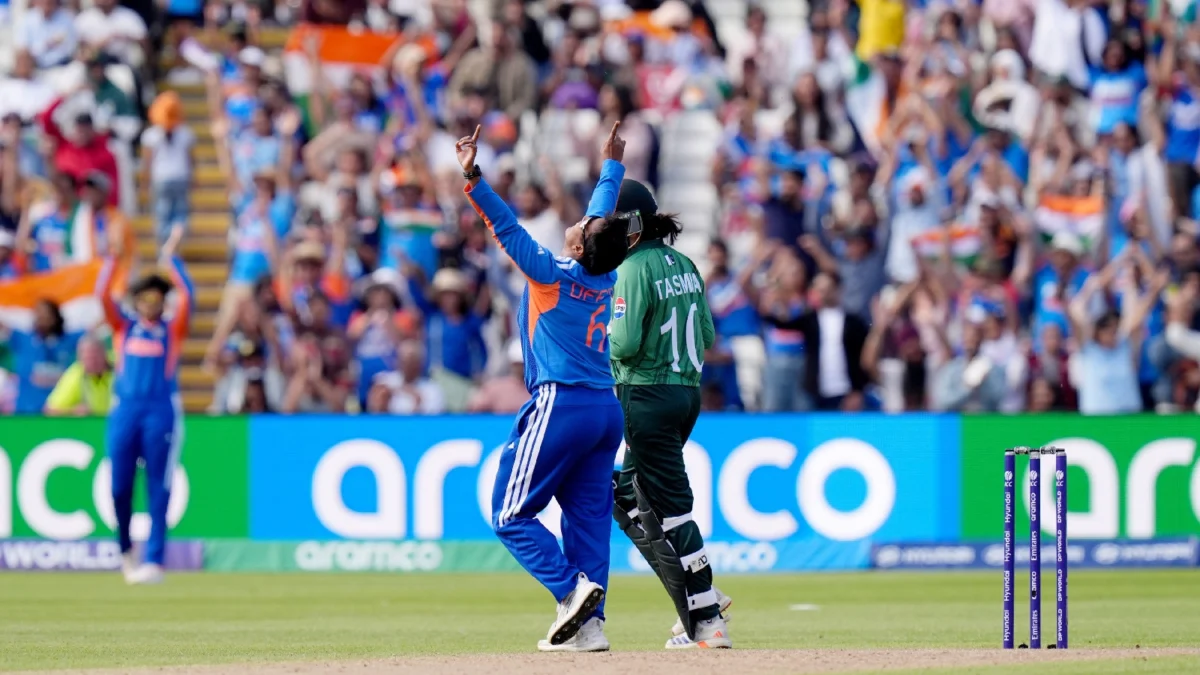
Dhaka, Bangladesh – In a dazzling display of strategic brilliance and individual heroics, India kicked off their Women’s T20 World Cup campaign with a resounding 64-run victory over arch-rivals Pakistan. The monumental win was orchestrated by an extraordinary five-wicket haul from vice-captain Deepti Sharma, who not only ripped through Pakistan’s batting lineup but also ascended to become the leading wicket-taker in T20 International history. Her spell of 5/10 in four overs was perfectly complemented by a gritty and intelligent innings of 68 off 44 balls from opener Smriti Mandhana, whose resilience laid the foundation for India’s competitive total of 170/6. The match, played under the floodlights in Dhaka, was a testament to India’s depth, tactical acumen, and ability to perform under immense pressure, setting an emphatic tone for their tournament aspirations.
India’s Resilience: Mandhana Anchors Against Early Turbulence
The highly anticipated clash began with India batting first, and the early exchanges suggested a stern test awaited Harmanpreet Kaur’s side. The initial period saw India grappling with a slow surface and disciplined Pakistani bowling. Tragedy struck early as the usually explosive Shafali Verma departed in the opening over, caught behind attempting a cut shot. Her dismissal was quickly followed by Jemimah Rodrigues, who managed only a single before misjudging a delivery, leaving India precariously placed at 18 for 2 inside the powerplay. The scoreboard pressure mounted, and the Pakistani bowlers, sensing an opportunity, maintained tight lines and lengths, denying the Indian batters any easy scoring opportunities.
It was amidst this early turbulence that Smriti Mandhana, India’s elegant left-handed opener, emerged as the beacon of stability. Exhibiting remarkable composure and an astute understanding of the conditions, Mandhana consciously reined in her natural attacking instincts. The pitch was demonstrably slow, causing the ball to hold up, and boundaries were a scarce commodity. Yet, Mandhana resisted the urge to force the issue, instead opting for a methodical approach. She meticulously worked the gaps, nudged the ball into the leg side with soft hands, and prioritized sharp strike rotation to keep the scoreboard ticking. This disciplined phase of her innings was crucial, absorbing the relentless pressure exerted by Pakistan’s attack and preventing a deeper collapse.
Pakistan’s bowlers, rotating their options effectively, kept Mandhana under constant examination, denying her rhythm through the first phase. However, a pivotal moment arrived when Mandhana was on 28. Attempting to clear the infield off the bowling of Sadia Iqbal, she miscued a lofted stroke, sending the ball soaring towards mid-off. Aliya Riaz, positioned perfectly, spilled what appeared to be a straightforward chance. It was a lapse in concentration that Pakistan would rue deeply, as Mandhana, granted a reprieve, visibly grew in confidence and began to assert her dominance.
From that point, Mandhana transformed her innings. The "inside-out loft" over the covers became her signature shot, a defining stroke that showcased her exquisite timing and exceptional footwork. Repeatedly, she skipped down the pitch, created room for herself, and elegantly lifted Pakistan’s spinners – be it Nashra Sandhu, Sadia Iqbal, or Rameen Shamim – over the off-side ring with impeccable precision. This shot, executed with consistent brilliance, became an unsolvable riddle for the Pakistani attack, allowing Mandhana to shift gears decisively. Her partnership with captain Harmanpreet Kaur (who contributed a vital 35 runs) further solidified India’s position, injecting momentum into the innings. Mandhana reached her fifth T20 World Cup half-century off just 34 balls, marked by yet another trademark inside-out boundary in the 12th over. By the time she finally perished for a magnificent 68 off 44 deliveries, attempting to clear long-on once too often, India had not only recovered but had also posted a formidable total of 170/6. Her innings was a masterclass in control under pressure and calculated acceleration, providing the crucial platform for India’s bowlers to complete the job.
Deepti Sharma’s Dominance: The Game-Changing Spell
When Pakistan began their chase, they did so with an ominous intent, racing to 37/0 after just four overs. India’s seamers appeared ineffective, struggling to find rhythm and purchase on the slow surface. Shreyanka Patil, in particular, had conceded 12 runs in her second over, highlighting the need for a change in strategy. It was at this critical juncture that Captain Harmanpreet Kaur, renowned for her instinctive leadership, turned to her most trusted bowler: Deepti Sharma. Despite not having bowled in the warm-up matches and having had modest recent returns, Deepti was entrusted with the responsibility of wresting back control, and she responded with a spell that irrevocably flipped the contest on its head.
Deepti Sharma, a master of subtle variations, immediately began operating with precision, employing clever changes of pace and flight. Her deliveries were slower through the air, fuller in length, and suddenly, the surface that had seemed benign for batting began to grip and misbehave. The early momentum Pakistan had built evaporated under her controlled aggression, and the tempo of the game was dragged down to her rhythm.
The breakthrough came almost immediately, confirming the wisdom of Harmanpreet’s decision. Gull Feroza, attempting an ill-advised reverse sweep, found backward point, providing Deepti with her first scalp. In the very next over, Ayesha Zafar, looking to work the ball into the leg side, only succeeded in looping a simple catch to Smriti Mandhana at short fine leg. Pakistan’s brisk start stalled in an instant, replaced by palpable hesitation and accumulating pressure.
From that point, Deepti never relinquished her stranglehold. She repeatedly drew batters into uncertain strokes, beating them in flight, dragging them forward, then forcing them back again. Natalia Pervaiz survived an lbw review only on the umpire’s call, a moment that starkly underlined how perilously close Pakistan were to slipping further behind. Even when wickets didn’t fall, the equation shifted dramatically. Dot balls became the dominant currency, and Pakistan’s early momentum evaporated under the sheer weight of Deepti’s accuracy and relentless pressure.
Her influence extended beyond her bowling. In a decisive blow in the field, Deepti reacted sharply in her follow-through to a straight drive from Muneeba Ali, combining seamlessly with wicketkeeper Richa Ghosh to effect a crucial run-out. Muneeba Ali, who had been Pakistan’s anchor, looked set on 41 runs, and her dismissal at this precise moment triggered the true unraveling of Pakistan’s chase. Their most stable batter removed, the middle order found itself exposed and under immense pressure.
If Deepti Sharma applied the squeeze, Sree Charani, the left-arm spinner, ensured there was no escape route. Settling immediately into disciplined lines, Charani attacked the stumps, forcing Pakistan’s middle order into manufactured and often ill-advised strokes. She struck in her very first over, when Saira Jabeen closed the bat face too early, offering a simple catch to Harmanpreet Kaur at short cover. Charani’s control allowed India to double down on the pressure created at the other end. Muneeba’s resistance faded, Natalia Pervaiz miscued again, and Pakistan’s innings disintegrated under mounting scoreboard pressure. The chase, once at 37 without loss, collapsed dramatically as India’s spin duo dictated every phase of the game.
Deepti Sharma’s spell, however, stood apart as the defining performance of the match. She finished with an astonishing 5/10 in her four overs, a performance that not only broke Pakistan’s back but also elevated her into becoming the leading wicket-taker in T20 Internationals, a monumental career milestone. It was a spell that single-handedly defined the contest and ensured India opened their Women’s T20 World Cup campaign with a commanding and memorable victory.
Supporting Data and Key Statistics
The match was a statistical goldmine, highlighting individual brilliance and team dominance. Deepti Sharma’s 5/10 is not only her personal best but also one of the most economical five-wicket hauls in Women’s T20 World Cup history, instantly etching her name in the record books. Her ascent to the top of the T20I wicket-takers list underscores her consistency and enduring impact on the shortest format of the game. Smriti Mandhana’s 68 off 44 balls, featuring her signature inside-out lofts, marked her fifth half-century in T20 World Cups, reaffirming her status as one of the format’s premier batters. Harmanpreet Kaur’s quickfire 35 provided crucial impetus in the middle overs, ensuring India capitalized on Mandhana’s foundation.
On the bowling front, Sree Charani’s disciplined 3/21 offered excellent support to Deepti, showcasing the depth of India’s spin attack. The combined efforts of the Indian spinners accounted for 8 of the 10 wickets that fell, highlighting the effectiveness of their strategy on the slow Dhaka pitch. Pakistan’s initial 37/0 start was their best powerplay performance against India in recent memory, but their subsequent collapse from 37/0 to 106 all out in 17 overs illustrates the devastating impact of India’s spin dominance. The margin of 64 runs also represents one of India’s most comprehensive victories over Pakistan in T20 World Cups, signaling a clear statement of intent for the tournament.
Official Responses and Reactions
Post-match, the air was thick with praise for India’s standout performers. Captain Harmanpreet Kaur, beaming with pride, lauded Deepti Sharma’s heroic effort. "Deepti is our most trusted bowler, and we knew she had the ability to turn the game around," Kaur stated in the press conference. "Her spell was simply phenomenal; she brought her experience to the fore, understanding the conditions perfectly and executing her plans flawlessly. That run-out of Muneeba was also a crucial moment, showing her all-round athleticism."
Kaur also acknowledged Mandhana’s pivotal role. "Smriti’s innings was invaluable. To bat the way she did after losing two early wickets on a challenging surface, and then to accelerate, shows her class and temperament. She absorbed the pressure and ensured we had a competitive total to defend."
Deepti Sharma, visibly emotional about her record-breaking achievement, expressed humility. "It feels incredible to contribute to a win, especially against Pakistan and in a World Cup opener," she remarked. "My focus was just on bowling to my strengths, varying the pace, and hitting the right lengths. The pitch offered some grip, and I tried to exploit that. The milestone is a bonus, but the team’s victory is what matters most."
Smriti Mandhana reflected on the challenging conditions. "It wasn’t an easy pitch to start on, the ball was holding up, and Pakistan bowled well initially," Mandhana explained. "My aim was to bat deep, rotate strike, and put away the loose balls. That dropped catch gave me a bit of extra confidence, and I knew I had to make it count. We always talk about building partnerships, and I’m glad I could do that today."
From the Pakistani camp, there was an air of disappointment, yet also an acknowledgment of India’s superior performance. Pakistan’s captain, Nida Dar, conceded, "We started well with the bat, but Deepti Sharma’s spell changed everything. We couldn’t handle the variations, and the pressure built quickly. The dropped catch of Mandhana was also a critical error that cost us dearly. We need to regroup and learn from this."
Social media platforms, including X (formerly Twitter), buzzed with reactions. The BCCI Women’s handle celebrated Deepti’s fifer as a "historic milestone," while Star Sports declared, "Champions play like champions," acknowledging both Deepti and Mandhana’s stellar contributions. The posts, laden with emojis and fervent fan support, underscored the significance of the victory and the individual accolades.
Implications: A Statement of Intent
This commanding victory carries significant implications for both teams and the wider context of the Women’s T20 World Cup 2026. For India, it is a dream start to their campaign, instantly boosting team morale and validating their strategic choices. The performance, particularly the dominance of their spin attack led by Deepti Sharma, sends a powerful message to other contenders in the tournament. It showcases India’s ability to adapt to varying pitch conditions and execute high-pressure plans. Mandhana’s form at the top of the order is a huge positive, providing the stability and firepower needed for a successful World Cup run. The psychological edge gained over arch-rivals Pakistan, especially in a World Cup setting, cannot be understated. This win positions India as a formidable force early in the tournament, setting a high benchmark for their subsequent matches.
For Pakistan, the defeat is a significant setback. Despite a promising start with the bat, the collapse highlights a vulnerability against quality spin bowling under pressure. They will need to quickly address their batting frailties and find ways to counter aggressive spin attacks if they are to remain competitive in the tournament. The loss also impacts their net run rate, which could be crucial in the latter stages of the group stage. Pakistan will need to regroup swiftly, learn from their mistakes, and ensure this early stumble does not derail their entire campaign.
Overall, India’s dominant performance in the Women’s T20 World Cup opener against Pakistan was more than just a win; it was a statement of intent. It underscored the crucial roles of experienced campaigners like Deepti Sharma and Smriti Mandhana, proving that under pressure, India possesses the individual brilliance and collective resolve to chase global glory. The tournament has just begun, but India has already laid down a formidable marker.
Brief Scores: India 170/6 in 20 overs (Smriti Mandhana 68, Harmanpreet Kaur 35) beat Pakistan 106 all out in 17 overs (Muneeba Ali 41; Deepti Sharma 5/10, Sree Charani 3/21) by 64 runs.
