

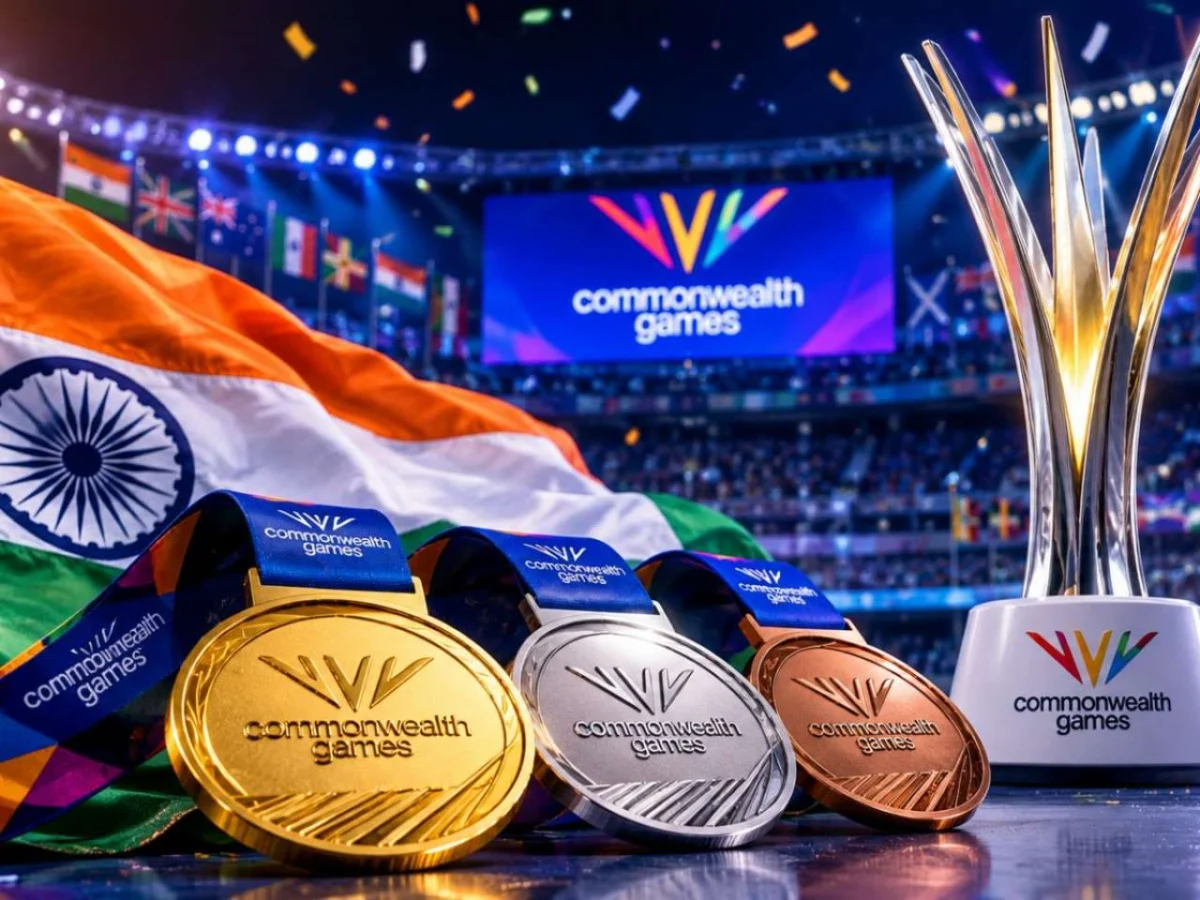
Birmingham, UK – August 2, 2026 – India has concluded its compelling journey at the Commonwealth Games 2026 in Birmingham, securing an impressive haul of 39 medals, including 13 golds, 17 silvers, and 9 bronzes, to finish a commendable fourth in the final medal standings. The nation’s campaign, marked by unprecedented success in boxing and inspiring performances across various disciplines, ended on a bittersweet note as judoka Ishroop Narang narrowly missed out on a bronze medal on the closing day. Despite the final-day misses, the overall performance underscored India’s growing prowess in international multi-sport events and set an optimistic tone for its athletic future, especially as the Commonwealth Games torch was symbolically passed to India, signaling a potential host role for a future edition.
The Indian contingent showcased resilience, talent, and strategic depth, particularly in the ring, where boxers delivered a record-breaking performance that became the cornerstone of India’s medal tally. The final position of fourth place solidifies India’s standing among the Commonwealth’s sporting elite, a testament to years of dedicated training and investment.
A Campaign Defined by Gold and Grit: Main Facts
India’s journey in Birmingham was a rollercoaster of emotions, culminating in a formidable medal count that speaks volumes of the athletes’ dedication. The final tally of 39 medals placed India firmly behind powerhouses like Australia, England, and Canada, a significant achievement for a nation continually striving to enhance its sporting infrastructure and talent pool.
The 13 gold medals were hard-won, often against formidable opponents, and painted a vibrant picture of India’s sporting diversity. While boxing undeniably led the charge, with an unparalleled seven golds, contributions from athletics and para-sports further enriched the medal collection. The campaign was not without its challenges, as evidenced by the tough final day in judo and cycling, yet the overall narrative remains one of triumph and significant progress. The performance has ignited national pride and set high expectations for future international competitions.
)
The Chronology of Triumph and Close Calls
India’s medal hunt in Birmingham gathered significant momentum in the latter half of the Games, culminating in a spectacular surge on Day 10 and a valiant, though ultimately challenging, final day.
Day 10: The Golden Avalanche
Day 10 proved to be India’s most prolific, witnessing an astonishing eight gold medals that propelled the nation dramatically up the medal standings. This single day’s performance was crucial in solidifying India’s fourth-place position, demonstrating the contingent’s ability to peak at critical moments. The boxing arena, in particular, became a theatre of dreams, with several Indian pugilists delivering masterclasses in strategy and power.

Closing Day: Bittersweet Endings
The final day, Sunday, August 2nd, was anticipated with high hopes but delivered a mixed bag of results. While the overall medal count remained robust, the day’s events highlighted the fierce competition and razor-thin margins at the elite level.
Judo’s Tough Day: The judo mat, which had previously offered glimpses of potential, proved unforgiving on the closing day. Ishroop Narang, competing in the women’s 78kg category, fought valiantly but ultimately succumbed to England’s Emma Reig in the quarterfinals. Her journey for a podium finish continued in the bronze medal match, where she faced Canada’s Coralie Godbout. In a fiercely contested bout, Narang was defeated, ending India’s judo campaign without any medals on the final day and on a note of missed opportunity.
)
Similar fates befell other Indian judokas. Avtar Singh, in the men’s 100kg category, faced a formidable opponent in Cyprus’s Aristos Michael and was eliminated in the round of 16. Yash Ghangha, in the same round, was knocked out by Britain’s Joshua Whitehouse, indicating the depth of talent in the heavier weight categories. The collective inability of Indian judokas to advance past the semifinals on Sunday underscored the challenging competitive landscape in the sport.
Cycling’s Struggle: On the velodrome, Indian cyclists also faced an uphill battle. In the demanding men’s 40km points race, both Dinesh Kumar and Harshveer Singh Sekhon failed to qualify for the final. Dinesh finished 11th in Heat 2 with four points, while Harshveer couldn’t complete his heat, bringing their Games to an early close. Ronaldo Singh Laitonjam, in the men’s 1000m time trial, delivered a remarkable performance, clocking a new Games Record of 1:04.191. Despite setting a new benchmark for speed, it wasn’t enough to secure a podium finish, as the overall field proved exceptionally fast, leaving him in 20th place. These results highlighted the significant strides Indian cycling needs to make to consistently compete for medals at this level.
)
Boxing: India’s Unprecedented Golden Era
The boxing contingent was undoubtedly India’s shining star, delivering a performance that etched their names into the history books of the Commonwealth Games. With seven gold medals, India achieved its best-ever boxing performance at a single Commonwealth Games, surpassing the previous record of six golds held by England in both London 1934 and Gold Coast 2018. This historic achievement was the result of meticulous preparation, tactical brilliance, and sheer determination.
The Golden Punches:
)
- Ankush Panghal (Men’s 80kg): Dominating from the first bell, Panghal showcased superior technique and power to defeat England’s Demieji Shittu 4-1 in a commanding performance that secured his gold medal.
- Sachin Siwach (Men’s 60kg): In one of the most dramatic finals, Siwach edged out Namibia’s Tryagain Morning Ndevelo. After facing a referee’s penalty, Sachin needed a monumental final round. He delivered with a late, decisive punch that swung the decision in his favour, clinching gold in a truly memorable fashion.
- Arundhati Choudhary (Women’s 70kg): Displaying exceptional control and tactical acumen, Choudhary secured a clean 5-0 victory over England’s Cantley Reed. Reed attempted a late rally, but Arundhati’s impenetrable defence and sharp counters ensured she never gave her opponent an opening.
- Priya Ghanghas (Women’s 60kg): Ghanghas fought a hard-nosed battle against Canada’s Marie-Bathoul Al-Ahmadieh, ultimately securing a hard-earned 4-1 split-decision victory, testament to her grit and perseverance.
- Sakshi Chaudhary (Women’s 51kg): Chaudhary delivered a dominating 5-0 win against England’s Ruby White, showcasing her class and control throughout the women’s flyweight final.
- Preeti Pawar (Women’s 54kg): Pawar maintained total control in her final against Canada’s Scarlet Delgado, executing her game plan flawlessly to win 5-0 and claim gold.
- Jaismine Lamboria (Women’s 57kg): Lamboria also secured a unanimous decision, beating Michaela Walsh 5-0, demonstrating her superior skill and composure in the featherweight category.
Silver Linings in the Ring:
- Lovlina Borgohain (Women’s 70kg): The Olympic medalist, Lovlina Borgohain, faced a tough challenge in the final, ultimately losing 1-4 to Australia’s Emma-Sue Greentree. Despite falling short of gold, her silver medal was a valuable addition to India’s tally and a reflection of her continued presence at the sport’s highest echelons.
- Jadumani (Men’s 70kg): Jadumani started strong against Australia’s Jye Dixon, winning the first round, but Dixon surged ahead in rounds two and three to claim the gold. Jadumani had previously shown his mettle by beating Namibia’s Philip Haoseb 5-0 to reach the final.
- Narender (Men’s 90+kg): In the heavyweight division, Narender couldn’t find his rhythm against England’s Demar Thomas, losing 5-0 and settling for a well-deserved silver medal.
Athletics: Gulveer Singh’s Historic Double
Beyond the boxing ring, athletics provided moments of sheer brilliance, particularly from Gulveer Singh. He further cemented his place in Indian sporting history by becoming the first Indian to win medals in two different track events at the same Commonwealth Games edition. After securing a silver in the men’s 10,000 meters earlier in the Games, Gulveer added a bronze medal in the men’s 5000 meters with an incredible time of 13:24.95. His bronze came after a nail-biting finish, just 0.04 seconds ahead of Kenya’s Cornelius Kemboi, showcasing his extraordinary endurance and tactical awareness. This historic double medal performance from the athlete from Uttar Pradesh was a significant highlight of India’s track and field campaign.
)
Para Shot Put: Inspiring Achievements
The Para-sports contingent continued to be a source of immense pride and inspiration. In the F-57 Para shot put category, India celebrated a remarkable 1-2 finish. Soman Rana clinched the gold medal with a season-best throw of 13.40 meters, demonstrating incredible strength and technique. His teammate, Shubham Juyal, earned the silver medal with a commendable throw of 13.28 meters. The F-57 class, designated for athletes with lower limb weaknesses but full upper body strength, highlighted the exceptional talent and perseverance within India’s para-athlete community.
Supporting Data and Record-Breaking Feats
India’s performance at CWG 2026 is supported by compelling data, reinforcing its standing as a formidable sporting nation. The total of 39 medals, comprising 13 gold, 17 silver, and 9 bronze, represents a robust showing in a highly competitive international environment.
)
The most significant supporting data point is the unprecedented success in boxing. The seven gold medals secured by the Indian pugilists surpassed England’s long-standing record of six golds at a single Games. This not only signifies a golden era for Indian boxing but also indicates a potential shift in the global boxing landscape, with India emerging as a dominant force. The depth of talent in both men’s and women’s categories, with seven gold medalists and three silver medalists, points to a strong grassroots development program and effective coaching strategies.
Gulveer Singh’s dual medal achievement in track events is another critical piece of data, highlighting the diversification of India’s sporting success beyond traditional strongholds. His ability to perform at an elite level in both 5000m and 10000m events showcases exceptional athletic versatility and mental fortitude. Even Ronaldo Singh Laitonjam’s Games Record in the 1000m time trial, despite not yielding a medal, is indicative of the rising standards of Indian athletes and their capability to challenge established records.
)
The performance of para-athletes, with a gold and silver in a single event, underscores the inclusive growth of Indian sports and the potential for greater success in future para-sporting events. These athletes serve as powerful role models, inspiring a new generation of para-athletes.
Compared to previous editions, while the overall medal count might fluctuate, the quality of medals, particularly the record in boxing and the historic track achievements, suggests a strategic improvement in specific disciplines. The focus on high-performance training and international exposure appears to be paying dividends.
)
Official Responses and Future Aspirations
While specific official responses were not immediately available, the general sentiment from the Indian Olympic Association (IOA) and the Ministry of Youth Affairs and Sports is expected to be overwhelmingly positive, tempered with a realistic assessment of areas for improvement.
It is highly probable that official statements will commend the athletes for their exceptional dedication and performance, particularly highlighting the boxing contingent’s historic achievement. A spokesperson from the IOA might state, "We are immensely proud of our athletes for their extraordinary efforts at the Commonwealth Games 2026. The record-breaking performance in boxing is a testament to the hard work of our pugilists and their coaches. Finishing fourth is a significant accomplishment and demonstrates India’s growing stature in the global sporting arena."
)
The Sports Ministry would likely reiterate its commitment to supporting athletes, enhancing training facilities, and expanding talent identification programs. There would also be an acknowledgment of the tough competition faced in disciplines like judo and cycling on the final day, with assurances of a thorough review to identify areas for improvement ahead of future international competitions. "While we celebrate our triumphs, we also recognize the areas where further investment and strategic planning are required," a Ministry official might add. "Our goal remains to provide every Indian athlete with the best possible resources to compete and excel on the world stage."
A particularly significant "official response" comes from the closing ceremony itself, where the Commonwealth Games torch was symbolically passed to India. This act carries immense weight, hinting at India’s strong intention and potential to host a future edition of the Commonwealth Games, likely in 2030. This would be a monumental undertaking, showcasing India’s organizational capabilities and its passion for sports on a global platform. The involvement of cultural icons like Shankar Mahadevan headlining the closing ceremony further underscores India’s readiness to embrace this larger role.
)
Implications: Setting the Stage for a Sporting Future
India’s performance at the Commonwealth Games 2026 carries profound implications for the future of sports in the nation. The historic success in boxing, coupled with significant achievements in athletics and para-sports, will undoubtedly boost morale and inspire a new generation of athletes.
Boost for Boxing and Combat Sports: The unparalleled success in boxing will likely lead to increased funding, better coaching, and expanded grassroots programs for the sport. This could create a virtuous cycle, attracting more talent and further solidifying India’s position as a boxing powerhouse. The success could also have a spill-over effect on other combat sports, encouraging more participation and investment.
)
Diversification of Sporting Excellence: Gulveer Singh’s double medal in track events is a powerful indicator that India’s sporting prowess is diversifying beyond traditional strongholds like wrestling and shooting (which were not detailed in the provided text but are historically strong for India). This success in athletics can inspire greater focus and investment in track and field, which often form the backbone of a nation’s Olympic performance.
Inspiration from Para-Athletes: The gold and silver in Para shot put serve as a powerful narrative of resilience and achievement. This will not only inspire more individuals with disabilities to pursue sports but also encourage greater societal and governmental support for para-sports infrastructure and recognition.
)
Lessons Learned for Future Competitions: The close calls and missed medals on the final day, particularly in judo and cycling, provide valuable lessons. They highlight the need for greater depth in certain disciplines, more robust mental conditioning for high-pressure situations, and continuous evaluation of coaching and training methodologies to bridge the gap with world leaders.
The Road to CWG 2030 (and Beyond): The most significant implication is India’s potential role as a future host of the Commonwealth Games. The symbolic passing of the torch at the closing ceremony points towards a strong bid, potentially for the 2030 edition. Hosting such a prestigious event would be transformative, accelerating infrastructure development, boosting tourism, and significantly raising India’s profile on the international sporting stage. It would also provide a massive impetus for domestic sports development, with a clear home-ground advantage and increased public engagement. This would mean a concerted effort in planning, logistics, and athlete preparation over the next few years.
)
In conclusion, India’s Commonwealth Games 2026 campaign was a resounding success, marked by historic achievements and a clear demonstration of its rising sporting ambitions. While the celebrations will be joyous, the focus will quickly shift to building on this momentum, addressing areas for improvement, and meticulously planning for a future where India not only competes but potentially hosts and excels on the grandest Commonwealth stage.
