

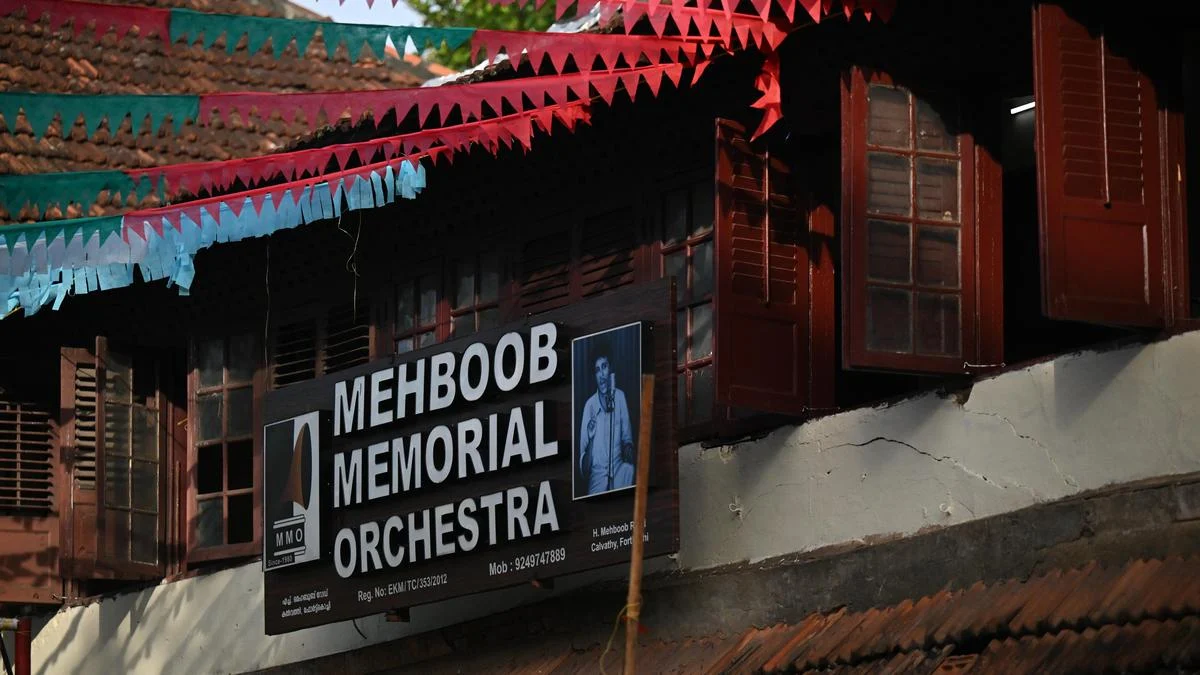
Fort Kochi, Kerala – Nestled opposite the iconic Aspinwall House in the historic heart of Fort Kochi, a modest building houses a vibrant sanctuary of memories: the Mehboob Memorial Orchestra (MMO). This institution is more than just an office; it’s a living testament to the enduring legacy of H. Mehboob, Kerala’s beloved singer whose captivating performances on stage and his magnetic personality off it, continue to resonate with generations. For those who knew him, and for those who have come to know him through his music, Mehboob remains an indelible emotion, a true maverick whose influence transcends time.
The walls of the MMO are adorned with faded photographs, each a frozen frame capturing moments of Mehboob’s illustrious career and his personal life. At the heart of the central hall lies a stage, a focal point that proudly showcases paintings of Mehboob alongside his idol, the legendary Mohammed Rafi. This space is not merely a memorial; it is a dynamic hub where the spirit of Mehboob’s music is kept alive.
A Sanctuary of Sound and Memory
The "club," as its members affectionately call it, convenes every Friday. It’s a gathering of individuals united by their shared admiration for Mehboob. Here, they not only reminisce about the past but also extend a welcoming hand to aspiring musicians, offering them a platform to hone their craft. "This is how we keep the spirit of his music alive," shares K.A. Hussain, the secretary of the MMO and one of its earliest members. Hussain, a custodian of Mehboob’s memory, speaks with a quiet reverence for the man he describes as "one of a kind – a true maverick." He elaborates, "No one could guess what he had up his sleeve, and that was part of his appeal." The very building that houses these memories is itself steeped in history, over 130 years old, adding another layer of timelessness to the MMO’s existence.

The Mehboob Memorial Orchestra traces its origins back to an informal collective named "Raag," formed a year before Mehboob’s passing in 1981. It was formally established in 1985 as a dedicated tribute to his life and music. Among its founding members was the late ghazal maestro Umbayee, who shared a profound bond with Mehboob and had shared many stages with him.
Mehboob: An Emotion Woven into Kerala’s Musical Fabric
For over four decades, the MMO has diligently continued Mehboob’s mission of spreading joy through music. His life story is described as one of the most dramatic and significant chapters in Kerala’s musical history. For those who came of age in the Fort Kochi-Mattancherry region during his peak, Mehboob was more than just a singer; he was an "emotion."
"He was ‘Bhai’ to everyone," Hussain recalls, his words punctuated by recitations of couplets from Mehboob’s iconic songs. "He had a rare knack to connect with people. There was a time when his stage shows would draw more crowds than even K.J. Yesudas’s." This ability to forge deep connections with his audience, coupled with his unique artistic flair, cemented his place in the hearts of Keralites.

A Tribute to Rafi: The "Rafi Nites" Tradition
A cornerstone of the MMO’s activities, and a highly anticipated event on the city’s cultural calendar, are the "Rafi Nites." These evenings are a heartfelt tribute to Mohammed Rafi, the legendary singer whom Mehboob so deeply admired. "We have been organizing this tribute to Mohammed Rafi since 1981," Hussain states. "For 43 consecutive years, we only stopped during the Covid-19 years, and immediately restarted when normal life resumed." These nights are a celebration of Rafi’s timeless melodies, performed with the passion and soul that Mehboob himself embodied.
Hussain further paints a vivid picture of Mehboob’s artistry: "His style was unique – there was a touch of humour, soul, and spontaneity in everything he sang. Even his sartorial choices were rather unique. He wore loose shirts, which added to his persona." This distinctive style, both in his music and his appearance, contributed to his captivating stage presence.
From Humble Beginnings to Cinematic Stardom
Born in Mattancherry in 1926, Mehboob’s early life was marked by poverty. His childhood was largely spent in the military barracks at Pattalam, Fort Kochi. Despite these challenging beginnings, his innate musical talent shone through. He was a constant presence in the local music scene, performing at weddings, informal gatherings (mehfils), and impromptu sessions with friends under the shade of Fort Kochi’s ancient trees.

His distinctive talent did not go unnoticed by the burgeoning Malayalam film industry. Actor T.S. Muthaiah recognized his potential and recommended him to composer V. Dakshinamoorthy. This led to Mehboob lending his voice to three songs in the film Jeevithanouka. However, it was K. Raghavan’s composition, "Maanennum Vilikkilla," from the film Neelakkuyil (1954), that truly catapulted him to cinematic fame. Following this breakthrough, he became a sought-after singer for all the leading composers in Malayalam cinema.
The Elusive Maestro: A Sufi-esque Charm
Despite his growing fame, Mehboob remained remarkably detached from the trappings of stardom. Music historians often describe him as "elusive," a trait that added to his enigmatic persona. "That was also part of Mehboob’s Sufi-esque charm," observes K. Pradeep, a veteran journalist and founder of Kraft, a literary and thought festival. "He was a poetic wanderer, who didn’t want to possess anything." Pradeep notes that even today, a barber or a fishmonger in Fort Kochi and Mattancherry would speak of Mehboob with a warmth rarely elicited by artists. The recent edition of the Kraft festival even featured a session, "Mehboob@100," dedicated to celebrating the singer and his profound impact on music.
A Mentor’s Embrace: The Story of Junior Mehboob
Among the few surviving musicians in Kochi who shared the stage with Mehboob is Junior Mehboob, a testament to the singer’s nurturing spirit. Junior explains that he earned his stage name from the legendary singer himself. His musical journey began at the tender age of six, when he started singing alongside Mehboob. "He literally took me under his wing," Junior recounts with deep emotion. "I would accompany him to his shows and sing with him. I am a musician today because of him. He showed me the way."

At 75, Junior Mehboob stands as a living archive of the maestro’s musical legacy. "I know all of his songs by heart. He has sung over 60 songs," he states. Junior has been an integral part of nearly all Mehboob memorial concerts and has even performed at tributes held abroad. He highlights Mehboob’s unique ability to infuse songs with his individual magic. "His style is inimitable. Take the song ‘Kathu sookshichoru kasthuri mambazham…’ from the film Nair Pidicha Pulivaal, for instance. He added his magic to the song, composed in a qawwali format. Few singers could infuse with such individuality and charisma."
Junior describes his mentor as an incredibly affectionate person. "He used to address me as ‘kutty’ (meaning child in Malayalam). And he was indeed like a father to me. He was the one who took me to Madras (Chennai) for the first time," he recalls. For the past 40 years, Junior has been a fixture at Hotel Abad Plaza, a passion he attributes directly to his mentor’s influence. "The Bhai I know is a wonderful human being," he concludes, his voice filled with enduring admiration.
Everyone Has a Mehboob Story: The Unifying Power of His Music
The impact of H. Mehboob extends far beyond the music fraternity, touching the lives of ordinary people in profound ways. TV producer and director Diana Silvester shares a deeply personal connection that dates back to her childhood. Her father, C.R. Silvester, was a fervent patron of the arts and frequently hosted mehfils at their home in Nazreth, Fort Kochi, with Mehboob being a regular and cherished guest.

While Diana’s direct memories are faint, she cherishes the vivid stories shared by her parents about Mehboob. "Anecdotes about Mehboob abound, but what strikes me the most is that he would sing the same song in different tunes. His life was like that too – everyone has their own Mehboob story," she observes.
In the late 1990s, Diana Silvester embarked on creating a documentary that sought to capture the essence of Mehboob’s genius. What began as a two-episode project blossomed into a ten-episode series. "While shooting, we had people come in with their own stories of Mehboob," Diana recounts. "It was an experience worth cherishing." During his final days, Mehboob spent some time at Diana’s home. She retains a tender memory of him sitting in their garden, surrounded by people, softly singing the English ditty, "Tommy and Laura were lovers…".
H. Mehboob passed away on April 22, 1981, at the age of 55. Forty-five years later, his stories, his songs, and his unforgettable antics continue to be retold with vivid enthusiasm by successive generations of music lovers, proving that his melody is indeed timeless. The Mehboob Memorial Orchestra stands as a living testament to this enduring legacy, a beacon of remembrance that ensures H. Mehboob’s music and his spirit will continue to inspire for years to come.
