

The sheer, almost incomprehensible scale of Eiichiro Oda’s One Piece saga has long been a subject of awe and, for the uninitiated, a daunting barrier to entry. Spanning nearly three decades of manga chapters and an anime that has sailed past the thousand-episode mark, its fictional ocean teems with islands, intricate conspiracies, and friendships forged in the crucible of adventure. The prospect of catching up can feel akin to gazing at an endless horizon from a crowded dock, while fervent devotees beckon you to dive in, assuring you the distant shores are more than worth the swim. Yet, for those who take the leap of faith, the world of One Piece unfolds with a breathtaking generosity that ceaselessly rewards curiosity.
It is this very essence of boundless exploration that the Netflix live-action adaptation, helmed by creators Matt Owens and Joseph E. Tracz, captures with remarkable clarity. The second season boldly propels the Straw Hat Pirates from the relatively familiar shores of the East Blue into the deliriously unpredictable waters of the Grand Line. In doing so, it masterfully recaptures the exhilarating spirit of discovery that defines Oda’s untamed imagination, all while staying true to the core values that endeared the original to millions. For newcomers embarking on this journey, whether through manga, anime, or the Netflix algorithm, it’s a moment of pure, unadulterated wonder, akin to witnessing rookie pirates cresting Reverse Mountain for the first time. Meanwhile, seasoned fans, their bounties measured in the billions, wave knowingly from distant islands, cherishing the vast ocean of narrative yet to be explored by these burgeoning adventurers.
The Unwavering Premise: A Rubber Man’s Quest for the Ultimate Treasure
For those unfamiliar with the sprawling narrative, the foundational premise of One Piece remains elegantly simple. Monkey D. Luffy, brought to life with infectious, open-hearted enthusiasm by Iñaki Godoy, is a young pirate with an extraordinary ability: his body stretches like rubber, a consequence of consuming a supernatural Devil Fruit. His singular ambition is to unearth the legendary treasure secreted away by the Pirate King, Gol D. Roger, and claim the coveted title for himself. Across the first season, Luffy diligently assembled his nascent crew aboard the iconic ship, the Going Merry. This motley ensemble included the prodigious swordsman Roronoa Zoro, the cunning navigator Nami, the resourceful sharpshooter Usopp, and the suave chef Sanji. The inaugural season meticulously chronicled their individual journeys as these disparate souls found each other across the East Blue, acquired their beloved ship, and discovered the profound truth that loyalty forms more swiftly than any ocean current when a captain refuses to abandon his comrades.
Season two commences as the Straw Hat Pirates finally breach the perilous threshold of the Grand Line. This legendary sea is a realm where each island boasts a distinct civilization, complete with its own unique climate, intricate political crises, and often bizarre supernatural eccentricities. As they venture deeper, a shadowy, criminal syndicate known as Baroque Works begins to cast an ominous net around the unsuspecting Straw Hats, heralding a new era of danger and intrigue.
Navigating the Grand Line: Season 2’s Narrative Voyage
The sophomore season of the Netflix adaptation ambitiously tackles a significant, yet contained, segment of Oda’s manga. This arc gracefully transitions from the Loguetown epilogue of the East Blue saga, through the treacherous waters of Whiskey Peak, and ultimately culminates in the poignant Drum Island arc. It’s worth noting that the anime adaptation, in its original run, often expanded minor narrative beats into multi-episode sagas to avoid outpacing the weekly manga serialization. This approach, while building a rich tapestry of detail, also contributed to a reputation for glacial pacing among veteran fans.
The live-action format, however, approaches this material with a commendable surgical economy. It artfully retains the crucial emotional landmarks of the narrative while deftly excising the narrative bloat that television animation sometimes necessitated. Consequently, each island visited in season two serves as a distinct narrative chamber, allowing character motivations that propel the overarching journey to surface with clarity, and conflicts to resolve with decisive momentum. This focused approach ensures that the audience is consistently engaged, experiencing the thrill of discovery without the frustration of protracted storytelling.

Episode by Episode: A Chronological Breakdown of the Grand Line’s Wonders
Loguetown: Echoes of the Pirate King
The journey begins in Loguetown, a bustling coastal settlement steeped in history. It is here that the Pirate King himself met his end, and in his final moments, ignited the global treasure hunt that forms the bedrock of this epic saga. Production designer Richard Bridgland masterfully imbues the streets with a vibrant, carnivalesque energy. The aesthetic is a captivating blend of late-Age-of-Sail maritime charm layered with a delightful theatrical eccentricity. Within this lively setting, the Straw Hats not only encounter familiar adversaries but also cross paths with Marine Captain Smoker, portrayed by Calum Kerr. Smoker’s formidable smoke-based Devil Fruit abilities immediately present a significant challenge to Luffy’s rubber-limbed bravado, effectively re-establishing the story’s central tension between those who seek freedom and the authorities determined to impose order.
Reverse Mountain and Laboon: The Gateway and the Gentle Giant

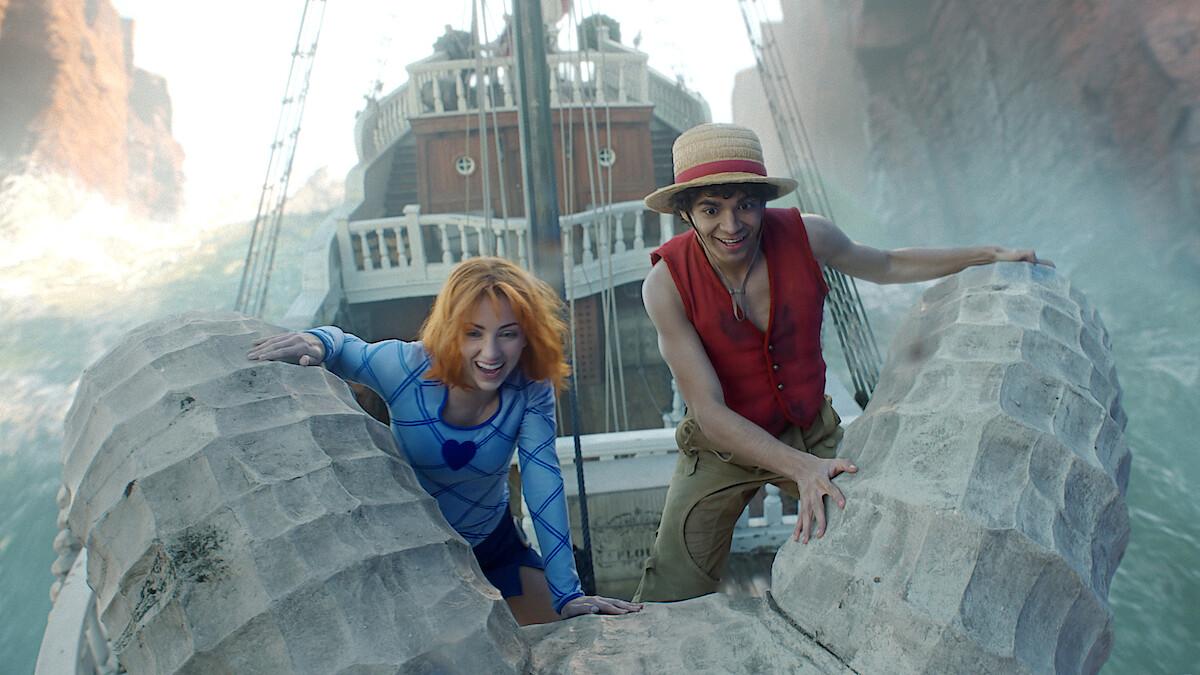
The passage across Reverse Mountain marks one of the season’s most visually daring sequences. This colossal summit serves as the nexus where four seas converge, and astonishingly, a river flows upwards against gravity towards its peak – the true gateway into the Grand Line. The production team ingeniously recreated this ascent on an immense, inclined set, forcing the actors to perform scenes while physically navigating a tilted deck. Upon cresting the summit, the narrative immediately confronts the crew with the colossal whale, Laboon. Laboon’s sheer size is so overwhelming that the Going Merry is swallowed whole. Luffy’s compassionate decision to soothe the distressed creature with song rather than resorting to violence beautifully encapsulates the show’s inherent streak of absurd, yet profound, compassion, executed with remarkable grace.
Whiskey Peak: Frontier Charm and Fierce Duels
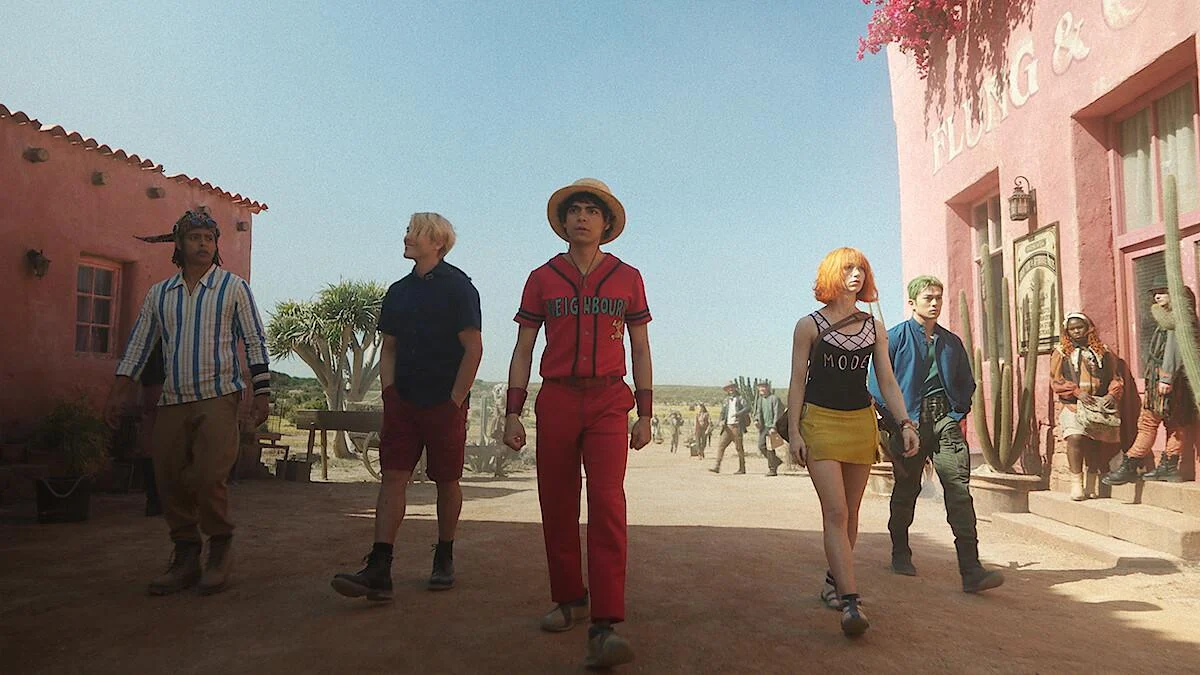
Whiskey Peak arrives next, presenting itself initially as a cheerful pirate sanctuary, constructed upon exaggerated frontier imagery. Towering cactus formations dominate the horizon, while lantern-lit saloons overflow with music, revelry, and suspiciously enthusiastic hosts. The episode expertly evokes the spirit of Sergio Leone Westerns, filtered through the lens of anime surrealism. A dramatic midnight ambush allows the season to stage one of its most kinetic and exhilarating action sequences, as Zoro engages in a brutal brawl against a hundred assassins within the sprawling confines of a saloon. Mackenyu delivers a performance imbued with grounded martial discipline, a stark contrast to the quirky costumes and outlandish hairstyles of his opponents. This grounding in physical realism is a crucial element that helps anchor the sequence, a feat that many live-action anime adaptations struggle to achieve.

Little Garden: A Prehistoric Playground and Ancient Honor
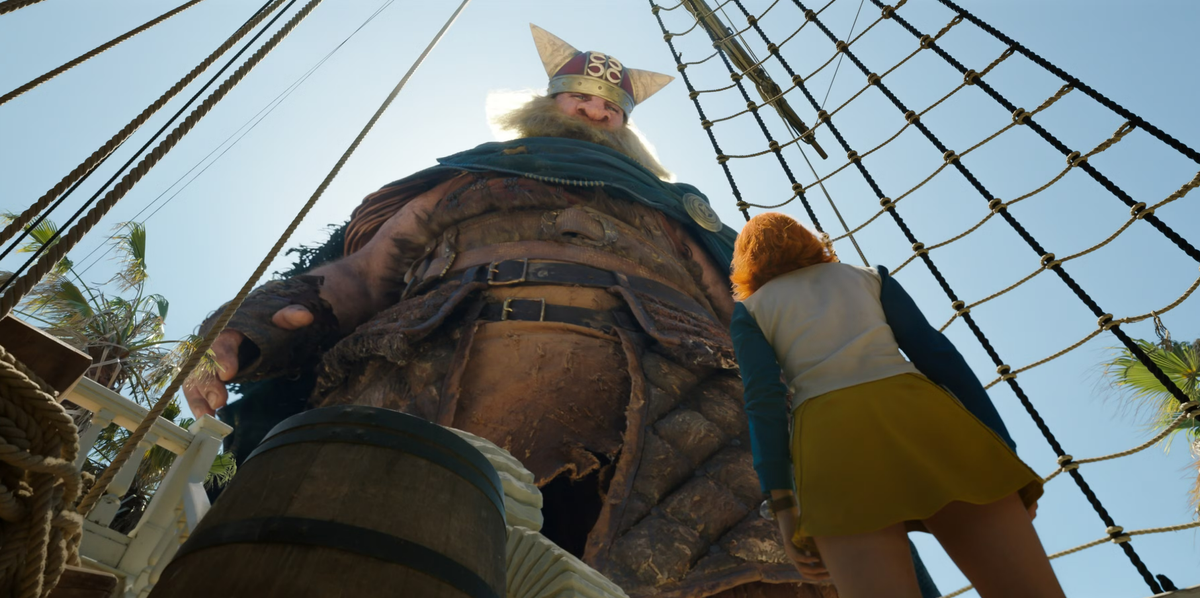
Little Garden dramatically expands the world’s imaginative bandwidth, transporting the crew to an island seemingly frozen in a prehistoric epoch. Here, formidable dinosaurs roam through humid, untamed jungles, while two colossal giants, Dorry and Brogy, continue a duel that commenced over a century prior. This ancient stalemate evolves into a surprisingly reflective meditation on honor and the warrior’s code, echoing themes found in classical heroic epics while retaining the whimsical spirit that defines One Piece. The production teams wisely leaned heavily on oversized physical sets and practical prosthetics to portray the giants, a decision that successfully prevents the environment from devolving into weightless, unconvincing digital imagery.
Drum Island: Tragedy, Healing, and the Dawn of a Doctor

Drum Island concludes the season’s arc with a significant tonal pivot, delving into themes of tragedy and profound healing. The island’s geography is characterized by towering, cylindrical mountains capped with perpetual snow, encircling the ruined Drum Kingdom. This kingdom was once ruled by a despotic monarch, Wapol, who callously monopolized the country’s medical resources before ultimately abandoning his people. When Nami contracts a life-threatening illness, the Straw Hats are compelled to scale these frozen peaks to reach the eccentric physician, Dr. Kureha. Her cynical demeanor, however, masks a deeply compassionate worldview, shaped by the memory of her late peer, Dr. Hiruluk. The narrative expertly transforms the island into a profound medical parable, where Hiruluk’s enduring belief that a nation can be cured through compassion becomes the philosophical bedrock for the introduction of the crew’s future doctor, a development that resonates deeply with the series’ overarching themes.
The Heart of the Crew: Character Dynamics and Ensemble Strength
At the core of this fantastical parade of eccentric islands, the Straw Hats themselves remain the unwavering anchor that prevents the narrative from drifting into incoherence. Iñaki Godoy continues to portray Luffy with an earnestness that borders on reckless optimism, perfectly embodying the character’s unique blend of childlike innocence and unyielding resolve. Emily Rudd sharpens Nami’s keen intellect and moral pragmatism, transforming her into the crew’s unofficial strategist whenever danger escalates. Jacob Romero Gibson imbues Usopp’s inherent cowardice with an emotionally recognizable vulnerability, rendering him far more than a purely comedic figure. Taz Skylar’s Sanji radiates an effortless charisma, his flashy martial-arts kicks and flirtatious bravado subtly masking a surprising depth of emotional sensitivity. Finally, Mackenyu’s Zoro anchors the ensemble with his dry stoicism and disciplined swordsmanship, providing a crucial tonal counterweight whenever the story threatens to veer too far into farce. The group’s infectious chemistry is palpable, already carrying the goofy, relaxed rhythms of friends who have shared too many near-death experiences to remain strangers.
Expanding the Universe: Supporting Cast and Technical Marvels
The expanding supporting cast further enriches the narrative tapestry. Lera Abova glides through her scenes as Miss All Sunday with a bewitching aura of threat, subtly hinting at deeper, more complex ambitions. Charithra Chandran injects warmth and a compelling sense of urgency into the portrayal of Princess Vivi, whose burgeoning alliance with the Straw Hats slowly but surely reshapes the season’s stakes. And David Dastmalchian chews scenery with delightful abandon as the wax-wielding Mr. 3, providing memorable moments of villainous flair.
The season’s most daunting technical challenge was undoubtedly the iconic Tony Tony Chopper, voiced by Mikaela Hoover. Rendering a talking reindeer who walks upright, cries convincingly, and interacts seamlessly with human actors carried the same peril that once plagued the adaptation of Sonic the Hedgehog. However, the visual effects team has seemingly found that delicate balance between cartoon charm and believable texture. Chopper’s expressive eyes and hesitant voice carry the weight of his tragic backstory, effectively transforming the seemingly whimsical mascot into a fully realized and emotionally resonant character.
Subtle Seeds and Future Foreshadowing: The Meta-Narrative
Long-time readers of the manga will undoubtedly discover additional pleasures hidden within the narrative’s margins. The series makes several surprising narrative choices that subtly hint at events far beyond the scope of this current season. Conversations reference the mysterious battle of God Valley and the enigmatic "Will of D." A fleeting pose echoes the ancient legends surrounding the Sun God Nika. Wooden carvings offer glimpses into the distant, mythical land of Elbaph. A flashback to the Reverie expands upon the intricate political tensions that are actively shaping the world. Furthermore, subtle lines pertaining to Sanji’s childhood suggest a complex backstory that is still waiting to be unveiled.
However, perhaps the most charming surprise arrives during the Laboon flashback. A familiar violinist makes a brief appearance amongst the Rumbar Pirates, performing the beloved sea shanty "Binks’ Brew" (or "Binks no Sake"). None of these meticulously placed details disrupt the immediate narrative flow, yet the writers have quietly planted potent seeds for stories that will not fully blossom until much later in the overarching saga. This masterful weaving of future plot points demonstrates a profound understanding of Oda’s grand design.

The Enduring Spirit of Freedom: Implications and a Glimpse of the Horizon
The greatest triumph of the live-action adaptation lies in its faithful capture of the indomitable spirit that compels fans to return to Oda’s universe year after year. The story has definitively moved beyond mere introductions and has fully embraced the exhilarating rhythm of island-hopping escapades, flamboyant villains, and emotionally resonant climaxes that have come to define the saga. Across the past year, the iconic Straw Hat flag has appeared on revolutionary banners around the globe, serving as a potent symbol of resistance against oppression and tyranny. The live-action series astutely understands why this symbol resonates so deeply.
In his own wonderfully peculiar ways, Luffy consistently frames piracy not as mere lawlessness, but as a profound metaphor for freedom – a resolute refusal to accept rigid hierarchies that stifle imagination, dignity, or dreams. Season two unequivocally proves that this core philosophy can successfully navigate the transition from the intricate panels of manga to the expansive spectacle of live-action television with surprising grace and emotional impact. With the horizon now clearly pointing towards the unfolding political turmoil of Alabasta, the voyage of the Straw Hat Pirates appears only to be gathering further momentum, promising even greater adventures and deeper explorations of the human condition within this richly imagined world.
One Piece Season 2 is currently streaming on Netflix.
