

NEW DELHI — For decades, the arrival of autumn in Northern India has been synonymous with a thick, suffocating blanket of grey smog that descends upon the National Capital Region (NCR). While the seasonal crisis is a well-known phenomenon, the precise mechanics of how toxic smoke travels from rural farm fires to urban lungs have remained partially obscured by technological limitations.
A groundbreaking study, conducted by a joint consortium of Indian and Japanese researchers, has finally mapped this "toxic trail" with unprecedented precision. Utilizing a dense network of ground-level sensors, the team successfully tracked massive plumes of particulate matter originating in the agricultural heartlands of Punjab and Haryana as they migrated directly into Delhi. The findings, which reveal extreme pollution levels often missed by multi-billion dollar satellite arrays, are set to redefine how the region approaches air quality management and public health.
Main Facts: A Breakthrough in Atmospheric Tracking
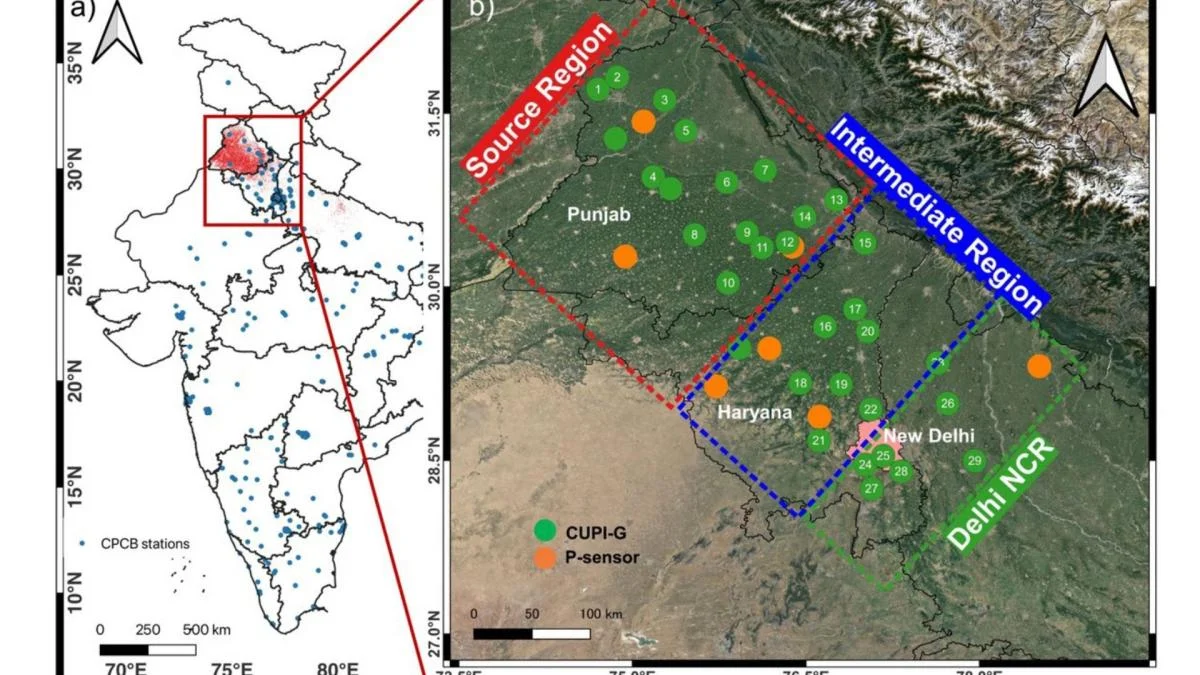
The study, which focused on the post-monsoon burning season, deployed a high-density grid of 32 robust air quality monitors across rural Punjab, Haryana, and the Delhi NCR. This initiative was a collaborative effort involving the Research Institute for Humanity and Nature (RIHN) in Japan, Nagoya University, the Postgraduate Institute of Medical Education and Research (PGIMER) in Chandigarh, Panjab University, and Jawaharlal Nehru University (JNU).
The core revelation of the research is the identification of a direct, quantifiable link between rural stubble burning and urban air quality spikes. While satellites have long provided a "bird’s-eye view" of thermal hotspots, they are frequently hindered by the very haze they seek to measure. By placing sensors directly in the wind’s path at ground level, the researchers were able to bypass these "blind spots" and record real-time data on Fine Particulate Matter (PM2.5).
Key findings from the report include:

- Direct Trajectory: Two massive PM2.5 plumes were tracked moving from rural Punjab, across Haryana, and into Delhi with a transit time of 24 to 72 hours.
- Invisible Extremes: In rural farming villages—areas traditionally ignored by official monitoring networks—hourly PM2.5 concentrations frequently exceeded 1,000 micrograms per cubic meter ($mu g/m^3$).
- The Midnight Spike: Contrary to the timing of the fires (usually midday), the most hazardous air quality at ground level occurs between midnight and early morning due to atmospheric trapping.
Chronology of the Crisis: From Field to City
The pollution cycle in Northern India is dictated by a rigid agricultural calendar. To understand the study’s significance, one must look at the timeline of the 2022 post-monsoon season, which served as the primary data window for this research.
September – Early October: The Harvest Window
Following the monsoon, farmers in Punjab and Haryana harvest their paddy crops. However, the window to sow the subsequent wheat crop is extremely narrow—often less than three weeks. To clear the massive volume of leftover rice straw (stubble) quickly and at zero cost, farmers resort to open-field burning.
Mid-October: Deployment of the Sensor Grid
Recognizing the limitations of existing urban-centric monitors, the Indo-Japanese team installed 32 low-cost but high-precision sensors across a strategic corridor. Unlike the official stations managed by the Central Pollution Control Board (CPCB), which are mostly located in cities, these sensors were placed in the heart of the "source zones" in rural Punjab.
Late October – Early November: The Plume Movement
As the burning intensified, the sensors began recording massive spikes. The data showed a distinct "wave" effect. A spike in PM2.5 in a village near Amritsar would be mirrored by a spike in Rohtak a day later, and finally in Delhi 24 to 48 hours after that. This chronological "fingerprinting" proved that the smoke was not merely dissipating into the atmosphere but was traveling as a concentrated, toxic river of air.
Late November: The Atmospheric Lockdown
As temperatures dropped toward the end of the month, the researchers observed the "Planetary Boundary Layer" effect, where the cooling air trapped the smoke close to the ground, leading to the most severe health impacts recorded during the study.

Supporting Data: The Science of "Ground-Truth"
The data harvested from the 32-sensor network provides a stark contrast to the data typically provided by the MODIS or VIIRS satellite instruments.
The Failure of Satellite Imagery
Satellites measure Aerosol Optical Depth (AOD), which calculates the total column of pollution from the ground to the edge of space. However, when the smoke is thick or when there is cloud cover, satellites cannot "see" what is happening at the breathing level. The study found that during peak pollution events, satellite data often underestimated the severity of the smog because the sensors were literally blinded by the haze.
The "Lid" Effect: Planetary Boundary Layer (PBL)
One of the most significant scientific contributions of this study is the explanation of the "Midnight Spike." Farmers typically set fires around noon when the sun is high and the stubble is dry. However, the sensors showed that air quality in Delhi and rural villages was actually better in the afternoon than at night.
This is due to the Planetary Boundary Layer—the lowest part of the atmosphere. During the day, heat from the sun causes the PBL to rise, giving the smoke more room to dilute. At night, the PBL collapses toward the earth like a heavy lid. This traps the smoke in a shallow layer of air, concentrating the PM2.5 to lethal levels just as citizens are sleeping and their bodies are most vulnerable.
Quantitative Extremes
The World Health Organization (WHO) recommends a 24-hour average exposure to PM2.5 of no more than 15 $mu g/m^3$. The ground sensors in rural Punjab recorded hourly peaks exceeding 1,000 $mu g/m^3$. This means that for hours at a time, rural populations were breathing air that was more than 60 times the safety limit—a reality that was previously "invisible" to the government’s urban-focused monitoring stations.

Official Context and Responses
For years, the blame game between the state governments of Punjab, Haryana, and the Delhi administration has stalled meaningful policy. Delhi officials often blame "external" smoke, while rural states point to Delhi’s internal factors like construction dust and vehicular emissions.
The CAQM and GRAP Framework
In response to previous crises, the Commission for Air Quality Management (CAQM) implemented the Graded Response Action Plan (GRAP). This plan triggers specific actions—such as banning construction or closing schools—based on PM2.5 thresholds. However, GRAP has often been criticized for being "reactive" rather than "proactive."
The Impact of New Data on Policy
The Indo-Japanese study provides the "smoking gun" evidence needed to shift from reactive to predictive governance. With the knowledge that a plume takes 1–3 days to travel from Punjab to Delhi, authorities can now implement "Early Warning Systems."
"By showing exactly how and when the smoke travels, we can now predict a hazardous smog event in Delhi two days before it hits," the researchers noted. This allows for:
- Advance School Closures: Preventing children from commuting during peak plume arrival.
- Targeted Agricultural Intervention: Deploying "Happy Seeder" machines (which sow seeds without burning stubble) to the specific villages identified as major plume contributors.
- Medical Readiness: Alerting hospitals to prepare for an influx of respiratory cases based on the sensor data.
Implications: A Shift Toward Environmental Justice
Beyond the technical achievements, this research highlights a critical issue of environmental justice. For years, the air pollution discourse in India has been "Delhi-centric." The narrative focused on the health of urban office workers and diplomats.

The Rural Health Crisis
The study’s revelation that rural villages face PM2.5 levels of 1,000 $mu g/m^3$ shifts the focus back to the farmers themselves. These communities are the first and most severely impacted by the smoke. The researchers argue that environmental policies must protect the health of farming communities at the source, rather than treating them merely as "polluters" to be fined.
Future Research: Secondary Particulates
The team acknowledged that while they have mapped the physical movement of smoke, the chemical evolution of the air is the next frontier. As smoke travels, gases like nitrogen oxides and volatile organic compounds react with sunlight to form "secondary particulates." Future phases of the study will analyze ozone and carbon monoxide levels to understand how the smoke becomes more toxic as it travels.
Global Applications
The success of the India-Japan sensor network offers a blueprint for other regions struggling with seasonal biomass burning, such as Southeast Asia (the "Asean Haze") and parts of sub-Saharan Africa. The use of low-cost, robust ground sensors proves that high-quality data can be gathered in developing regions without relying solely on expensive satellite infrastructure.
Conclusion: Clearing the Air
The findings from the 2022-2023 campaign serve as a wake-up call for South Asian environmental policy. The ability to track toxic plumes in real-time strips away the anonymity of air pollution, turning a vague seasonal "act of God" into a trackable, predictable, and ultimately manageable meteorological event.
As the region prepares for future winters, the integration of ground-sensor data with satellite imagery will be essential. However, the study concludes that data alone is not a cure. While we can now see the smoke with terrifying clarity, the ultimate solution remains rooted in providing farmers with viable, economic alternatives to burning—ensuring that the "toxic trail" is broken before it ever begins.
