

The Onasadya, a revered culinary tradition of Kerala, is undergoing a fascinating evolution. For generations, this elaborate vegetarian feast, served on a banana leaf with a prescribed sequence of over two dozen dishes, has remained remarkably consistent. However, a new wave of chefs is challenging this culinary orthodoxy, reinterpreting the sadya not as a rigid ritual to be preserved, but as a dynamic format ripe for creative exploration. This shift is sparking a lively debate about the delicate balance between honoring tradition and embracing culinary innovation.
A Feast Reimagined: From Ritual to Canvas
The Onasadya has long been defined by its fixed structure: a precise arrangement of dishes, each cooked in a traditional manner, meticulously placed on a banana leaf to guide the diner through a symphony of flavors and textures. The order itself is as significant as the food, a culinary choreography that culminates in a harmonious blend of sweet, sour, salty, and spicy notes. Yet, this steadfast adherence to convention is beginning to waver as a growing number of chefs are viewing the sadya as a fertile ground for experimentation.
Chef Arthi Rathore, a participant in MasterChef India Tamil, exemplifies this new approach. At a pop-up venue in Ghitorni near Gurugram last year, her sadya offered a radical departure from the norm. A red rice congee, infused with sambar spices and crowned with avial vegetables, replaced the traditional rice dish. An olan, typically a creamy ash gourd curry, was transformed into a delicate consommé, accompanied by grilled pineapple. Even the beloved pradhaman, a rich rice pudding, was reimagined as a toasted coconut cake drizzled with salted jaggery caramel. While these creations might appear, on paper, to bear little resemblance to their ancestral counterparts, a taste reveals the unmistakable essence of sadya flavors, artfully rearranged into novel forms.
"We wanted to innovate while staying true to the ethics of the sadya," Rathore explains. "There’s been a lot of innovation globally around food from the north of India, and almost none from the south. I wanted to show that southern food can be reimagined too, because of the sheer power of flavor we have here." Her philosophy underscores a desire to showcase the inherent versatility and depth of South Indian cuisine, proving it can transcend its traditional confines without losing its soul.
The Non-Vegetarian Gambit and Superfood Infusions
Perhaps the most striking departure comes from Sara Jacob Nair, co-founder and executive chef of Nair On Fire, a Mumbai-based chain of delivery kitchens specializing in authentic home-style Kerala cuisine. Nair’s approach boldly integrates non-vegetarian elements into the traditionally vegetarian sadya. Her onsadya retains the classic vegetarian spread but introduces a celebratory roast of prawn, fish, chicken, mutton, or buff. This inclusion is a direct nod to the Syrian Christian households of Kerala, where meat and seafood have long been integral to festive meals.
This innovative inclusion has proven exceptionally popular, with over 60 percent of Nair’s customers now opting for the non-vegetarian version. "It’s about evolving with contemporary palates while respecting the core," Nair states. "We’re not replacing tradition; we’re expanding its embrace."

Furthermore, Nair is pioneering a "superfood sadya" concept, building her menu around ingredients like black rice, palm jaggery, jackfruit, and moringa. She views these not as trendy additions but as fundamental components that have historically underpinned Kerala’s culinary landscape. "These are ingredients that have always been part of our cooking, we’re just highlighting them and their inherent goodness," she asserts.
Nair also reconfigures the presentation, transforming the traditional 20-30 dishes on a leaf into a structured, course-wise dining experience. "A Malayali doesn’t need instruction; you just mix everything on the leaf and eat. But for someone unfamiliar with the cuisine, 25-30 dishes can be overwhelming. This gives them an entry point," she explains. She is firm in her conviction that this is not a dilution of the sadya but rather an act of "creating more doors into tradition."
Subtle Shifts and Deconstructed Delights
Not all reinterpretations venture into such bold territory. At OMO in Gurugram, Culinary Director Chetna Chopra adopts a more conservative approach. While keeping the classic dishes largely intact, she subtly introduces ingredient variations. A toran might feature fiddlehead fern instead of beans, a pulissery could incorporate pineapple, and the payasam might be crafted with Kashmiri plums sourced from a partner farm.
"The idea is to create an unmistakably traditional sadya seen through our sourcing philosophy, rather than a contemporary reinterpretation," Chopra states. Her focus is on enhancing the sadya by highlighting premium, seasonal, and ethically sourced ingredients, thereby elevating the familiar without fundamentally altering it.
In Mumbai, Sarada Krishnan, founder of South Side Mumbai, a catering company and supper club, has been meticulously preparing traditional Onasadya for six years. This year, however, she’s injecting a modern flair into the presentation by offering each dish as a tasting portion. Her menu showcases parippu vada with puli inji and chammandi, mooru curry balls, and a pothichoru featuring Kerala red rice accompanied by sambar, avial, kalan, olan, thoran, and manga curry, all wrapped in banana leaf. For Krishnan, the format is evolving, but the essence of the food remains paramount.
"The intention is to honor the essence of the sadya while presenting it in a way that allows every guest to appreciate each individual preparation," she says. This approach aims to make the complex sadya more accessible and digestible, allowing diners to savor each component before experiencing the harmonious blend.

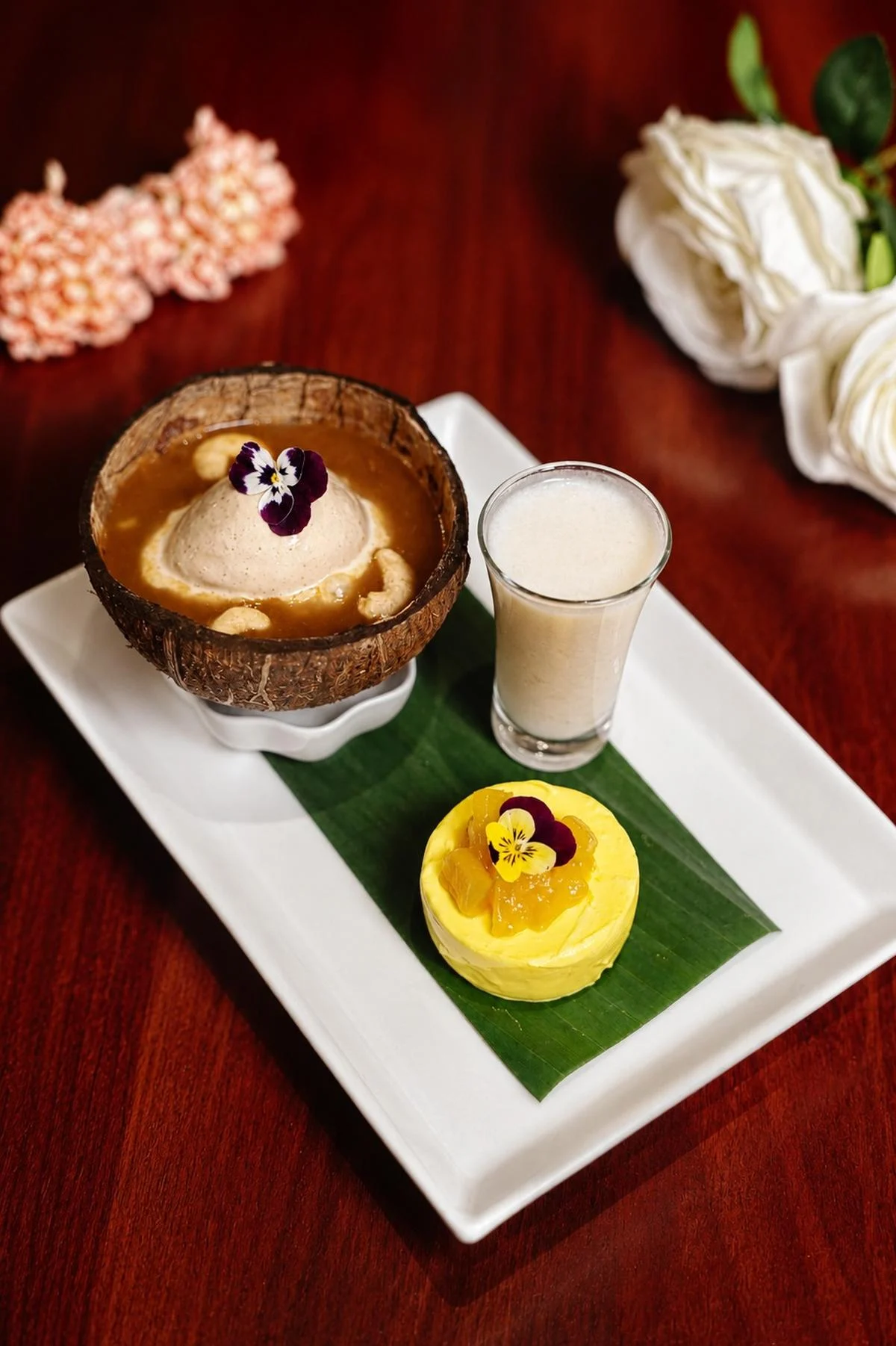
Further afield, at Punjab Grill in Dubai, Brand Executive Chef Sandeep Ail has found a middle ground by focusing his experimentation on the dessert course. He meticulously preserves the traditional forms of all savory dishes, recognizing their iconic status. His creative endeavors are reserved for the sweets: pal payasam is transformed into ice cream, served alongside ada pradhaman in a coconut shell, while jackfruit and tender coconut are combined in a panna cotta.
"The heart of a sadya lies in its iconic dishes like avial, olan, kalan, and erissery, so we stayed true to those recipes," Ail explains. His strategy is straightforward: maintain the comforting, familiar flavors of the savory courses and introduce unexpected delights in the sweet finale. This allows diners to experience the traditional sadya they know and love, with a playful and innovative twist at the end.
The Purists’ Perspective: A Defense of Tradition
However, not all culinary figures embrace these reinterpretations. Marina Balakrishnan, renowned for her unwavering commitment to traditional sadya, views these innovations with skepticism, considering them more as "interference" than genuine elevation.
"A sadya is already elevated. How do you elevate an avial by turning its sauce into a foam?" Balakrishnan questions. "The beauty of an avial is its rusticity, its earthiness, the way the vegetables are cut, the coarseness of coconut. There’s a reason it’s done that way." She argues that such deconstructions strip away the very essence of what makes dishes like avial so beloved.
Balakrishnan recounts an experience with a nine-course sadya where rasam was served through a percolator. "If something is already perfect in color, flavor, and texture, why meddle with it?" she asks. She invokes Ayurvedic principles, suggesting that a traditional sadya on a banana leaf is a complete sensory experience designed to engage all six rasas. "If you serve it French style, is that still a sadya? The invention here was already made decades ago. You’re only tampering with what was there before." Her perspective highlights a deep respect for the established culinary wisdom and a concern that innovation for its own sake can undermine the integrity of a time-honored tradition.
Preserving the Ritual: The Uncompromising Format
For some chefs, the sadya’s enduring appeal lies precisely in its strict adherence to tradition. Regi Mathew, who helms Kappa Chakka Kandhari in Chennai and Bengaluru, and Chatti in New York, has been serving sadya in restaurants since 2007. This year, Chatti is presenting its own Onasadya with 27 dishes, maintaining an uncompromising format.

Mathew goes to extraordinary lengths to preserve authenticity, even bringing Namboodaris from Kerala to prepare the feast. This ensures that the customs and rituals surrounding the meal are given as much importance as the food itself. "A sadya has cultural nuances and rules. The Namboodaris start with prayers before the flame is even lit," Mathew explains. "I could cook it myself, but when they make it, it becomes more than a meal. It’s our culture on a plate."
He emphasizes the intricate logic embedded within the sadya’s structure. "The number of dishes is always odd, twenty-five or twenty-seven, each with a fixed place on the leaf that dictates the order in which it’s eaten, building toward four payasams and ending in buttermilk for digestion," he elaborates. "It’s all very logical, very scientific. When you put hot rice on a banana leaf, the polyphenols in it rupture and add flavor to the food. You can’t get that with a plate. And you can’t really enjoy a sadya with a spoon and fork; it has to be eaten with your hand," he insists. His perspective underscores the sensory and scientific considerations that have shaped the sadya over centuries.
The Future of the Feast
The question is no longer whether the sadya can change, but rather how much it can evolve before it risks becoming something else entirely. Thankfully, the traditional sadya, with its deep-rooted cultural significance and exquisite flavors, is not going anywhere. Simultaneously, the chefs who are passionately reinterpreting it are also ensuring its continued relevance and appeal to a broader audience.
This Onam, both the steadfast traditionalists and the adventurous innovators will be sharing the table, offering a rich tapestry of culinary expression. The evolving plate of the Onasadya reflects a dynamic gastronomic landscape where tradition and innovation engage in a flavorful dialogue, ensuring that this beloved feast continues to delight and inspire for generations to come. The debate itself is a testament to the enduring power and cultural significance of the Onasadya, a meal that continues to provoke thought and conversation, much like its complex and layered flavors.
