

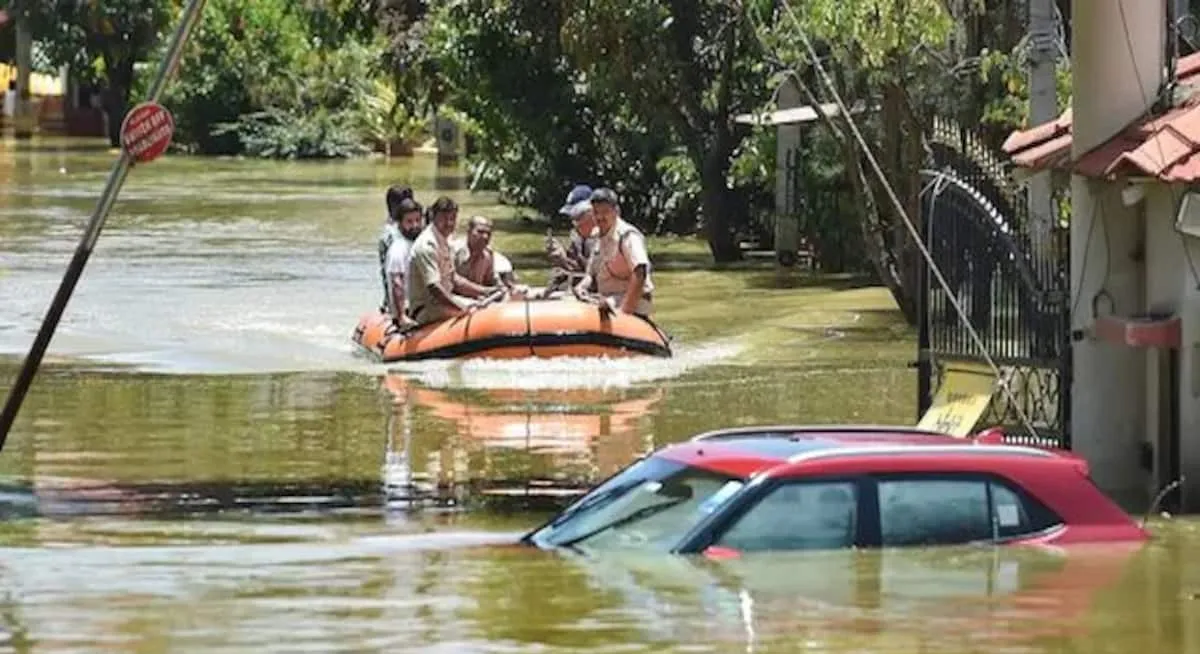
BENGALURU – For decades, Bengaluru was celebrated as India’s "Garden City," a temperate upland retreat defined by its sprawling parks and a sophisticated network of interconnected lakes. Today, that reputation is being submerged under the weight of rapid urbanization and a destabilized climate. As El Niño-induced weather patterns bring unpredictable monsoon delays followed by violent, concentrated downpours, the city’s infrastructure is buckling.
In a landmark effort to provide a technological shield against this rising tide, researchers from the CSIR Fourth Paradigm Institute (CSIR-4PI) and the Academy of Scientific and Innovative Research (AcSIR) have unveiled a high-resolution hydrological "digital twin" of one of the city’s most flood-prone regions. Published recently in the journal Natural Hazards, a Springer Nature publication, the study utilizes the United States Environmental Protection Agency’s (EPA) Stormwater Management Model (SWMM) to simulate urban deluge with unprecedented accuracy.
This digital framework offers more than just a post-mortem of past disasters; it provides a predictive blueprint that could save lives and billions in economic assets in India’s Silicon Valley.
1. The Core Challenge: An Engineered Crisis
Bengaluru’s transformation into a global IT hub has come at a staggering environmental cost. The city’s natural topography is defined by three major ridge lines that create a series of valleys. Historically, these valleys were home to a "tank-chain system"—man-made lakes designed centuries ago to capture runoff and move it gently from higher elevations to lower ones.
However, the "Silicon Valley" boom saw these natural drainage pathways systematically paved over. Wetlands were replaced by high-tech business parks, and natural streams were "engineered" into narrow, concrete-lined storm drains (Rajakaluves).
When extreme rainfall events occur—a phenomenon increasing in frequency due to climate change—the rainwater has nowhere to seep into the earth. Instead, it hits impervious concrete and asphalt, transforming streets into raging rivers. This situation has been described by urban experts as a "legally engineered" disaster, where planning permissions often ignored the hydrological reality of the terrain.
2. Chronology of a Deluge: Analyzing Historical Floods
To build a model capable of predicting the future, the research team first had to master the past. They focused on the Koramangala-Challaghatta (KC) Valley, a 299-square-kilometer watershed in the city’s southeast. This area is the nerve center of Bengaluru’s economy, housing major IT corridors, but its bowl-like topography makes it a perennial victim of inundation.
The researchers analyzed four notorious historical flood events that paralyzed the city:
- September 15, 2015: An early warning of the infrastructure’s fragility.
- June 1, 2016: A pre-monsoon strike that caught the administration off guard.
- August 15, 2017: The most devastating event in the study, where 109.28 millimeters of rain fell within 24 hours, submerging massive swathes of the KC Valley.
- September 24, 2018: A late-season downpour that highlighted the "backwater effect" in clogged drains.
By gathering granular, hourly data from 26 telemetric rain gauge stations, the team was able to feed real-world "stress tests" into their digital model. The results were striking: the simulation’s recreated water surges matched the actual recorded levels with a margin of error of just plus-or-minus four cubic meters per second.
3. Supporting Data: The Physics of the Digital Twin
The "Digital Twin" is not merely a map; it is a complex mathematical recreation of urban physics. The study’s methodology represents a significant evolutionary leap over traditional hydrological modeling used in India.
High-Resolution Mapping
Using satellite data from India’s CARTOSAT and the international Shuttle Radar Topography Mission (SRTM), the researchers carved the KC Valley into 39 distinct "sub-catchments." Each unit was assigned specific parameters based on its slope, land-use type (concrete vs. vegetation), and soil characteristics.
The Mathematics of Flow
The model employs several critical equations to track water movement:
- Modified Green-Ampt Infiltration: This calculates how much water the soil can actually absorb before it begins to pool on the surface.
- Manning’s Equation: This accounts for "surface roughness." It recognizes that water flows faster over a smooth concrete road than it does over a grassy park, allowing for more accurate velocity predictions.
- Saint-Venant Equations: These are the heart of the "dynamic wave routing." Unlike older models that assumed water flows in a simple, steady stream, these equations account for water pressure, local acceleration, and—crucially—backwater effects. This is what happens when a drain is too narrow or "choked," causing water to flow backward and flood upstream neighborhoods.
4. Official Responses and Institutional Realities
The study arrives at a critical juncture for the Greater Bengaluru Authority (formerly the Bruhat Bengaluru Mahanagar Palike, or BBMP). For years, the municipal response to flooding has been reactive: deploying pumps after the water has already entered homes or arbitrarily widening drains without a scientific understanding of the watershed’s capacity.
While the research provides a sophisticated tool, the authors and urban planners highlight several "real-world" hurdles that the administration must address:
The "Clog" Factor: The model assumes that stormwater channels are clean. In reality, Bengaluru’s drains are often choked with plastic waste, construction debris, and silt. Researchers warn that if the drains are 50% blocked by trash, even the best predictive model will underestimate the flooding.
The Pace of Construction: Using Landsat-7 imagery, the study accounts for land use, but Bengaluru grows faster than satellites can often track. A "green" zone in a 2022 map might be a "concrete" apartment complex by 2024, further increasing runoff rates.
The Call for a Decision-Support System: The researchers are now urging the city administration to integrate this model into a "Proactive Decision-Support System." By plugging real-time weather forecasts into the calibrated model, the BBMP could receive a 3-to-6-hour head start. This would allow for:
- Targeted Evacuations: Moving residents from specific low-lying blocks before the rain peaks.
- Strategic Deployment: Placing emergency NDRF (National Disaster Response Force) teams and heavy-duty pumps at known "bottleneck" points identified by the model.
- Traffic Management: Diverting vehicles away from zones the model predicts will be submerged, preventing the multi-hour gridlocks that typically follow Bengaluru rains.
5. Implications: Toward a Resilient Urban Future
The implications of this research extend far beyond the KC Valley. As climate change accelerates, the "Bengaluru Model" of flash flood simulation could be exported to other rapidly urbanizing Indian cities like Hyderabad, Pune, and Chennai, which face similar topographical challenges.
Economic Preservation
The economic cost of Bengaluru’s floods is measured in the hundreds of crores. When IT parks are flooded, global supply chains are disrupted, and productivity plummets. By using the digital twin to optimize drainage investment, the city can ensure that public funds are spent on widening the correct channels rather than speculative construction.
Nature-Based Solutions
Perhaps most importantly, the model allows planners to run "what-if" scenarios. For example, what if the city converted 10% of its concrete rooftops to green roofs? Or what if permeable pavements were installed in Koramangala? The simulation can quantify exactly how much these "green infrastructure" interventions would reduce the pressure on the drainage grid, providing a scientific basis for sustainable urban design.
A Warning and a Hope
The study serves as a stark reminder that Bengaluru can no longer rely on its historical climate. The delay in the monsoon this year, followed by the threat of extreme "cloudburst" style events, suggests a future of volatility.
"This research marks a transition from ‘disaster management’ to ‘disaster prevention’," says the study’s conclusion. By embracing the "Fourth Paradigm" of data-intensive science, Bengaluru has the opportunity to reclaim its status as a livable city. The digital twin is ready; the question remains whether the city’s governance will move fast enough to implement it before the next clouds gather over the KC Valley.
Data Summary Table: The KC Valley Study at a Glance
| Parameter | Metric |
|---|---|
| Study Area | Koramangala-Challaghatta (KC) Valley |
| Total Area | ~299 Square Kilometers |
| Modeling Software | EPA Stormwater Management Model (SWMM) |
| Historical Benchmark | August 15, 2017 (109.28 mm rainfall) |
| Sub-catchments | 39 distinct drainage units |
| Simulation Accuracy | Discharge bias within ±4 m³/s |
| Key Topography | Cascading tank system (Madiwala, Bellandur, Varthur) |
