

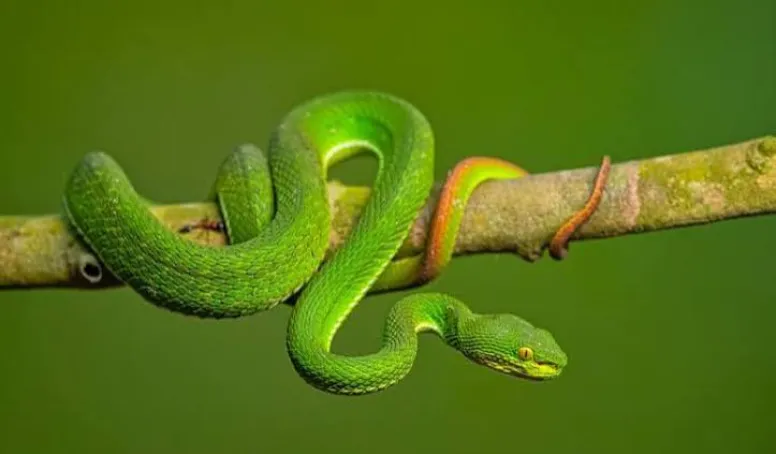
Guwahati, Assam — In the dense, humid forests of Northeast India, a silent predator is exposing a lethal gap in the country’s public health infrastructure. A groundbreaking study conducted by a consortium of India’s leading scientific institutions has revealed that the standard polyvalent antivenom—the primary treatment for snakebites across the nation—is fundamentally ineffective against the venom of the red-tailed pit viper (Trimeresurus erythrurus).
The research, a collaborative effort between the Institute of Advanced Study in Science and Technology (IASST), the Academy of Scientific and Innovative Research (AcSIR), Amrita Vishwa Vidyapeetham, and Tezpur University, warns that thousands of residents in rural and agricultural communities are being left defenseless. Despite receiving medical intervention, victims of the red-tailed pit viper often suffer from irreversible organ damage and fatal hemorrhaging, simply because the medicine available was never designed to fight this specific snake’s toxins.
The Main Facts: A Failure of Binding and Neutralization
The crux of the study lies in the molecular mismatch between the "Big Four" antivenom and the unique venom profile of the red-tailed pit viper. For decades, India’s antivenom production has focused exclusively on the "Big Four" species: the spectacled cobra, the common krait, the saw-scaled viper, and Russell’s viper. While these snakes are responsible for a high volume of bites in peninsular India, they represent only a fraction of the subcontinent’s ophidian diversity.
The research team found that the antibodies in commercial polyvalent antivenoms exhibit "poor immunoreactivity" toward the venom of the red-tailed pit viper. In simpler terms, the antivenom proteins are unable to recognize, latch onto, and neutralize the lethal toxins in the viper’s venom.

The consequences of this failure are catastrophic. The study demonstrated that even when administered in massive doses, the antivenom failed to stop the progression of systemic envenomation. Specifically, the venom’s metalloproteinases—enzymes that digest tissue and blood vessel walls—continued to function unabated, leading to severe internal bleeding, "brain congestion," and multi-organ failure.
Chronology of the Research: From Mizoram to the Laboratory
The investigation began with the recognition of a disturbing trend: clinicians in Northeast India were reporting that snakebite victims often failed to respond to standard treatment protocols. To investigate this, the research team structured their study across several phases:
- Field Collection (Mizoram): Researchers traveled to the state of Mizoram to collect venom samples directly from red-tailed pit vipers in their natural habitat. This was crucial to ensure that the venom tested was representative of the specific regional population.
- Biochemical Characterization: In the laboratory, the venom was analyzed to identify its primary toxic components. The team focused on snake venom metalloproteinases (SVMPs) and serine proteases, which are known to disrupt blood clotting and cause localized tissue necrosis.
- In-Vitro Interaction Tests: The team mixed the red-tailed pit viper venom with two of India’s most widely used commercial polyvalent antivenoms. They used immunological assays to observe whether the antivenom antibodies could bind to the venom proteins. The results showed a significant lack of affinity.
- In-Vivo Testing (Live Animal Models): To understand the physiological impact, the researchers used mice models. They administered venom followed by varying doses of antivenom.
- Histopathological Analysis: Post-mortem examinations of the test subjects were conducted to assess the extent of internal damage. This phase provided the visual evidence of the antivenom’s failure to protect vital organs.
Supporting Data: The High Cost of Evolutionary Divergence
The reason for this therapeutic failure is rooted in evolutionary biology. The red-tailed pit viper belongs to the Crotalinae subfamily, a lineage that diverged significantly from the "Big Four" vipers (which belong to the Viperinae subfamily). This evolutionary distance means that the protein structures in the red-tailed pit viper’s venom are distinct.
The study’s data paints a grim picture:
- Organ Damage: Mice treated with standard antivenom still showed massive congestion in the lungs and brain, as well as degeneration of the heart muscles and kidney tubules.
- Hematological Failure: The venom caused a sharp drop in blood cell counts, a condition the antivenom could not reverse.
- Lethality Gap: The dose of antivenom required to provide even a marginal chance of survival in the models was exponentially higher than what is considered standard, and even then, it did not prevent long-term morbidity.
This study follows previous work by the same team regarding Pope’s pit viper (Trimeresurus popeiorum), which also showed resistance to standard antivenoms. However, the data suggests that the red-tailed pit viper may be even more lethal, requiring a complete rethink of how envenomation is managed in the Northeast.

Official Responses and the Public Health Crisis
While the Indian government has long recognized snakebite as a "Neglected Tropical Disease" (NTD) in line with World Health Organization (WHO) classifications, the "Big Four" paradigm remains the gold standard for manufacturing.
Health experts in the region have responded to the study with a mixture of vindication and alarm. "We have seen patients consume 20, 30, or even 40 vials of antivenom without showing improvement," noted one regional healthcare consultant. "This study provides the scientific evidence for what we have observed clinically: we are using the wrong tools for the job."
The research team from IASST and its partners have called for an immediate shift in policy. They argue that the current centralized model of antivenom production—where venom is primarily sourced from a single cooperative in Tamil Nadu (the Irula Snake Catchers Industrial Cooperative Society)—is insufficient for a country as ecologically diverse as India.
Implications: The Case for Regional Antivenoms
The implications of this study extend far beyond the laboratory. It highlights a socio-economic crisis: snakebites primarily affect the rural poor—farmers, tea garden workers, and indigenous communities who are the backbone of the Northeast’s economy. When a primary breadwinner is incapacitated or killed by a snakebite that "should" have been treatable, entire families are pushed into a cycle of debt and poverty.
The study outlines three critical paths forward:

1. Decentralized Antivenom Production:
The researchers advocate for the establishment of regional venom collection centers. By including the venom of the red-tailed pit viper and other regional species (like the monocled cobra or the Himalayan pit viper) into the immunization mixture for horses (the animals used to produce antivenom), manufacturers can create a "region-specific" polyvalent treatment.
2. Next-Generation Therapeutics:
The study suggests moving toward recombinant antivenoms or monoclonal antibodies. These lab-grown treatments could be engineered to target specific protein families common to many vipers, potentially creating a "universal" viper antivenom that does not rely on traditional horse-derived antibodies, which often cause severe allergic reactions (anaphylaxis).
3. Improved Diagnostic Kits:
Currently, doctors often don’t know which snake bit a patient unless the snake is brought to the hospital. The study emphasizes the need for rapid diagnostic kits that can identify the snake species from a blood or swab sample, allowing for more targeted treatment.
Conclusion: A Call to Action
The discovery that the red-tailed pit viper venom evades India’s standard medical defense is a wake-up call for the nation’s scientific and policy-making bodies. As climate change and deforestation increase the frequency of human-snake encounters, the "one-size-fits-all" approach to snakebite treatment is no longer tenable.
The researchers conclude that while the "Big Four" antivenom has saved millions of lives over the decades, it has also created a false sense of security in regions where those four snakes are not the primary threat. To meet the WHO’s goal of halving snakebite deaths and disabilities by 2030, India must embrace the complexity of its own biodiversity.

For the people of Mizoram, Assam, and the surrounding states, the development of a regional antivenom is not just a scientific goal—it is a matter of survival. The red-tailed pit viper is a part of the landscape; it is time that the medicine used to treat its bite is finally part of the solution.
About the Study:
The study, titled "Proteomic Analysis and In-Vivo Assessment of Trimeresurus erythrurus Venom," was published by researchers from the Institute of Advanced Study in Science and Technology (IASST), Guwahati; the Academy of Scientific and Innovative Research (AcSIR), Ghaziabad; Amrita Vishwa Vidyapeetham, Kochi; and Tezpur University, Assam. It represents one of the most comprehensive efforts to date to map the efficacy of Indian antivenoms against the diverse snake species of the Northeast.
