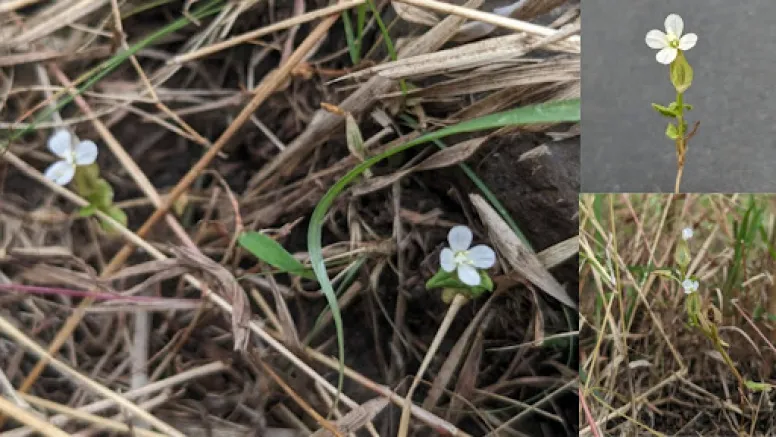
PUNE, MAHARASHTRA — In the rocky, sun-drenched stretches of Sus Hill, a seemingly unremarkable outcrop in the sprawling metropolis of Pune, a decade-long botanical mystery has finally been unraveled. Researchers from the Indian Institute of Science Education and Research (IISER) Pune and the Savanna Science Foundation have announced the discovery of Canscora agni, a new species of dwarf herb that offers more than just a new entry in the annals of Indian flora.
Named after the Sanskrit and Marathi word for fire, Canscora agni stands as a biological testament to the vital, yet frequently misunderstood, role of wildfire in maintaining the health of India’s ancient savanna ecosystems. Its discovery comes at a precarious time, as these "old-growth savannas" face existential threats from urban expansion and, paradoxically, well-intentioned but ecologically misplaced afforestation programs.
Main Facts: A Miniature Marvel of the Indian Savanna
The discovery of Canscora agni is the result of a meticulous, long-term study led by researchers Ashish N. Nerlekar and Sharad Suresh Kambale. The plant is a member of the Gentianaceae family, a group known for its medicinal properties and diverse forms. However, unlike many of its more conspicuous relatives, C. agni is a master of subtlety.
Measuring no more than 10 centimeters in height, this dwarf herb is specifically adapted to the harsh, open environments of the Western Ghats’ rain-shadow regions. Its most striking physical features include delicate white petals and uniquely "winged" stems—lateral outgrowths that give the stalk a flattened, leafy appearance.

The choice of the name "Agni" is a deliberate provocation to the current conservation orthodoxy. In the Indian context, fire is almost universally viewed as a disaster to be suppressed. Yet, for C. agni and the ecosystem it inhabits, fire is a life-giver. It clears the dense thatch of dried grasses and prevents woody shrubs from encroaching, creating the open, sunlit patches necessary for these tiny herbs to germinate and bloom.
Chronology: A Decade of Botanical Detective Work
The journey to identifying Canscora agni as a distinct species was not an overnight success but a marathon of scientific persistence that spanned over ten years.
- 2014–2016: The Initial Encounter: During routine vegetation surveys of the rocky plateaus around Pune, Nerlekar and Kambale first spotted the tiny herb. At the time, the specimens were tentatively identified as Canscora alata, a well-documented and much larger relative found across various parts of India.
- 2017–2020: Growing Doubts: As the researchers continued their field observations, they noticed consistent morphological differences that C. alata descriptions did not account for. While C. alata typically thrives in slightly more mesic (moist) environments and grows up to 60 centimeters, the Sus Hill population remained stubbornly dwarfed, even in peak growing conditions.
- 2021–2023: Global Comparison and Verification: To prove the species was new to science, the team embarked on an exhaustive comparative analysis. This involved digitizing and examining historical "type specimens" (the original physical examples used to describe a species) stored in global herbaria, including records from the British era. They compared their Pune samples with catalogs from across Southeast Asia and Africa to ensure no prior name existed for the plant.
- July 2026: Official Publication: Following peer review, the discovery was formally published, identifying the plant as a unique species endemic to the specific fire-prone savanna habitats of Maharashtra.
Supporting Data: Morphological Distinctions and Ecological Niche
To the untrained eye, Canscora agni might be indistinguishable from other small herbs. However, the researchers provided a suite of biometric data to establish its unique identity.
Comparative Morphology
The primary point of comparison was Canscora alata. The data revealed several "diagnostic" features:

- Stature: C. agni reaches a maximum height of 10 cm, whereas C. alata can reach 60 cm.
- Winged Stems: In C. agni, the wings on the stem are uneven—wider directly below the flowers and narrowing toward the base. In its taller cousin, these wings are more uniform.
- Leaf Glandularity: Microscopic examination revealed minute glandular hairs on the leaves of C. agni, a feature entirely absent in C. alata.
- Floral Architecture: The new species possesses a shorter ovary and a calyx (the base of the flower) characterized by a distinct web-like, or "reticulate," vein pattern.
The Role of "Old-Growth" Savannas
The study emphasizes that C. agni is not just found anywhere; it is a specialist of "old-growth savannas." Unlike secondary grasslands that emerge after deforestation, these are ancient ecosystems that have existed for millions of years. They are characterized by shallow, rocky soils and a "pyrophytic" nature—meaning the flora has evolved to survive and even require periodic burning.
Official Responses: The Call for Policy Shift
The researchers have been vocal about the policy implications of their find. Ashish N. Nerlekar, lead author of the study, argues that the discovery of C. agni should serve as a wake-up call for land management agencies.
"The current narrative in Indian forestry is dominated by ‘tree-centric’ conservation," Nerlekar noted in discussions following the publication. "We see open landscapes as ‘wastelands’ or ‘degraded forests’ that need to be filled with trees. But Canscora agni tells a different story. It tells us that these open, fire-prone spaces are high-biodiversity zones containing species found nowhere else on Earth."
The research team has officially suggested that Canscora agni be classified as ‘Critically Endangered’ under the IUCN Red List criteria. This recommendation is based on two primary factors:

- Geographic Restriction: The species has currently been documented in only one micro-location on Sus Hill.
- Habitat Loss: The site is under immediate threat from urban development and "greenery" initiatives that involve planting saplings in the middle of these grasslands, which effectively shades out and kills the native ground-layer flora.
Botanists from across India have echoed these concerns, suggesting that the "Agni" discovery provides the necessary scientific backing to challenge the Compensatory Afforestation Fund Management and Planning Authority (CAMPA) policies, which often target savannas for large-scale plantation drives.
Implications: Fire as a Conservation Tool
The most profound implication of the Canscora agni discovery is the need to re-evaluate the role of fire in Indian ecology. For decades, the Forest Department’s primary goal during the summer months has been "fire suppression." However, the researchers argue that total fire suppression is a death sentence for species like C. agni.
The "Savanna Paradox"
In many tropical regions, fire acts as a "herbivore," consuming biomass and preventing the landscape from turning into a dense, dark thicket. When fire is removed:
- Invasive woody species take over.
- The thick layer of unburnt grass (thatch) prevents small seeds from reaching the soil.
- The unique "dwarf" biodiversity of the savanna is choked out.
Redefining "Wastelands"
India’s "Wasteland Atlas" frequently categorizes rocky plateaus and savannas as areas in need of "reclamation." The discovery of C. agni proves that these areas are far from wasted. They are evolutionary laboratories that have produced specialized life forms capable of surviving extreme heat and seasonal drought.

A New Chapter for Urban Biodiversity
The fact that a new species was found on Sus Hill—a popular spot for morning walkers and nature enthusiasts in Pune—highlights how much of India’s biodiversity remains hidden in plain sight. It underscores the importance of protecting "urban commons" and "inselbergs" (isolated rocky hills) which act as refugia for rare species amidst the concrete jungle.
As the scientific community celebrates the naming of Canscora agni, the message remains clear: conservation is not just about planting trees. It is about understanding the ancient rhythms of the land, including the scorching heat of the fire, which allows the smallest among us to bloom. Without a shift in how we perceive and manage India’s open natural ecosystems, C. agni may vanish before the world truly learns its name.