

By [Journalist Name]
Published: June 25, 2026
The silence at 8,848 meters is unlike any other. It is a vacuum of sound where the only rhythm is the hiss of supplemental oxygen and the steady, thumping heartbeat of a climber pushed to the absolute edge of human endurance. For Dr. Priya Selvaraj, a woman whose professional life is defined by the microscopic precision of fertility medicine and the cacophony of a bustling metropolitan hospital, this silence was not a void, but a sanctuary.
What began as a desperate search for a "scenic yet culturally significant trek" to escape the claustrophobia of grief and a global pandemic eventually transformed into one of the most remarkable mountaineering trajectories in recent Indian history. Dr. Selvaraj’s ascent of Mount Everest is not merely a story of physical triumph; it is a narrative of psychological resilience, a transition from the white coats of Chennai’s GG Hospital to the down-filled suits of the "Death Zone."
I. Main Facts: A Physician’s Ascent Beyond the Clouds
Dr. Priya Selvaraj, a renowned fertility specialist and the granddaughter of the legendary Gemini Ganesan and daughter of IVF pioneer Dr. Kamala Selvaraj, has officially etched her name into the annals of high-altitude mountaineering. While her professional pedigree is rooted in the miracle of life, her personal journey over the last five years has been a flirtation with the limits of existence.
The core facts of her achievement are as follows:
- The Catalyst: The emotional toll of the COVID-19 pandemic and a profound personal loss served as the primary drivers for her departure from the city.
- The Progression: Unlike many "tourist" climbers, Selvaraj followed a rigorous, multi-year technical progression, moving from low-altitude treks to technical 6,000-meter peaks, and finally to the world’s highest 8,000-meter summits.
- Key Summits: Her resume now includes Sandakphu Phalut, Khopra Ridge, Mount Kilimanjaro (5,895m), Lobuche East (6,119m), Mount Manaslu (8,163m), and finally, Mount Everest (8,848.86m).
- Technical Qualification: Her successful ascent of Lobuche East served as the critical technical gateway, providing the necessary experience in crampon work, fixed-line navigation, and high-altitude survival required for the world’s highest peaks.
II. Chronology: The Path from Grief to the Summit
The journey of Dr. Priya Selvaraj did not begin with a childhood dream of climbing. In fact, for most of her adult life, her focus remained steadfastly on the clinical precision of reproductive medicine. The timeline of her transformation is a study in how tragedy can be redirected into transcendental physical effort.
2020–2021: The Breaking Point
The COVID-19 years brought an unprecedented "emotional upheaval" to the medical community. For Dr. Selvaraj, the weight of the pandemic was compounded by a deep personal loss. The hospital walls, once a place of purpose, became reminders of the fragility of life. Seeking a "refuge far from the noise," she turned to the one place where the air is thin and the distractions are non-existent: the Himalayas.
Early 2022: The First Steps
Her initial foray was modest. She sought "scenic and culturally significant" routes, leading her to Sandakphu Phalut on the Singalila Ridge and the Khopra Ridge in the Annapurna region. These treks were intended to be therapeutic, but they revealed a latent physiological gift: her body acclimated exceptionally well to high altitudes.
Late 2022: The Continental Shift
Encouraged by her stamina, she set her sights on Africa. Scaling Mount Kilimanjaro in Tanzania provided her first taste of a major peak. While Kilimanjaro is a non-technical walk-up, its nearly 6,000-meter altitude served as a "proof of concept" for her lungs and her resolve.
2023: Technical Maturation
Recognizing that she wanted to go higher, Selvaraj understood that she needed technical skills. She returned to Nepal to complete the Everest Base Camp (EBC) trek, but she didn’t stop at the colorful tents of the base camp. She pushed upward to Lobuche East, a technical peak that requires the use of ice axes, ropes, and harness work. Success here was the turning point; it qualified her for the "Big 8,000ers."
2024–2025: The 8,000-Meter Club
Her first major objective was Mount Manaslu, the world’s eighth-highest mountain. Often used as a precursor to Everest, Manaslu is notorious for its avalanche risks and technical summit ridge. Her "spiritually fulfilling" success on Manaslu provided the final psychological brick in the wall. She was no longer a doctor who hiked; she was a mountaineer.
2026: The Everest Summit
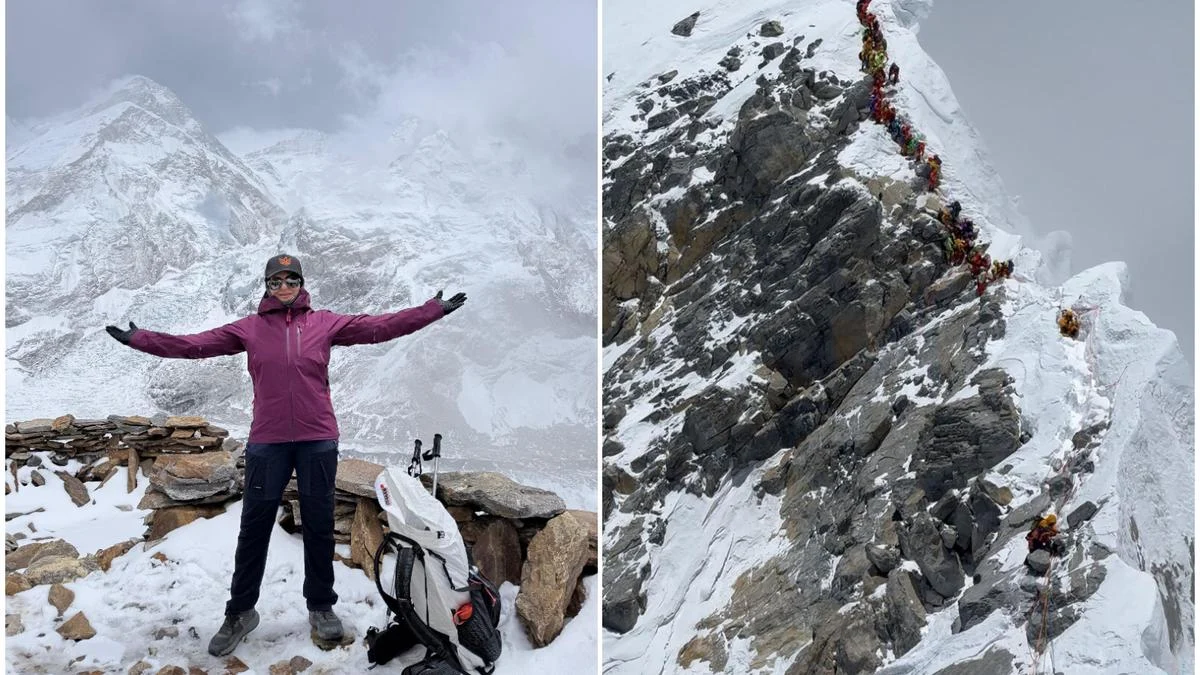
The culmination of this five-year odyssey occurred in the spring of 2026. Following a grueling two-month expedition, navigating the treacherous Khumbu Icefall and the thinning air of the South Col, Dr. Selvaraj stood on the summit of the world.
III. Supporting Data: The Physics and Physiology of the Climb
To understand the magnitude of Dr. Selvaraj’s achievement, one must look at the data surrounding 8,000-meter peaks.

The "Death Zone" Statistics
Above 8,000 meters, the atmospheric pressure is about one-third of that at sea level. The human body cannot acclimate to this height; it is effectively dying.
- Oxygen Levels: At the summit of Everest, each breath contains only 33% of the oxygen available at sea level.
- Caloric Burn: A climber of Dr. Selvaraj’s profile burns between 12,000 and 15,000 calories during the summit push—roughly six times the daily average for an active adult.
- Temperature: Average temperatures on the summit ridge hover around -30°C (-22°F), with wind chills often dropping to -50°C.
The Technical Gradient
Dr. Selvaraj’s preparation was data-driven. Her progression followed a strict safety protocol:
- Aerobic Base: Built through years of high-altitude trekking.
- Acclimatization Cycles: On Everest, she performed three "rotations"—climbing to Camp 2 and Camp 3 and returning to Base Camp—to trigger the production of extra red blood cells.
- The Manaslu Factor: Manaslu has a success rate that fluctuates wildly based on weather. By summiting Manaslu first, she entered the Everest expedition with a "High Altitude Memory" that allowed her body to adapt faster than first-time 8,000m climbers.
IV. Official Responses and Perspectives
The news of Dr. Selvaraj’s ascent has resonated across multiple sectors, from the medical fraternity to the international climbing community.
The Medical Community:
Colleagues at GG Hospital and the wider Indian medical circle have expressed a mixture of awe and professional pride. "Dr. Priya has always demonstrated a surgical focus in the lab," said a senior embryologist. "To see that same discipline applied to the Khumbu Icefall is inspiring. She has redefined what it means to have a work-life balance—or rather, a work-life-summit balance."
Mountaineering Experts:
Expedition leaders in Kathmandu noted that Dr. Selvaraj’s approach was a model for modern climbing. "She didn’t rush," says Ang Dorjee Sherpa, a veteran of 15 Everest summits. "Many people try Everest with no experience. Dr. Priya did the work. She climbed Lobuche, she climbed Manaslu. She respected the mountain, and that is why the mountain allowed her to pass."
The Family Legacy:
While the Selvaraj family is synonymous with the arts and medicine in South India, Dr. Kamala Selvaraj noted that her daughter’s journey was a deeply personal one. "Priya found her own path. In the mountains, she wasn’t a ‘legacy’ or a ‘famous doctor.’ She was just a climber with a goal. We are immensely proud of her courage to face the silence."
V. Implications: The Mountain as a Mirror
The implications of Dr. Priya Selvaraj’s journey extend far beyond a simple entry in a record book. Her story touches on several critical themes in contemporary society.
1. The Therapeutic Power of High Altitudes
Dr. Selvaraj’s journey highlights a growing trend of "adventure therapy." For those suffering from the burnout of high-stress professions—particularly in healthcare—the physical demands of mountaineering offer a form of "forced mindfulness." In the mountains, survival requires total presence, effectively silencing the "noise" of grief and professional pressure.
2. Redefining Women’s Roles in High-Altitude Sports
In a field historically dominated by men, Dr. Selvaraj represents a new wave of Indian women mountaineers who are balancing high-powered careers with elite-level sports. Her success challenges the narrative that such grueling physical feats are the exclusive domain of professional athletes or the young.
3. The Discipline of the Surgeon-Climber
There is a profound overlap between the skills required in the operating theater and those required on a fixed rope. Both require meticulous preparation, the ability to remain calm under extreme pressure, and a deep understanding of human physiology. Dr. Selvaraj’s ascent is a testament to the "transferable skill set" of the medical profession.
4. Environmental and Ethical Awareness
As a woman of science, Dr. Selvaraj’s journey also brings attention to the changing state of the Himalayas. Her observations of the receding glaciers and the impact of climate change on the Everest region serve as a call to action for the global community to preserve these "refuges" that she found so vital to her own healing.
Conclusion: The Descent and the Future
As Dr. Priya Selvaraj returns to the sea-level humidity of Chennai and the familiar halls of her clinic, she carries with her more than just a summit certificate. She carries the perspective of the "Everest view"—an understanding that while the valleys of life may be filled with noise and loss, there is always a summit that offers clarity.
Her journey from Google searches for "scenic treks" to the top of the world stands as a powerful reminder: the mountains do not just test our lungs and our legs; they mend our spirits. For the doctor who helps bring life into the world, the mountains provided a way to reclaim her own.
