

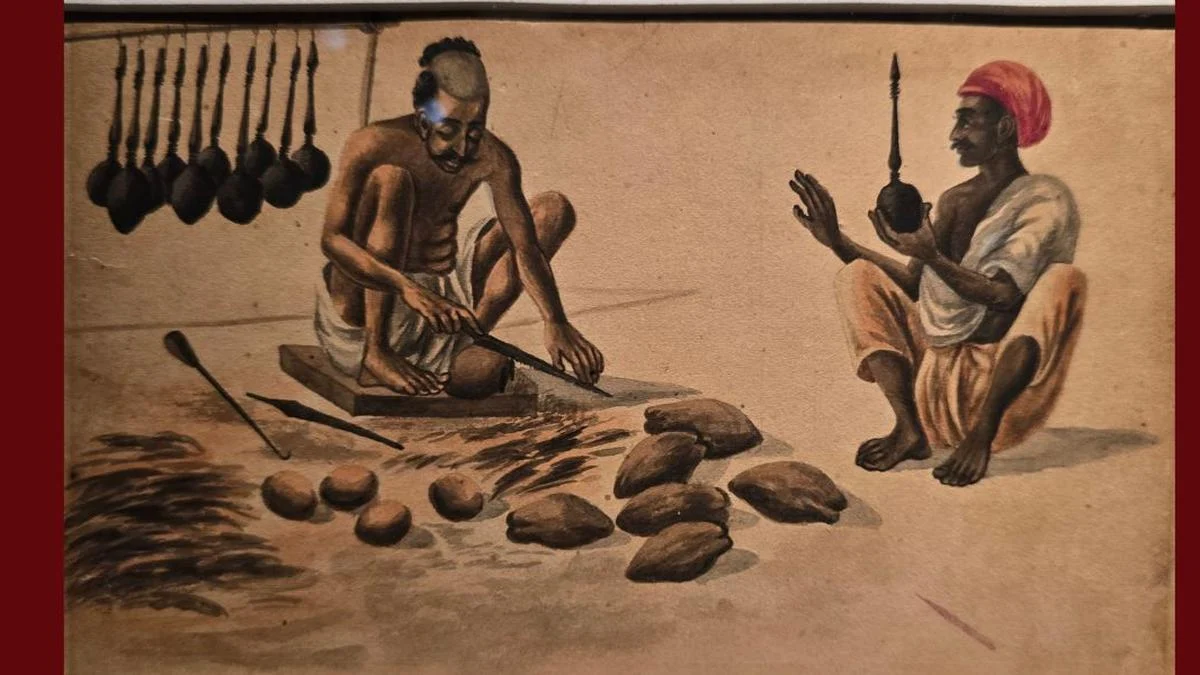
In the quiet corridors of the Bihar Museum and the dusty archives of London’s Victoria & Albert Museum, a nearly forgotten visual legacy is being beckoned back into the light. Patna Kalam, an 18th-century school of painting that served as a pre-photographic documentation of Indian life, is currently undergoing a precarious but passionate revival. Once the primary medium for capturing the mundane and the magnificent in the streets of Bihar, this art form—characterized by its stark realism and delicate brushwork—is moving from the confines of locked trunks into the public consciousness.
The recent Patna Kalam: Ek Virasat exhibition, held between December 2025 and February 2026, alongside the Bihar Museum Biennale, has sparked a renewed dialogue. It raises a poignant question for historians and art lovers alike: Why did an art form designed to celebrate the vibrancy of daily life become a relic surviving only behind glass, and can it find a place in the chaotic landscape of modern India?

Main Facts: The Essence of the Patna School
Patna Kalam, also known as the Patna School of Painting, occupies a unique niche in the history of Indian art. Unlike the grand, highly ornamented Mughal miniatures that preceded it, Patna Kalam was the art of the "common man." While Mughal art focused on the lives of emperors, hunts, and courtly romance, Patna Kalam turned its gaze toward the street.
The subjects were ordinary: a blacksmith hammering at his anvil, two men in dhotis tending to a distillery, a woman peeking through the red curtains of a palanquin, or a roadside baniya (grocer) meticulously weighing pulses. These were "snapshots" of 18th and 19th-century Bihar, rendered with a technical precision that blended Eastern and Western sensibilities.

Technically, the style is a subset of the "Company School" (Kompani Qalam), a term used for a hybrid style of Indo-European painting. However, Patna Kalam retained distinct regional characteristics. It is marked by:
- Minimalism: The paintings often lack a background or landscape, focusing entirely on the subject.
- Technique: It eschews the heavy ornamentation of earlier traditions. There is little play of light and shadow; instead, the focus is on the precision of the line and the "watercolour" effect on imported paper or mica (abrak).
- Media: Artists frequently used gouache on mica, a translucent mineral that gave the paintings a unique luminosity.
Chronology: The Rise, Fall, and Re-emergence
The trajectory of Patna Kalam is inextricably linked to the shifting political tides of the Indian subcontinent.

1750–1760: The Migration
Following the decline of the Mughal Empire and the subsequent lack of patronage in Delhi, artists began migrating toward regional centers. A significant group settled in Murshidabad, West Bengal. However, after the Battle of Plassey in 1757, which established British hegemony in the region, the Nawab’s patronage dwindled. Artists migrated again, this time to Patna, which was then a burgeoning hub of trade and administration under the British East India Company. By 1760, the seeds of Patna Kalam were firmly sown.
1790–1840: The Golden Age
This period saw the emergence of masters like Sewak Ram and Hulas Lal. They pioneered the firka sets—series of paintings depicting various trades and social classes. These were highly sought after by British officials and travelers as souvenirs of "exotic" India. Later, cousins Shiva Lal and Shiva Dayal Lal led the Patna workshop tradition, refining the naturalistic style that would define the school for decades.

1850–1947: The Decline into Oblivion
The mid-19th century brought two major threats: the advent of photography and the mass production of cheap lithographs. European collectors, who were the primary patrons, shifted their interest to the camera’s accuracy. As patronage dried up, artists were forced into other professions. By the time of India’s Independence in 1947, the living tradition of Patna Kalam had almost entirely vanished, preserved only by a few descendant families and in foreign museums.
2023–Present: The Modern Revival
The 21st century has seen a concerted effort by the Bihar State Government and organizations like INTACH (Indian National Trust for Art and Cultural Heritage) to reclaim this heritage. Since 2023, over eleven workshops have been conducted to train young artists, culminating in the major exhibitions of 2025 and 2026.

Supporting Data: Archives and Private Collections
The survival of Patna Kalam today owes much to a handful of dedicated collectors and historians. British art historian Mildred Archer’s 1948 book, Patna Painting, remains the definitive text on the subject. Archer acknowledged the immense contribution of Radha Krishna Jalan, a businessman whose private collection became a sanctuary for these works.
Today, the distribution of Patna Kalam works is telling of its historical journey:

- International Holdings: Significant collections reside in the British Museum and the Victoria & Albert Museum in London, highlighting the colonial-era demand for the art.
- The Jalan Legacy: The Quila House (Jalan House) in Patna remains an iconic landmark. Recently, Aditya Jalan, the great-grandson of Radha Krishna Jalan, opened "Planet Patna," a private museum that makes these "Company Paintings" accessible to the public for a nominal fee of ₹100, contrasting with the often inaccessible government-held archives.
- Institutional Storage: While the Patna Museum and the College of Arts and Crafts hold original works, many have historically remained locked in trunks. The recent exhibitions mark the first major effort to bring these out for public viewing in decades.
In contrast to Patna Kalam, the Tikuli art tradition, also native to Patna, has seen more commercial success. While Patna Kalam vanished as a professional practice, Tikuli was revived in the mid-20th century and adapted for home décor, such as coasters and trays. The success of Tikuli, which earned artist Ashok Kumar Biswas a Padma Shri in 2024, provides a potential roadmap—and a point of comparison—for the commercial viability of Patna Kalam.
Official Responses: The Push for Cultural Preservation
Government officials and art educators are now vocal about the need to integrate Patna Kalam into Bihar’s cultural identity.

Anjani Kumar Singh, Director General of the Bihar Museum, expressed optimism following the success of recent workshops. He noted that the museum is actively looking for skilled art trainers to impart technical skills to a new generation, with the goal of creating "contemporary Patna Kalam" that speaks to modern life.
Ashok Kumar Sinha, Deputy Director of the Bihar Museum, has gone a step further, labeling the art form as "Bihar’s heritage." He announced plans for a permanent gallery dedicated to Patna Kalam. Drawing a parallel to the successful international touring of the Vaidehi Sita exhibition in 2024, Sinha suggested that Patna Kalam works should also travel to other Indian states and abroad to raise global awareness.

Bhairav Lal Das, the convenor of INTACH’s Patna chapter, emphasized the role of incentives. INTACH’s strategy involves building a "bank" of Patna Kalam paintings through student workshops, which can then be promoted and sold, providing a financial ecosystem for artists who choose to specialize in this time-consuming style.
Implications: Can an 18th-Century Lens Capture the 21st Century?
The revival of Patna Kalam faces a fundamental challenge: the world it once documented has changed beyond recognition. The original artists worked in a Patna that was a series of quiet trades and slow-moving palanquins. Today’s Patna is a bustling, chaotic metropolis.

The Challenge of Sustainability
Aditya Kumar Singh, an architect and urban sketcher, points out the disparity in labor. While a contemporary architectural sketch might take thirty minutes, a true Patna Kalam painting, with its nuanced brushwork and traditional preparation, requires at least three days of dedicated labor. In a fast-paced digital world, the economic viability of such a slow art form remains questionable without significant subsidies or high-end patronage.
Contemporary Evolution
However, there is hope in adaptation. Textile designer Sunita Prakash has already begun incorporating Patna Kalam motifs into fabric through block printing, proving that the aesthetic can survive even if the medium changes. Furthermore, young artists like Anurag Kumar Verma, who discovered the style through INTACH workshops, are beginning to experiment with "contemporary elements."

Rachana Priyadarshini of the start-up Your Heritage argues that the path forward involves moving from "copying" old masters to "observing modern architecture and people" through the Patna Kalam lens. If the school was originally defined by its documentation of daily life, its survival depends on its ability to document the current daily life of Bihar—the street food vendors, the rickshaw pullers, and the modern laborers—using the same delicate, unornamented honesty of the 18th-century masters.
As Bihar seeks to reclaim its historical narrative, Patna Kalam stands as a vital bridge. It is more than just a painting style; it is a visual record of a people’s history, a reminder that before the camera, there was the brush, and before the grand histories of kings, there was the simple, profound beauty of the ordinary man. The success of this revival will be measured not just by the number of paintings behind glass, but by the number of artists once again finding inspiration in the streets of Patna.
