WAYANAD, KERALA — The echoes of the catastrophic 2024 landslides had barely faded from the collective memory of Wayanad when the earth gave way once again. On July 7, 2026, a massive slope failure at the construction site of the ambitious Anakkampoyil-Kalladi-Meppadi twin tunnel project claimed seven lives and left two others missing, raising urgent questions about the safety of large-scale infrastructure projects in India’s most ecologically sensitive mountain ranges.
The incident occurred less than a month before the second anniversary of the July 2024 disaster, which remains the deadliest landslide event in Kerala’s history, having killed 298 people. This latest tragedy, striking at the heart of the Vellarimala hills, has reignited a fierce national debate: Is the pursuit of high-speed connectivity worth the risk of destabilizing an already precarious landscape?
Chronology of a Disaster: July 7, 2026
The disaster unfolded following a period of relentless monsoon activity. According to data from the Hume Centre for Ecology and Wildlife Biology, a local research institute, the Kalladi-Meppadi corridor had been lashed by approximately 260 mm of rainfall over the three days preceding the collapse. The soil, already saturated by the early monsoon, reached its breaking point.
At the exit section of the under-construction twin tunnel near the Meenakshi Bridge at Kalladi, the mountain slope suffered a catastrophic failure. Witnesses described a deafening roar as a massive wall of earth, boulders, and waterlogged debris surged down the hillside.

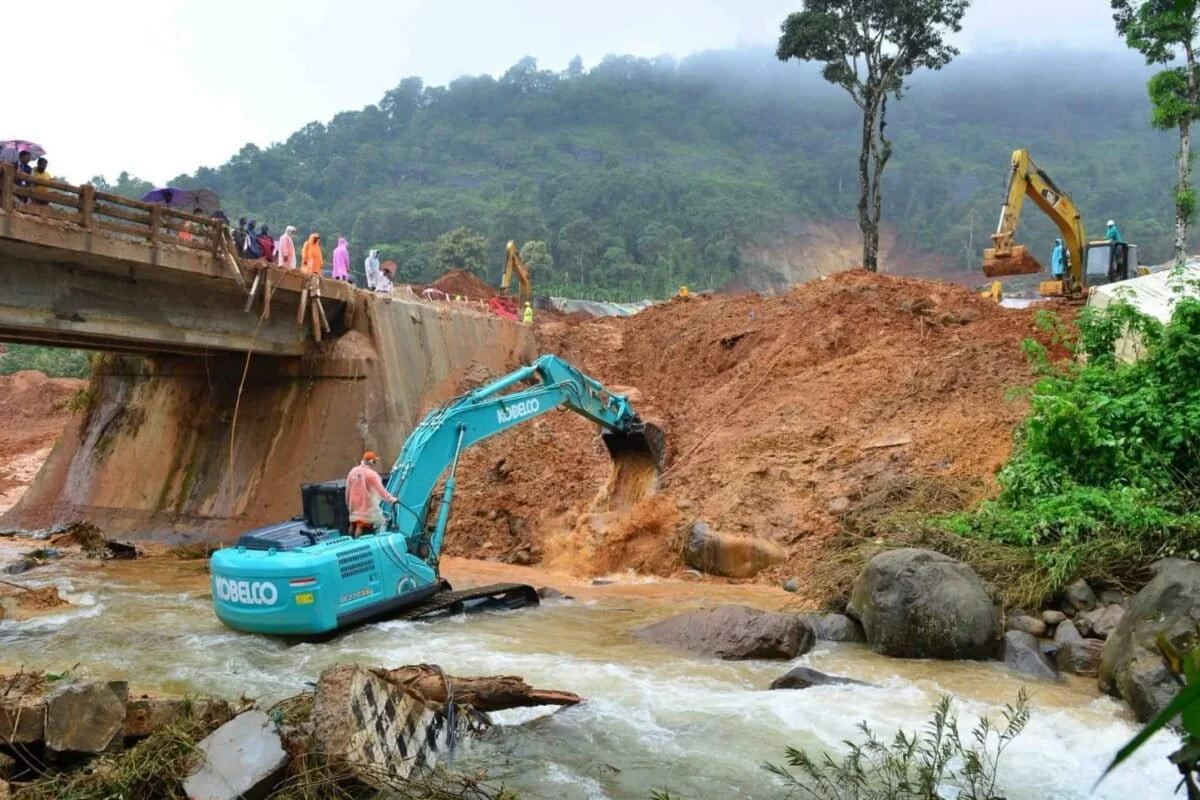
While initially characterized as a mudslide, experts later clarified that it was a complex landslide that originated high above the construction zone. However, the destruction was significantly amplified by "tunnel spoil"—the massive quantities of earth and rock excavated during the tunneling process. This accumulated material, which had been piled near the site, was swept up by the landslide, creating a slurry of immense weight and force that buried workers, heavy machinery, and transport vehicles.
Rescue operations began immediately, with personnel from the National Disaster Response Force (NDRF) and local emergency services battling thick layers of mud and twisted metal. By the end of the week, seven bodies had been recovered, while excavators continued to sift through the debris in the Meenakshi River for those still missing.
Supporting Data: The Vulnerability of the Vellarimala Hills
The Anakkampoyil-Kalladi-Meppadi project was envisioned as a landmark engineering feat. Designed to be India’s third-longest road tunnel, the 7-kilometer twin-tube structure aimed to provide a direct link between Kozhikode and Bengaluru, bypassing the notorious Thamarassery Ghat Road. Proponents argued the project would revolutionize Wayanad’s economy, benefiting farmers and the tourism sector by slashing travel times and reducing the risk of accidents on the steep hair-pin bends of the existing mountain pass.
However, scientific data has long suggested that the region is a "high-hazard" zone.
- Rainfall Intensity: The 260 mm of rain recorded in 72 hours is significantly above the threshold for slope failure in the Western Ghats, where deeply weathered rock (saprolite) loses its cohesive strength when saturated.
- Slope Susceptibility: Landslide susceptibility maps prepared by the Kerala State Disaster Management Authority (KSDMA) and the Geological Survey of India (GSI) have consistently classified the Meppadi and Vellarimala regions as "highly unstable."
- Environmental Compliance: When the Union Ministry of Environment, Forest and Climate Change (MoEFCC) granted environmental clearance in May 2025, it did so under 60 mandatory conditions. These included the installation of four automated ground vibration monitoring stations with real-time telemetry and strict protocols for the disposal of excavated earth.
Preliminary investigations suggest that several of these safeguards may have been ignored. Environmental activists point out that the automated vibration sensors—crucial for detecting early signs of slope instability caused by tunneling—were never installed.

Official Responses and Allegations of Negligence
In the wake of the tragedy, the Kerala state government moved swiftly to halt all construction activities on the tunnel project. Chief Minister V.D. Satheesan announced the formation of two separate high-level committees—one technical and one environmental—to investigate the causes of the collapse.
"The findings will determine whether this was an unavoidable natural calamity or a case of criminal negligence," Satheesan told reporters. "We are specifically looking into whether the contractor failed to follow the mandatory environmental safeguards, particularly regarding the removal of excavated soil before the onset of the monsoon."
Kerala’s Agriculture Minister, T. Siddique, who represents the Wayanad region, echoed these concerns. He emphasized that while the tunnel is vital for development, it cannot come at the cost of human lives. He noted that local residents had previously raised alarms about the massive piles of tunnel spoil being stored precariously close to natural drainage channels.
The contractor, Dilip Buildcon Ltd, has denied any wrongdoing. In a formal statement, the company maintained that the landslide was a "natural event" that originated outside the engineered project area.
"The project is being executed in strict compliance with all engineering and safety protocols," the statement read. "The handling of excavated material was carried out according to the approved environmental management plan. We are cooperating fully with the ongoing investigations."
The Science of Instability: A Risk Multiplier
Geologists and environmental researchers argue that the Kalladi disaster is a textbook example of how human intervention can exacerbate natural risks.

C.K. Vishnudas of the Hume Centre for Ecology and Wildlife Biology explained that the Western Ghats operate as a delicate hydrologic system. "When you excavate a tunnel, you aren’t just moving rock; you are altering the way water moves through the mountain," Vishnudas said. "The interaction between altered slopes, disrupted natural drainage, and extreme weather events creates a ‘perfect storm’ for disasters."
Geologist K.G. Thara, a prominent voice on disaster management in Kerala, criticized the current approach to infrastructure planning. She argued that geological monitoring must be a continuous process rather than a "one-time box-ticking exercise" performed before construction begins. "In a landscape this complex, the mountain changes every day as you drill into it. If you aren’t monitoring those changes in real-time, you are flying blind," she said.
Furthermore, climate scientists highlight the role of climate change as a "risk multiplier." C.P. Rajasekharan, former Additional Director General of the GSI, noted that while landslides are natural to the Ghats, the frequency of "extreme rainfall events"—where a month’s worth of rain falls in a few days—is increasing. When this intense rainfall hits a slope that has been weakened by construction or burdened by heavy excavation waste, a catastrophic failure becomes almost inevitable.
Implications: Development vs. Survival
The Kalladi landslide has placed the Kerala government in a difficult position. The tunnel project was a flagship initiative designed to solve the long-standing isolation of Wayanad. However, the optics of a government-sponsored project causing the very type of disaster that the 2024 tragedy warned against are devastating.
The implications of this event extend far beyond Wayanad:

- Infrastructure Policy: There is a growing call for a moratorium on "mega-projects" in the Western Ghats until a comprehensive, high-resolution carrying capacity study is completed.
- Legal Accountability: If the investigation finds that the EAC conditions were indeed violated, it could set a legal precedent for holding construction firms and oversight agencies civilly and criminally liable for "man-made" disasters.
- The Future of Wayanad: For the residents of Meppadi, the landslide is a grim reminder that their home is becoming increasingly uninhabitable. As survivors of the 2024 disaster still wait for permanent housing, this new tragedy deepens the sense of insecurity pervading the district.
Conclusion
As the search for the two missing workers continues along the mud-choked banks of the Meenakshi River, the Kalladi landslide serves as a sobering warning. It suggests that the lessons of 2024—the need for ecological humility and rigorous scientific oversight—have yet to be fully integrated into the state’s developmental DNA.
The Vellarimala hills have spoken again, and this time, the message is clear: Engineering can bypass a mountain, but it cannot ignore the laws of geology. Until the balance between connectivity and conservation is recalibrated, the slopes of Wayanad will remain a landscape of fear rather than a gateway to progress.