

By [Your Name/Agency]
The image of an astronaut is often one of sterile perfection: a silent, silver-clad figure perched atop a pillar of fire, possessing nerves of steel and an intellect that operates with the cold precision of a computer. However, as India prepares for its historic maiden human spaceflight mission, Gaganyaan, one of its primary astronaut-candidates is working hard to dismantle this archetype.
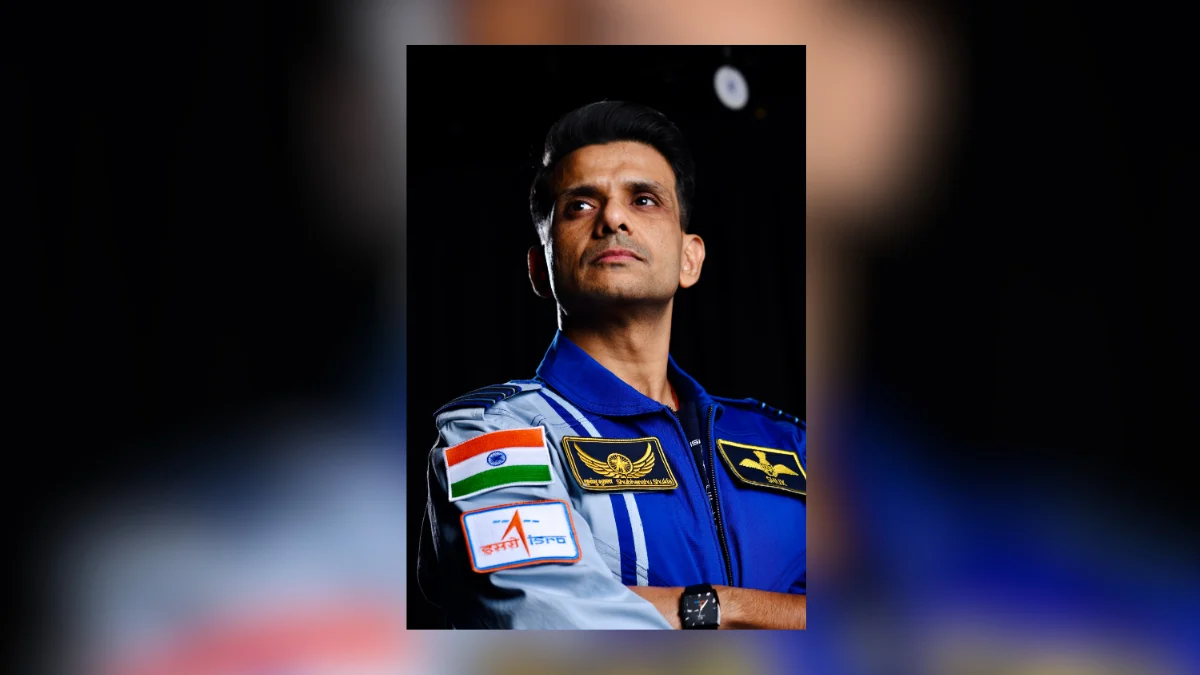
Air Force test pilot Shubhanshu Shukla has emerged not just as a mission specialist, but as a prolific and vulnerable science communicator. In his recently released book, The Second Orbit, Shukla peels back the layers of the "hero" narrative to reveal the raw, often undignified, and deeply human reality of preparing to leave the planet. From a young boy in Lucknow paralyzed by the fear of a handwriting competition to a man training for the violent physics of atmospheric re-entry, Shukla’s journey serves as a bridge between the elite corridors of the Indian Space Research Organisation (ISRO) and the aspirations of a billion people.
Main Facts: The Architect of a New Space Narrative
Group Captain Shubhanshu Shukla is one of the four astronaut-candidates selected for the Gaganyaan mission, alongside Prasanth Balakrishnan Nair, Angad Pratap, and Ajit Krishnan. While all four bring the rigorous discipline of the Indian Air Force (IAF) to the program, Shukla has distinguished himself through his commitment to public engagement.
The Second Orbit is more than a memoir; it is a manifesto for a new kind of scientific culture in India. The book covers his selection, his grueling training in Russia and the United States, and the psychological shifts required to transition from a solo fighter pilot to a collaborative astronaut. Key highlights of the book include:
- Demystifying Space: Using domestic analogies like a "water hat" or a "train on a fixed track" to explain complex orbital mechanics.
- The Anatomy of Failure: A candid retelling of a communication breakdown during a kayaking expedition in Baja California, challenging the "perfect persona" expected of military officers.
- Physical Vulnerability: Detailed accounts of "puffy face syndrome" and the painful stretching of the spine in microgravity.
- National Aspiration: Redefining the role of an astronaut as a "conduit" for a civilizational dream rather than just a government employee.
Chronology: From Lucknow to the Launchpad
The trajectory of Shubhanshu Shukla’s life reflects a steady climb from ordinary beginnings to extraordinary heights, marked by moments of profound self-doubt.
The Formative Years in Lucknow
Shukla’s story begins in the classrooms of Lucknow. Far from the "prodigy" narrative, he describes himself as a child who once refused to enter a handwriting competition because he was "paralyzed by doubt." This period of his life is crucial to his current message: that "average" or "mediocre" academic standing is not a permanent sentence, but a starting point.
The IAF and the Cockpit
Shukla joined the Indian Air Force, eventually rising to the prestigious rank of Test Pilot. In the military, he learned the "precise terminology" and the rigid physical discipline required to master high-performance aircraft. This environment, while professional, often discouraged the admission of vulnerability—a theme he later confronts in his writing.
Selection for Gaganyaan (2019–2020)
In late 2019, Shukla was among the hundreds of IAF pilots who underwent a grueling selection process. By early 2020, he was announced as one of the final four. This marked the beginning of his transition from a pilot, who controls his environment, to an astronaut, who must often surrender to it.
International Training and the Writing of The Second Orbit
The training took the candidates from the Yuri Gagarin Cosmonaut Training Center in Russia to specialized survival training in the United States. During this time, Shukla began documenting his experiences, realizing that the "bureaucracy of space travel" and the "physical mutiny" of the body were stories that belonged to the Indian public. His book was born from this realization, culminating in its recent release as India nears the final phases of Gaganyaan’s unmanned trials.
Supporting Data: The Physical and Psychological Toll
Space travel is often romanticized, but Shukla’s account provides the "labor of science" with a visceral reality. His book and recent interviews provide specific data points on the stresses placed on the human frame.
The "Quiet Mutiny" of the Body
Shukla describes the physiological changes in space with clinical honesty. "Puffy face syndrome" occurs as fluids shift toward the head in the absence of gravity. More significantly, he discusses the pain of the spine stretching—sometimes by as much as two inches—as the vertebrae decompress. "The body, quite simply, was not designed for this," Shukla notes, highlighting that space strips away the familiarity of the cockpit.

The Baja California Incident
One of the most telling data points in Shukla’s journey is not a technical success, but a navigational failure. During a kayaking exercise in Baja California, a team of highly trained individuals found themselves paddling in the wrong direction due to a breakdown in communication. Shukla uses this to illustrate that in high-stakes environments, the "ego-stripping" lessons of teamwork are more valuable than individual brilliance.
The "Human Centrifuge"
In a striking anecdote that bridges the gap between high-tech science and "undignified" labor, Shukla describes having to act as a "human centrifuge." While suspended sideways on a wall, he had to physically whip his arm to force air bubbles out of a syringe to perform a chemistry experiment. This image serves to remind the scientific community that progress is often physical, messy, and manual.
Official Responses: Insights from the Astronaut
In a series of reflections and interview excerpts, Group Captain Shukla provides a philosophical framework for India’s space program.
On the Role of the Astronaut:
Shukla rejects the idea that his public role is a burden. "I don’t experience the public role as a burden, because I genuinely believe in what it represents," he says. "India’s journey into space is not a government project; it is a civilizational aspiration."
On International Bureaucracy:
Having navigated the complex systems of NASA and Roscosmos, Shukla offers a pointed critique of the current state of space exploration. He notes that the bureaucracy often reflects "geopolitical boundaries" that become invisible once one actually leaves the planet. His recommendation for the next generation is the cultivation of an "Earth culture"—a shared identity that transcends national interests.
On Redefining Potential:
Addressing the millions of Indian students stressed by exam scores, Shukla’s stance is clear: "The trajectory of a life is not determined in a classroom in Class 10—it is determined by the decision to keep going anyway."
Implications: What Shukla’s Journey Means for India
Shukla’s emergence as a science communicator has several long-term implications for the Indian scientific landscape and the Gaganyaan mission.
1. The Democratization of Space
By using domestic analogies and admitting to failures, Shukla is lowering the barrier to entry for the next generation of scientists. His "Earth-centric" language ensures that space is not seen as a playground for the elite, but as a frontier accessible to anyone with the "decision to keep going."
2. A Shift in Institutional Culture
Shukla’s willingness to put failures in print suggests a maturing of the professional culture within ISRO and the IAF. Moving away from a "perfect persona" toward a culture that views mistakes as "the path to excellence" could lead to more robust safety protocols and better team dynamics in future missions.
3. Diplomatic and "Earth Culture" Aspirations
His call for an "Earth culture" in space bureaucracy aligns with India’s growing role as a leader in the Global South. As India participates in the Artemis Accords and collaborates with the ISS (Shukla himself is slated for a mission to the International Space Station via Axiom Space), his philosophy could influence how India negotiates its place in the international space community.
4. Psychological Preparedness
Perhaps the most profound implication is the "shift in scale" that Shukla describes. His newfound ability to view "small problems" from a planetary perspective suggests that the psychological benefits of space travel—often called the "Overview Effect"—are being integrated into the Indian national consciousness through his writing.
As India stands on the precipice of sending its own citizens into orbit, Shubhanshu Shukla reminds us that the most important orbit is not the one around the Earth, but the one that brings us back to our shared humanity. The Second Orbit is not just a book about space; it is a guide on how to remain grounded while reaching for the stars.
