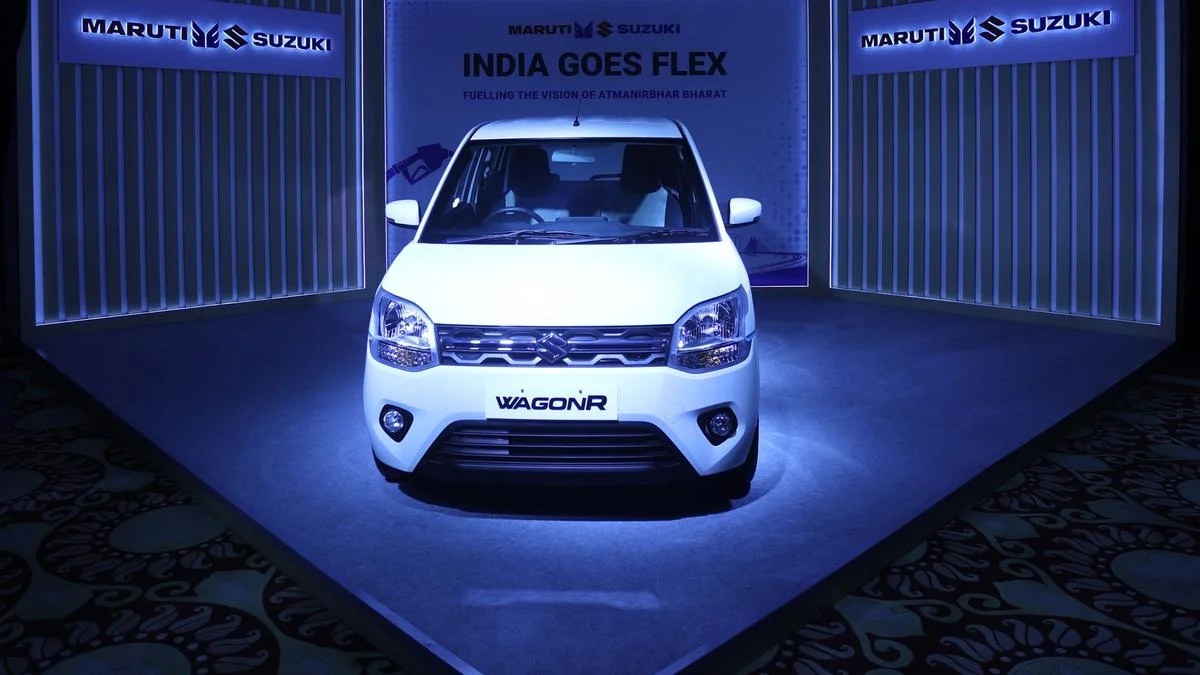
The Indian automotive landscape is currently undergoing a period of profound metamorphosis. As the world’s third-largest energy consumer, India finds itself at a critical crossroads, balancing the urgent necessity of decarbonization with the economic imperative of reducing a staggering reliance on imported crude oil. While the narrative of "green mobility" has been dominated by the rapid ascent of Battery Electric Vehicles (BEVs), a quieter but equally significant revolution is brewing in the internal combustion engine (ICE) space.
The recent unveiling of the Maruti Suzuki Wagon R Flex Fuel prototype marks a pivotal moment in this transition. By integrating sophisticated flex-fuel technology into one of the nation’s most iconic and high-volume nameplates, India’s largest carmaker is signaling that the path to net-zero is not a singular track, but a multi-modal journey.
Main Facts: The Engineering Behind the Wagon R Flex Fuel
At first glance, the Maruti Suzuki Wagon R Flex Fuel maintains the familiar silhouette of the "Tall Boy" hatchback that has dominated Indian roads for decades. However, beneath the hood lies a sophisticated suite of engineering modifications designed to handle the unique chemical properties of ethanol.
Technical Specifications and Adaptability
The standout feature of this prototype is its ability to operate on any ethanol-petrol blend ranging from E20 (20% ethanol) to E100 (100% ethanol). This is achieved through a localized development effort by Maruti Suzuki’s engineering team, supported by Suzuki Motor Corporation, Japan.
The heart of the system is a newly developed, advanced Engine Control Unit (ECU). Unlike standard engines, which are calibrated for a specific fuel density and oxygen content, the Flex Fuel ECU utilizes a "smart" sensor system to continuously monitor the ethanol concentration in the fuel line. It then adjusts the ignition timing and fuel injection parameters in real-time to optimize combustion.
Hardware Reinforcements
Ethanol, while cleaner-burning, is chemically more aggressive than petrol. It is hygroscopic (absorbs water) and can be corrosive to certain metals and rubber components. To ensure long-term durability, Maruti Suzuki has upgraded several critical components:

- Fuel System: The fuel pump, injectors, and fuel lines have been reinforced with ethanol-resistant coatings and materials.
- Engine Internals: Valve seats and piston rings have been modified to withstand the higher combustion temperatures and different lubrication requirements of high-ethanol blends.
- Cold Start Capabilities: One of the traditional drawbacks of ethanol is poor cold-start performance. The Wagon R Flex Fuel incorporates a heated fuel induction system to ensure reliable ignition even in colder climates.
Market Positioning
Maruti Suzuki has indicated an expected price bracket of INR 7.50 – 8.00 lakh for the production version. By choosing the Wagon R—a vehicle synonymous with the Indian middle class—rather than a premium SUV, the company is positioning flex-fuel technology as a democratic solution rather than a niche luxury.
Chronology: India’s Ethanol Blended Petrol (EBP) Roadmap
The journey toward the Wagon R Flex Fuel is the result of a decades-long policy evolution aimed at securing India’s energy future.
- 2003: The Government of India officially launched the Ethanol Blended Petrol (EBP) programme, initially targeting a modest 5% blending in select states.
- 2018: The National Policy on Biofuels was notified, expanding the scope of raw materials for ethanol production beyond sugarcane molasses to include damaged food grains, maize, and rice husk.
- 2021: In a major policy acceleration, Prime Minister Narendra Modi announced the advancement of the target for 20% ethanol blending (E20) in petrol from 2030 to 2025.
- 2023: E20 fuel was rolled out at select petrol pumps across India. During the G20 Summit in New Delhi, the Global Biofuels Alliance was launched, placing India at the center of the international biofuel movement.
- 2024: Maruti Suzuki showcases the Wagon R Flex Fuel prototype as a "production-ready" concept, demonstrating that the automotive industry is prepared to meet the government’s ambitious E100 aspirations.
Supporting Data: The Economic and Environmental Imperative
The push for flex-fuel technology is driven by cold, hard data regarding India’s economic vulnerabilities and environmental commitments.
The Import Bill and Energy Security
India currently imports approximately 85% of its crude oil requirements. Fluctuations in global oil prices, often driven by geopolitical instability in the Middle East or Eastern Europe, have a direct and often devastating impact on India’s Current Account Deficit (CAD) and domestic inflation.
- By achieving 20% blending, India is estimated to save approximately INR 30,000 crore (USD 3.6 billion) in foreign exchange annually.
- Moving toward E85 and E100 could potentially slash the oil import bill by double digits, providing a massive cushion for the national treasury.
The Agricultural Synergy
Unlike oil, which is a finite resource, ethanol is a renewable byproduct of India’s massive agricultural sector. India is the world’s second-largest producer of sugarcane.
- Surplus Management: Ethanol production provides a vent for surplus sugar production, ensuring that farmers receive timely payments (Fair and Remunerative Prices) even when global sugar prices are low.
- Diversification: The shift toward using "broken rice" and maize for ethanol ensures that the benefits of the biofuel economy are spread across the grain-producing belts of Northern and Central India, not just the sugar-producing states of Maharashtra and Uttar Pradesh.
Carbon Footprint Reduction
From a "Well-to-Wheel" perspective, ethanol is significantly less carbon-intensive than fossil fuels.

- High-blend ethanol (E85/E100) can reduce greenhouse gas (GHG) emissions by up to 70-80% compared to conventional petrol, as the CO2 emitted during combustion is largely offset by the CO2 absorbed by the crops during their growth phase.
- The reduction in tailpipe emissions of Carbon Monoxide (CO) and Hydrocarbons (HC) contributes significantly to improving urban air quality.
Official Responses and Industry Sentiment
The transition to flex-fuel is a collaborative effort involving the government, the automotive industry, and the oil marketing companies (OMCs).
Government Advocacy
Nitin Gadkari, the Union Minister for Road Transport and Highways, has been the most vocal proponent of flex-fuel vehicles (FFVs). He has frequently urged manufacturers to accelerate their FFV lineups, suggesting that ethanol is the "swadeshi" (indigenous) fuel that will empower the Indian farmer. The government is also considering tax incentives for FFVs to bring them at par with the lower GST rates enjoyed by electric vehicles.
Maruti Suzuki’s Strategic Vision
Hisashi Takeuchi, Managing Director & CEO of Maruti Suzuki India, has emphasized that the company’s "Carbon Neutral" goal involves a bouquet of technologies. "We believe that for a country as diverse as India, one technology will not be enough. We need a mix of EVs, Hybrids, CNG, and Biofuels to reach our goals," Takeuchi stated during a recent industry forum. The company’s focus on the Wagon R demonstrates a commitment to making green technology accessible to the "Aam Aadmi" (common man).
Industry Challenges
Despite the optimism, the Society of Indian Automobile Manufacturers (SIAM) has noted that the transition requires massive investment. Developing engines that can handle E100 requires rigorous testing for "material compatibility" and "lubricity," ensuring that the engine life is not compromised. Furthermore, Oil Marketing Companies like IOCL and BPCL must invest in dedicated ethanol storage and dispensing infrastructure to prevent moisture contamination.
Implications: A Multi-Fuel Future and the Road Ahead
The introduction of the Wagon R Flex Fuel has far-reaching implications for the Indian consumer and the broader economy. However, the path to mainstream adoption is fraught with hurdles that require careful navigation.
The Consumer Trust Deficit
For the average Indian car buyer, "ethanol" is often associated with concerns about engine damage. There is a lingering fear that higher ethanol blends will corrode fuel tanks or lead to frequent fuel filter clogs. To overcome this, Maruti Suzuki and the government must launch a comprehensive public awareness campaign. Buyers need to be assured that an "FFV-compliant" vehicle is fundamentally different from an older petrol car and is fully covered by manufacturer warranties.

The Running Cost Equation
Perhaps the most critical factor for the success of flex-fuel vehicles is the price of the fuel at the pump. Ethanol has a lower energy density than petrol, meaning a car running on E100 will deliver roughly 25-30% lower fuel efficiency (mileage) than a car running on pure petrol.
- For FFVs to be economically viable for the consumer, the price of E100 must be significantly lower than petrol to offset the drop in mileage.
- If the government does not implement a tiered pricing structure that favors higher ethanol blends, consumers will have little incentive to switch from traditional petrol or CNG.
Infrastructure: The Final Frontier
While ethanol can leverage the existing petrol pump network, it cannot simply be "dropped in." High-concentration ethanol requires specialized storage tanks and dispensing nozzles to prevent water ingress. The rollout of E100 pumps must happen in tandem with the launch of the vehicles; otherwise, the "Flex" in Flex Fuel will remain a theoretical advantage rather than a practical utility.
Conclusion: More Than Just a Car
The Maruti Suzuki Wagon R Flex Fuel is more than a mere addition to a product portfolio; it is a proof of concept for a self-reliant India. It represents a future where the money spent at the fuel station goes into the pockets of Indian farmers rather than foreign oil conglomerates.
As Maruti Suzuki prepares to move from prototype to production, the success of this venture will depend on an "all-of-government" and "all-of-industry" approach. If the infrastructure, pricing, and technology align, the humble Wagon R might just lead India into a new era of sustainable, indigenous, and affordable mobility. The engineering is ready, and the product is here; now, the ecosystem must evolve to meet the moment.
This report was prepared in association with Motorscribes and The Hindu. For more updates on the evolving Indian automotive landscape, follow @motorscribes on Instagram.