

NEW DELHI – Toyota Kirloskar Motor (TKM) has released its comprehensive sales performance report for July 2026, revealing a complex but ultimately resilient market position. As the Indian automotive landscape undergoes rapid transformation driven by hybrid technology and a shift toward premium utility vehicles, Toyota’s latest figures underscore a deepening divide between its booming domestic demand and a cooling export market.
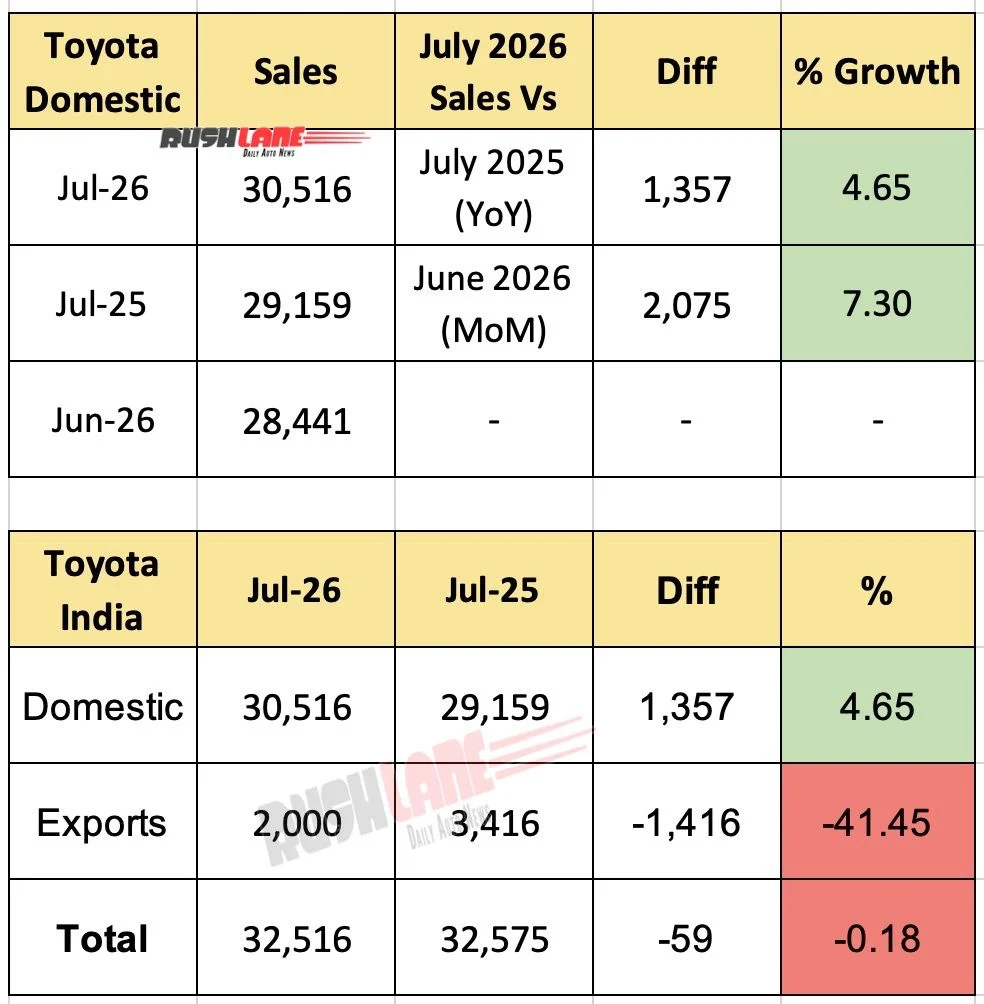
The company reported total sales of 32,516 units for the month of July 2026. When compared to the 32,575 units sold during the same month in 2025, the overall volume appears nearly stagnant, marking a marginal decline of 0.18%. However, this top-line stability masks a significant surge in the Indian domestic market, which remains the primary engine of growth for the Japanese automaker’s Indian subsidiary.
Domestic Performance: A Stronghold of Growth
While the total volume showed little movement, Toyota’s domestic sales narrative is one of consistent expansion. TKM dispatched 30,516 units to the Indian market in July 2026, representing a 4.65% year-on-year (YoY) increase from the previous year. This growth is particularly notable given the high base effect and the increasingly competitive nature of the SUV and MPV segments in India.
The momentum is even more evident when looking at month-on-month (MoM) performance. In June 2026, Toyota recorded domestic sales of 28,441 units. The jump to 30,516 units in July represents a healthy 7.3% MoM improvement. This uptick suggests that the company is successfully navigating supply chain constraints that have previously hampered the delivery of high-demand models like the Innova Hycross and the Fortuner.
The sustained demand is largely attributed to Toyota’s diversified and modernized portfolio. The company’s strategy of offering a "multi-pathway" approach—comprising internal combustion engines (ICE), strong hybrids, and rebadged collaboration models—has allowed it to capture a wide demographic of Indian buyers.
The Export Challenge: Analyzing the 41% Slump
The primary drag on Toyota’s total sales volume in July 2026 came from its export operations. TKM’s exports witnessed a sharp contraction, falling 41.45% to just 2,000 units, compared to 3,416 units in July 2025.
Industry analysts suggest that this decline could be the result of several factors. First, Toyota may be prioritizing domestic deliveries to reduce the notoriously long waiting periods for its popular MPVs and SUVs in India. Second, shifting economic conditions in key export markets in Africa and the Middle East may have dampened demand for Indian-manufactured units. Despite this slump, the company remains optimistic that its export strategy will stabilize as global supply chains and regional demands recalibrate in the second half of the fiscal year.

Fiscal Year 2026-27: A Cumulative Overview
Looking at the broader picture of the current fiscal year (FY2027), Toyota Kirloskar Motor’s trajectory remains positive. For the April to July 2026 period, the company’s domestic sales reached 1,19,690 units. This is a substantial 9.08% increase over the 1,09,725 units sold during the same four-month period in the previous fiscal year.
Total cumulative sales (including exports) for the first four months of FY2027 stood at 1,28,746 units, up 7.59% from 1,19,669 units in FY2026. While the export segment for the fiscal year to date has declined by 8.93% (9,056 units vs. 9,944 units), the sheer volume of domestic growth has more than compensated for the shortfall.
Key Drivers of the Product Portfolio
The backbone of Toyota’s success in India continues to be its dominance in the MPV and SUV categories. The following models have been identified as the primary contributors to the July 2026 volumes:
- Innova Hycross & Crysta: The Innova brand remains the gold standard for MPVs in India. The Hycross, with its strong-hybrid powertrain, continues to attract premium buyers looking for efficiency and luxury, while the Crysta diesel remains the preferred choice for fleet operators and long-distance travelers.
- Fortuner: Despite its premium pricing, the Fortuner maintains an iron grip on the full-size SUV segment, with virtually no direct competition capable of matching its resale value and brand equity.
- Urban Cruiser Taisor & Hyryder: These models, born out of the Toyota-Suzuki global partnership, have allowed Toyota to penetrate the sub-compact and compact SUV segments. The Hyryder, in particular, has been a pioneer in bringing hybrid technology to the masses.
- Glanza & Rumion: These models provide steady volumes in the hatchback and entry-level MPV segments, ensuring that Toyota showrooms have products for various price points.
Official Response: Focusing on Customer-Centricity
Commenting on the sales performance, Sabari Manohar, Executive Vice President of Sales-Service-Used Car Business at Toyota Kirloskar Motor, emphasized the brand’s resilience.
"Our performance in July reflects the sustained confidence that Indian consumers place in the Toyota brand," Manohar stated. "While we monitor global market dynamics that affect our export volumes, our domestic growth remains robust. We are seeing a clear trend where customers are gravitating toward our technologically advanced and eco-friendly mobility solutions."
Manohar also highlighted the strategic importance of the newly launched Hilux, noting, "The introduction of the all-new Hilux further strengthens our SUV and utility portfolio. It is designed for those who seek a blend of ruggedness and sophistication. Our focus remains on delivering reliable, innovative, and customer-centric mobility as we head into the high-demand festive season."
The All-New Hilux: A Strategic Lifestyle Play
A major highlight of July 2026 was the launch of the ninth-generation Toyota Hilux. Long celebrated globally for its "indestructible" reputation, the new Hilux arrives in India with significant updates aimed at broadening its appeal beyond niche off-road enthusiasts.

The new Hilux features a redesigned exterior with a more aggressive grille and enhanced LED lighting signatures. However, the most significant change lies in the drivetrain options. For the first time, Toyota has introduced a 4×2 automatic variant. This move is specifically designed to make the Hilux more accessible to "lifestyle" buyers who desire the presence and utility of a pickup truck but primarily drive in urban or highway environments.
Pricing and Market Positioning
The new Hilux is priced between Rs 31.99 lakh and Rs 36.69 lakh (ex-showroom). While it remains a premium offering, the revised pricing and variant mix position it as a unique alternative to D-segment SUVs. By offering a more refined cabin and an automatic transmission in a 4×2 configuration, Toyota is attempting to create a new sub-segment in the Indian automotive market, targeting adventure seekers and small business owners alike.
Implications and Future Outlook: The Road to 2027
Toyota’s current sales data provides a window into the future of the Indian automotive industry. The company’s heavy reliance on hybrids suggests that Indian consumers are currently more comfortable with "bridge technologies" than a full transition to Battery Electric Vehicles (BEVs).
The "Hybrid" Advantage
As competitors like Tata Motors and Mahindra focus heavily on EVs, Toyota’s success with the Hycross and Hyryder proves there is a massive market for vehicles that offer high fuel efficiency without the "range anxiety" associated with current charging infrastructure. This hybrid-first approach is likely to be the cornerstone of TKM’s strategy for the remainder of the decade.
Looking Ahead: 2027 Product Offensive
The automotive industry is already looking toward 2027, which promises to be a landmark year for Toyota Kirloskar Motor. The company is reportedly preparing two major launches:
- Innova Hycross Facelift: Expected to bring mid-cycle refreshes to aesthetics and onboard technology to maintain its leadership against emerging competition.
- Next-Generation Fortuner: Perhaps the most anticipated launch in the SUV segment, the next-gen Fortuner is expected to feature a new platform, potentially incorporating mild-hybrid or strong-hybrid diesel powertrains to meet increasingly stringent emission norms while maintaining its legendary torque and durability.
Conclusion
Toyota Kirloskar Motor’s July 2026 performance is a testament to the brand’s localized strength. While the export decline is a point of concern for the company’s global manufacturing balance, the 4.65% YoY domestic growth and the 7.3% MoM recovery signal a healthy appetite for Toyota vehicles in India. With the launch of the new Hilux and a clear roadmap for 2027, Toyota appears well-positioned to maintain its status as a dominant force in the Indian premium vehicle market, leveraging its reputation for quality, durability, and reliability.
