

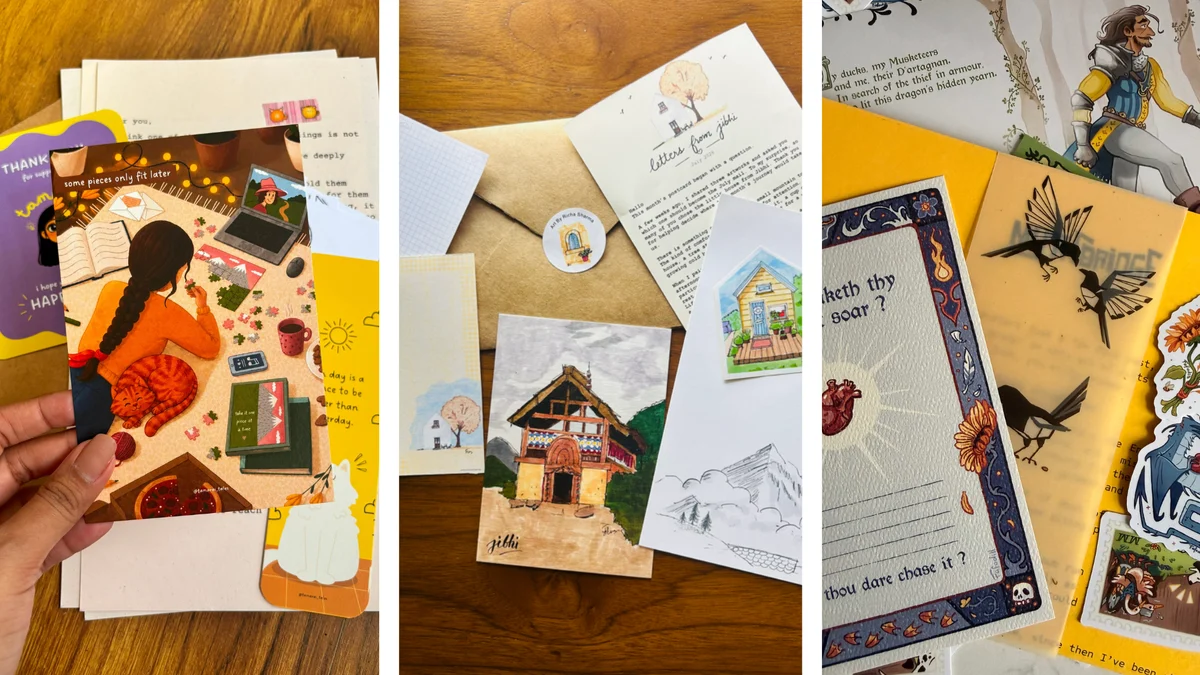
In an era defined by instant connectivity and ephemeral digital interactions, a quiet revolution is unfolding. Across India and the globe, a growing movement is embracing the tangible, the slow, and the deliberately imperfect. From meticulously crafted snail mail packages to the resurgence of vinyl records and independent bookstores, people are rediscovering the profound satisfaction of analogue experiences. This isn’t merely a nostalgic yearning for the past; it’s a conscious rejection of the fleeting nature of digital life and a deliberate cultivation of meaning through deliberate effort.
The Allure of the Handwritten Word
For Sowbharanika Lakshmipathy, a Coimbatore-based IT professional and the founder of the snail mail club Tamarai Tales, the last weekend of every month is a testament to this burgeoning analogue movement. Her dining table transforms into a creative hub, laden with handwritten letters, meticulously trimmed stickers, colourful pages for colouring, and rolls of decorative washi tape. This elaborate preparation, unfolding over nearly two weeks, is a labor of love. "I want every envelope to feel like it was put together for one person, not produced in bulk," Lakshmipathy shares, her dedication evident in her words. "By the time I’m done, it feels like I’m sending little pieces of myself."

Lakshmipathy’s approach embodies the core of this revival: a commitment to creating something personal and enduring. Much of the content within each package is her own handiwork – written words and original designs. The remaining elements are carefully curated from other stationery artisans. Each monthly theme delves into introspective topics, from feelings of falling behind in life and the courage to start anew, to explorations of loneliness, friendship, self-worth, and well-being. The irony of using social media to promote a movement that encourages disengagement from it is not lost on her. "Social media helps people find me," she acknowledges, "But what I’m really hoping to give them is a reason to spend a little less time on it."
The journey of these envelopes across India – from bustling metropolises to quieter towns – is a deliberate echo of a bygone era. While this postal transit would have been ordinary for much of human history, in the hyper-connected landscape of 2026, it feels almost radical, a testament to the value placed on slowness and deliberation.

Life Beyond the Digital: A Craving for Tactile Experiences
The resurgence of analogue experiences is a direct response to the increasingly digital and often impersonal nature of modern life. As interactions become predominantly virtual and social media feeds become saturated with AI-generated content, a growing segment of the population, particularly younger generations, is actively seeking out analogue alternatives. This trend is manifesting in a variety of ways:
- Vinyl Records: The warm, rich sound of vinyl has seen a remarkable comeback, with collectors and music enthusiasts alike embracing the ritual of playing and appreciating music on physical media.
- Independent Bookstores: In an age of e-readers and online giants, independent bookstores are experiencing a renaissance, becoming community hubs that offer curated selections and a tangible browsing experience.
- Pen-Pal Communities: The art of letter writing is being revived through organized pen-pal networks, fostering genuine connections across geographical divides.
- Creative Workshops: From calligraphy and scrapbooking to journaling and bookbinding, workshops dedicated to traditional crafts are attracting thousands, offering hands-on learning and a sense of accomplishment.
Snail mail clubs, which gained significant traction in Western countries around 2024-2025, are now slowly but surely finding their footing in India. These clubs boast subscriber numbers in the thousands, with creators earning substantial monthly incomes. The offerings are diverse and imaginative, ranging from art prints and mystery mail to fantasy fiction, recipes, wellness packages, and even sensory experiences like pressed flowers, essential oil-scented envelopes, and tactile ephemera such as vintage ticket stubs.

In India, this trend is being championed by a new generation of artists and creators:
- Tim Yanger’s Orange Boy Print Club (Nagaland): Self-taught artist Tim Yanger offers original prints, postcards, hand-cut vinyl stickers, and bookmarks, inspired by nostalgia and his childhood. His work has garnered popularity both domestically and internationally.
- Diya Soni’s Moo Mail Club (Mumbai): Soni translates her passion for travel and animals into art prints, zines, and unique "unrot activities" for her subscribers.
- Udita Gowdety’s Mixed Monet (Hyderabad): Gowdety sends out mixed-media posters and prints of her captivating canvas paintings, offering a blend of artistic expression.
For Megha Jeevan, a tattoo artist in Goa, launching her snail mail club, Scratching Post, seven months ago was a profound act of self-care and a response to the ephemeral nature of online communication. "Knowing that people are waiting for a letter every month holds me accountable to creating," she explains. Despite spending hours on platforms like WhatsApp and Instagram, genuine connections often feel fleeting. Her club, priced at ₹599 per month, caters to a small but dedicated subscriber base (around 50 individuals, aged 23-40), delivering original artwork, stickers, a handwritten letter, and surprise gifts like puzzles or habit trackers.

Similarly, Richa Sharma, a software engineer in Chandigarh, uses her art club as a conduit to give her illustrations a life beyond the digital realm. After gaining a following on Instagram in 2024, she yearned to create tangible art. For ₹299, her subscribers receive a postcard featuring her artwork, themed stickers, and a handwritten letter, bridging the gap between her digital presence and the physical world.
The Making of a Ritual: Cultivating Patience and Presence
The appeal of snail mail and other analogue experiences extends beyond mere novelty; it represents a fundamental shift in how individuals seek meaning and connection in their lives. This movement is not simply a fleeting trend but a deliberate reaction against the instant gratification offered by online algorithms and a reassertion of ownership and permanence.

Psychologist Risha Bhattacharya, based in Kolkata, offers a nuanced perspective: "We often assume this is about nostalgia, but nostalgia requires memory. Most Gen Z and Gen Alpha consumers don’t have lived memories of writing letters or listening to records in the way that previous generations do. They’re looking for experiences that feel different from the digital environments they’ve always known. When every experience is designed to be immediate, there is very little opportunity to cultivate patience or immerse yourself in a single activity."
The inherent "friction" in analogue activities – the time it takes to write a letter, the care required to set up a record player, the deliberate act of visiting a bookstore – is precisely what imbues them with value. This friction fosters patience, encourages mindfulness, and allows for a deeper immersion in the present moment.

Viola Devassy, an illustrator from Mumbai, whose snail mail initiative, CutePeachClub, started in December, highlights this point: "Reading a letter forces you to be present in a way a notification never does." Her subscribers eagerly await her illustrated journaling materials, planning inserts, stickers, and stationery, all designed to encourage reflection, spark creativity, and carve out moments of calm amidst fragmented routines.
The anticipation built by waiting for mail – the delayed gratification – is an integral part of the experience. It’s an opportunity to "touch grass," as younger generations put it, meaning to step away from screens and reconnect with the physical world. Greishma Ramesh, a 27-year-old IT professional from Coimbatore, describes opening her mail as a ritual. "I wait until I have some quiet time. Then I colour, journal, or just sit with the prompts. It’s become my way of disconnecting from my phone." She meticulously preserves her mail, revisiting it for moments of calm, finding solace in these tangible keepsakes that remind her to slow down.

For Harini, a 28-year-old event planner and new mother in Chennai, receiving mail during her postpartum recovery offered an unexpected source of comfort. "It felt very personal," she recalls. "Like someone had written exactly what I needed to hear." This personal touch, this feeling of being seen and understood, is something that digital communication often struggles to replicate.
"Friction Creates Meaning": The Power of Deliberate Effort
The appeal of analogue experiences is deeply rooted in the concept of "friction," a term that has gained prominence in discussions about modern consumption. Bhanuj Kappal, head of music programming at Idoru Bombay, argues that while technology has long strived to eliminate friction from our lives, its very absence can diminish the meaning we derive from experiences. "For the better part of two decades, technology has been trying to remove friction from our lives," Kappal observes. "Whether it’s ordering food in 10 minutes or streaming a film instantly, convenience has become the default."

Kappal posits that the resurgence of analogue formats is a direct consequence of this overemphasis on convenience. "Friction creates meaning," he states. In 2026, the act of "friction maxxing" – deliberately choosing to do things the harder way – is not about masochism, but about seeking out real-world experiences that enhance focus, improve mental health, and foster a deeper sense of engagement.
This phenomenon also helps explain a seeming paradox: how individuals discover analogue hobbies through digital platforms. A young person might find a calligraphy tutorial on Instagram, spend hours practicing the art offline, and then share their beautiful creations back on the same platform. This interplay highlights how digital tools can serve as gateways to tangible experiences, ultimately enriching rather than replacing them.

Creating a Physical Connection
The desire for physical connection is a driving force behind the analogue revival. Tomas Jauregui, a video games producer in London and founder of Mythbridge, a fantasy-themed snail-mail community with nearly 1,800 members worldwide, exemplifies this. His project, born from the quiet atmosphere of COVID-era Cambridge, invites subscribers to explore a meticulously crafted fictional world through handwritten letters and illustrated artifacts. "I wanted to see what would happen if I built an entire fictional world that people could explore through letters," Jauregui explains. Mythbridge has become his full-time occupation, demonstrating the economic viability of these analogue ventures.
Bengaluru-based editor and arts manager Manju Sara Rajan views the analogue revival as part of a broader cultural shift. She points to the growing popularity of fountain pens and handmade journals, objects that necessitate time and intention. "Writing with a fountain pen is a laborious exercise," Rajan notes. "You have to slow down, refill the ink, and commit yourself to the act of writing." The appeal, she believes, lies in the tactility of these objects. "There’s something fundamentally different about holding an object that someone has written on, folded, or carried. It creates a physical connection that screens simply cannot replicate."

Rajan’s conviction is informed by her childhood experiences during the Gulf War. In an era predating widespread internet access, she corresponded with children of American expatriates, sharing everyday details of their lives. "That’s what made those letters so memorable," she reminisces. "They gave shape to everyday life somewhere else. Suddenly, places that felt distant and unfamiliar became deeply human. You realised that children thousands of kilometres away worried about the same exams, celebrated the same birthdays, and navigated many of the same experiences." This profound sense of shared humanity, fostered through tangible communication, underscores the enduring power of analogue connection.
"Nobody Reads Old Emails": The Enduring Power of Tangible Memories
The ephemeral nature of digital communication stands in stark contrast to the longevity and emotional resonance of handwritten letters. Journalist Veena Venugopal experienced this firsthand when she wrote to her daughter at boarding school, a time when phones and laptops were prohibited. Her weekly letters, filled with updates and encouragement, became a campus sensation. "My daughter would tell me her friends waited to see what I’d written next," Venugopal chuckles. "Her friends thought I was a cool mother."

Years later, these letters have become cherished mementos, preserved through family moves. Venugopal continues to send her daughter postcards during her travels. "Nobody goes back and reads old emails or scrolls through years of messages," she asserts. "But letters stay with you. You rediscover them inside books or old drawers years later, and they bring back an entire moment in your life." This ability of physical objects to encapsulate memories and transport us back to specific moments in time is a quality that digital formats struggle to replicate.
The creators of today’s snail mail initiatives are not merely sending letters or art prints; they are crafting objects designed to outlive the immediate moment of their reception. As Rajan eloquently puts it, the appeal of collecting limited-edition art prints or handwritten notes lies not just in ownership, but in the evolving relationship people build with these objects over time. "Unlike something you scroll past online, these are things you revisit," she explains. "They become a part of your personal archive, carrying memories as much as they carry the artwork itself."

This tangible revival, driven by a desire for deeper connection, mindful engagement, and enduring meaning, is more than a passing trend. It is a profound cultural recalibration, a testament to the enduring human need for the tactile, the personal, and the truly memorable in an increasingly digital world.
