

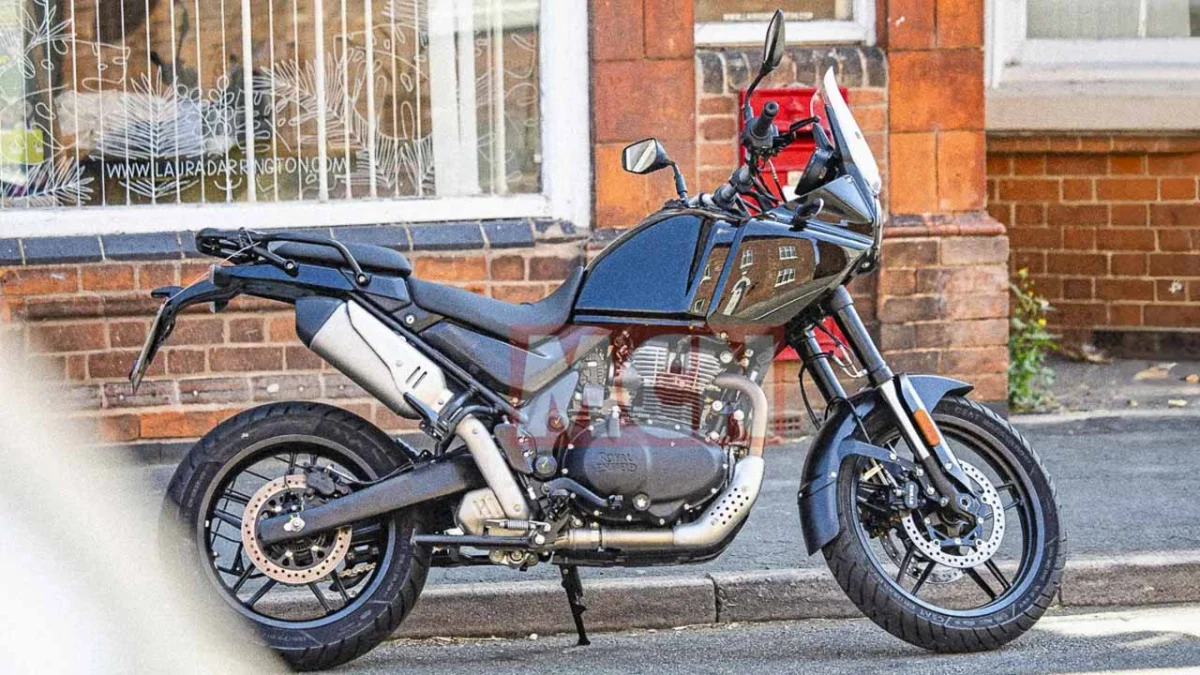
The global motorcycling community is currently focused on Leicestershire, England, where the latest sightings of the Royal Enfield Himalayan 750 have sent ripples through the industry. As the most anticipated adventure-touring motorcycle from the Indian multinational, the Himalayan 750 represents a seismic shift in Royal Enfield’s product strategy. Recent spy shots captured near the company’s UK Technology Centre reveal a motorcycle that has moved past the experimental "test mule" phase and is now appearing in what experts describe as production-ready form.
This development marks a significant milestone for Royal Enfield, a brand that has successfully transitioned from a niche retro-classic manufacturer to a global heavyweight in the middleweight segment. The Himalayan 750 is not just a larger version of its predecessors; it is the flagship of a brand-new 750cc platform designed to compete with the world’s most established adventure brands.
Main Facts: A Production-Ready Powerhouse
The latest prototype of the Royal Enfield Himalayan 750 offers the clearest look yet at the final product. Unlike earlier versions seen in India and Europe, which were often cluttered with data-logging equipment and exposed wiring, this latest unit features finished body panels, integrated lighting, and finalized switchgear.

Design and Aesthetics
The Himalayan 750 maintains the rugged, functional DNA of the Himalayan family but with a noticeably more muscular "big-bike" presence. It draws clear inspiration from the recently launched Himalayan 450, featuring the signature circular LED headlamp and an upright, commanding silhouette. However, the 750cc variant scales everything up. The fuel tank is significantly larger, designed for the long-range touring that a twin-cylinder engine facilitates. The fairing is more expansive, and the taller windscreen suggests a focus on high-speed wind protection—a necessity for a motorcycle intended to cruise at highway speeds effortlessly.
Hardware and Ergonomics
One of the most striking revelations from the Leicestershire sightings is the choice of hardware. The motorcycle is equipped with:
- Suspension: High-specification Showa upside-down (USD) front forks and a rear monoshock featuring a remote preload adjuster.
- Braking: For the first time on a Himalayan, a twin-disc setup is visible at the front, paired with ByBre calipers. This is a critical addition to handle the increased weight and performance of the 750cc engine.
- Wheels and Tires: The prototype sports cast alloy wheels with a 19-inch front and 17-inch rear configuration, wrapped in road-biased CEAT rubber. This confirms that the initial launch variant will be a road-focused adventure tourer.
Chronology: From Rumor to Reality
The journey of the "Twin-Cylinder Himalayan" has been a long and speculative one, spanning over half a decade.

2018–2021: The 650cc Rumors
Following the massive success of the Interceptor 650 and Continental GT 650, enthusiasts began clamoring for a Himalayan powered by the same 648cc parallel-twin engine. For years, Royal Enfield executives remained tight-lipped, often suggesting that the Himalayan 411’s chassis was not designed to accommodate the weight of the 650cc twin.
2022–2023: The Shift to the 450 and Early Prototypes
In late 2022, focus shifted to the "Sherpa 450" engine, which eventually powered the new Himalayan 450. However, even as the 450 was being finalized, secret test mules of a larger twin-cylinder adventure bike began appearing in the UK and India. At this stage, the industry still believed the bike would use a modified 650cc engine.
2024: The 750cc Confirmation
The narrative changed dramatically in mid-2024. During investor meetings and press briefings, Royal Enfield CEO B. Govindarajan confirmed that the company was developing a dedicated 750cc platform. This was a strategic pivot; rather than simply repurposing the 650cc unit, Royal Enfield decided to increase displacement to ensure the motorcycle could hold its own against 700cc–800cc rivals from Europe and Japan.

2025 (Expected): EICMA Reveal
With the latest sightings showing a production-spec bike, the timeline is now clear. The motorcycle is expected to make its global debut at EICMA 2026, though a "pre-production" concept or teaser is highly likely at EICMA 2025.
Supporting Data: Technical Specifications and Performance Expectations
While Royal Enfield has not officially released a spec sheet, the engineering visible on the test mules allows for highly accurate deductions.
The 750cc Powerplant
The engine is a parallel-twin unit, expected to be an evolution of the 648cc architecture found in the Super Meteor and Shotgun 650. By increasing the bore and stroke to reach approximately 750cc, Royal Enfield aims to provide a broader torque curve.

- Power Output: Industry analysts expect the engine to produce between 55 and 60 bhp.
- Torque: Torque is expected to sit in the 65–70 Nm range, with a heavy emphasis on low-to-mid-range delivery, consistent with the Himalayan’s "go-anywhere" philosophy.
- Technology: The presence of a refined throttle body setup suggests the inclusion of Ride-by-Wire technology, which would enable multiple riding modes (Rain, Road, Off-Road) and cruise control.
Chassis and Dimensions
The Himalayan 750 utilizes a trellis frame, likely a reinforced version of the architecture seen on the 450, designed to cradle the wider twin-cylinder engine.
- Weight: The bike is expected to weigh between 210kg and 220kg (kerb), making it a heavyweight in the segment but still manageable compared to full-sized 1200cc ADVs.
- Ground Clearance: Despite the higher-mounted exhaust, the road-biased 19/17-inch wheel setup suggests a slightly lower ground clearance than the off-road-centric Himalayan 450, prioritizing stability and seat accessibility.
Official Responses: The Corporate Strategy
Royal Enfield’s leadership has been calculated in their communication regarding the 750cc project. CEO B. Govindarajan’s confirmation of the 750cc platform at EICMA 2026 was a deliberate move to manage expectations and signal the brand’s long-term ambitions.
In recent statements, the company has emphasized that the 750cc platform is not just about one motorcycle. It is a "global platform" intended to spawn several models, including a possible Cafe Racer or a large-capacity Scrambler. The UK Technology Centre, where the bike was recently spotted, has been the nerve center for this development, blending British engineering expertise with Indian manufacturing efficiency.

The company’s strategy is clear: they are no longer content with being the leader of the "affordable retro" space. With the Himalayan 750, they are entering the "Premium Middleweight" category, a space currently dominated by the likes of the Yamaha Ténéré 700, the Honda XL750 Transalp, and the KTM 790 Adventure.
Implications: Market Impact and Competitive Landscape
The arrival of the Royal Enfield Himalayan 750 will have profound implications for both the Indian and global motorcycle markets.
Disruption in the Indian Market
In India, the adventure-touring segment is currently split between the sub-500cc class (Himalayan 450, KTM 390 Adv) and the expensive imports (Tiger 900, BMW F850GS). There is a massive "white space" in the Rs 4 lakh to Rs 6 lakh price bracket. With an expected price tag of under Rs 5 lakh (ex-showroom), the Himalayan 750 will effectively monopolize this segment, offering twin-cylinder performance at a price point that competitors cannot currently match.

Global Market Positioning
Globally, the Himalayan 750 will serve as an "approachable" alternative to high-strung European ADVs. While it may not match the KTM 890 Adventure in terms of raw horsepower or electronic complexity, it will appeal to the "slow-adventure" movement—riders who value reliability, ease of maintenance, and character over spec-sheet dominance.
The "Road-Biased" Strategy
By launching with alloy wheels and road-biased tires, Royal Enfield is acknowledging a hard truth of the ADV market: the vast majority of adventure bikes spend 95% of their time on tarmac. By optimizing the Himalayan 750 for touring comfort and high-speed stability, they are targeting the "Tourer" demographic that finds the Interceptor 650 too small and the Super Meteor 650 too ergonomically specific.
Conclusion
The Royal Enfield Himalayan 750 is more than just a motorcycle; it is a statement of intent. From the early days of the air-cooled 411cc single to this upcoming 750cc twin, the Himalayan brand has matured into a sophisticated global entity. The latest sightings in Leicestershire suggest that the wait is nearly over.

When the curtains finally rise at EICMA, the motorcycling world will see a machine that promises to bring the "Himalayan" experience to the fast lane. With a production-ready design, a confirmed 750cc heart, and a price point designed to disrupt, Royal Enfield is poised to redefine what adventure means for the modern rider. Whether it’s crossing the urban sprawl or traversing continental highways, the Himalayan 750 looks ready to carry the torch of Royal Enfield’s global expansion into a new era of performance.
