

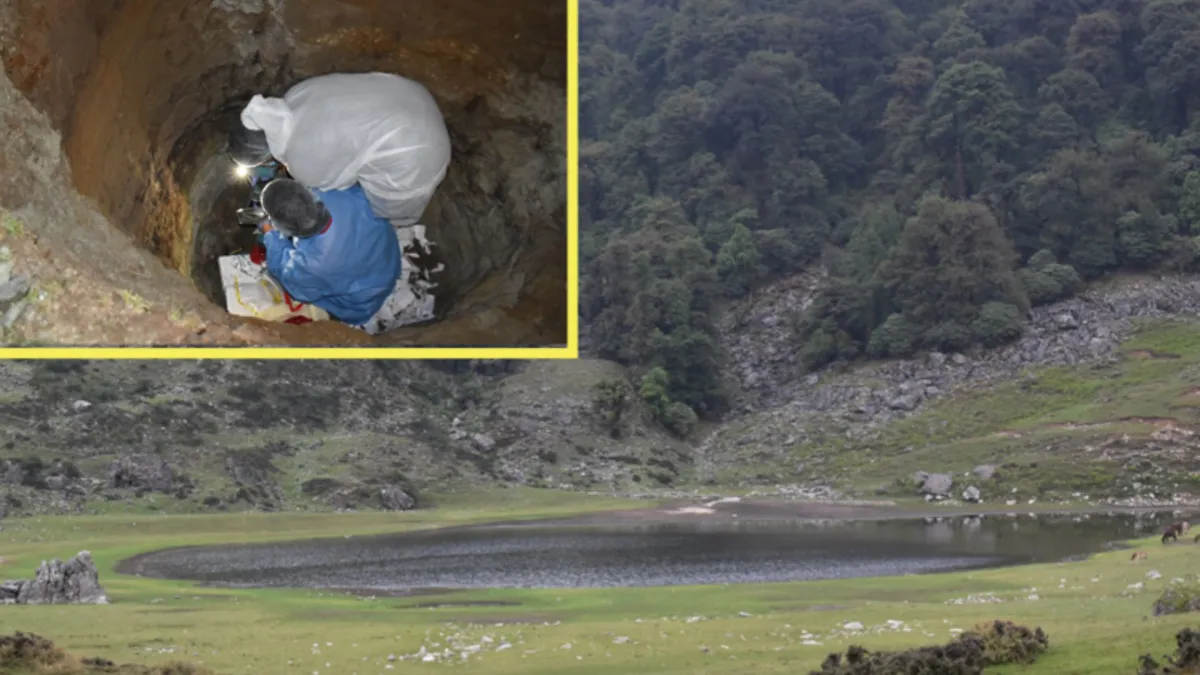
ROORKEE – In the high-altitude reaches of the Garhwal Himalaya, a remote body of water known as Toli Lake has long sat in silence, cradled by the rugged peaks of Uttarakhand. However, beneath its tranquil surface, the lakebed has been acting as a biological vault, meticulously preserving the genetic and chemical secrets of the past 15,000 years.
A groundbreaking study led by a multidisciplinary team of Indian scientists has recently unlocked this archive, revealing a startling discovery: humans were present in these challenging high-altitude environments as early as 8,300 years ago. This finding pushes back the timeline of human migration into the central Himalayas by a staggering 5,000 years, fundamentally challenging existing archaeological narratives that relied solely on physical artifacts.
By utilizing cutting-edge sedimentary ancient DNA (sedaDNA) analysis and molecular fossil tracking, the researchers have reconstructed a continuous history of the region. Their work provides an unprecedented look at how the retreat of the Ice Age, the intensification of the Indian Summer Monsoon (ISM), and the arrival of humans shaped one of the world’s most fragile ecosystems.
The Core Discovery: A 5,000-Year Leap in History
For decades, the history of human settlement in the Garhwal Himalaya was dictated by the "visible" record—pottery shards, stone tools, and remnants of permanent structures. Based on these physical finds, archaeologists estimated that humans began inhabiting these high valleys approximately 3,300 years ago.
However, the new study, published in Quaternary Science Reviews, presents a different story. By analyzing a 178-centimeter-thick sediment core extracted from the bottom of Toli Lake, the team detected human genetic material in layers dating back 8,300 years. This suggests that while humans may not have been building permanent stone settlements at that time, they were certainly traversing, hunting, and perhaps seasonally residing in these mountains during the early Holocene.

This discovery places humans in the high Himalayas shortly after the planet emerged from the Last Glacial Maximum, a period when much of the region was covered in ice and largely uninhabitable. As the climate warmed, these early pioneers followed the retreating glaciers, moving into newly fertile valleys in search of resources.
A Chronology of Change: 15,000 Years of Himalayan Evolution
The researchers meticulously mapped the environmental shifts of the region, dividing the 15,000-year record into distinct climatic and biological epochs.
1. The Post-Glacial Dawn (15,000 to 9,500 years ago)
As the world began to shake off the chill of the last Ice Age, the Garhwal Himalaya remained a harsh, cold, and dry landscape. The sediment layers from this era indicate that Toli Lake was a shallow, low-energy pool. Biological activity was minimal, and the surrounding vegetation was sparse, dominated by hardy species capable of surviving in a semi-arid, high-altitude desert.
2. The Holocene Climate Optimum (9,500 to 3,600 years ago)
This period marked a dramatic transformation. As the Earth’s orbit shifted and the Indian Summer Monsoon (ISM) intensified, the region became significantly warmer and wetter. The lake levels rose, and the landscape turned lush. It was during this "fertile window," specifically around 8,300 years ago, that the first traces of human DNA appear in the mud. The environment had become hospitable enough to support both diverse wildlife and the nomadic human groups that followed them.
3. The Arid Shift and Permanent Settlement (3,600 years ago to Present)
Around 3,600 years ago, the climate began a slow transition back toward drier conditions. Interestingly, as the climate became more challenging, human impact on the land became more visible. By 2,100 years ago, the chemical record shows a massive spike in fire activity, indicating that humans were no longer just passing through; they were actively managing the landscape, likely clearing forests for agriculture and permanent grazing.

The Science of the Mud: Supporting Data and Methodology
The success of this study lies in its "multi-proxy" approach. Rather than relying on a single piece of evidence, the scientists combined several sophisticated techniques to cross-verify their findings.
Sedimentary Ancient DNA (sedaDNA)
This was the first time sedaDNA was used to study a lake in the central Himalayas. Unlike traditional DNA studies that require bones or teeth, sedaDNA looks for microscopic fragments of genetic material shed by organisms—skin cells, waste, or decaying tissue—that settle in the mud. This allowed the team to identify the presence of humans, specific animals, and even plants like domesticated rice and tropical guava, even in layers where no pollen or seeds were preserved.
n-Alkanes: The Leaf Wax Fingerprint
Plants produce a waxy coating on their leaves to prevent water loss. These waxes contain long-chain hydrocarbons called n-alkanes, which are incredibly durable and survive for millennia in sediment. By measuring the length of these carbon chains, the researchers could distinguish between aquatic plants (indicating high water levels) and land-based grasses or trees (indicating a shift in terrestrial vegetation).
Polycyclic Aromatic Hydrocarbons (PAHs)
PAHs are chemical molecular fossils created by fire. By analyzing the concentration of these soot markers, the team could reconstruct the history of wildfires in the region. They found that earlier fires were likely natural, driven by climate cycles, but the fires starting around 2,100 years ago bore the hallmark of human land management.
Collaborative Research and Official Perspectives
The study was a massive collaborative effort involving several of India’s premier scientific institutions:

- Indian Institute of Technology (IIT) Roorkee
- Indian Institute of Science Education and Research (IISER) Mohali
- Birbal Sahni Institute of Palaeosciences
- Inter-University Accelerator Centre
- Indian Institute of Geomagnetism
The researchers emphasized that this multidisciplinary approach is essential for understanding "blind spots" in history. While the DNA confirms human presence 8,300 years ago, the team is cautious. They noted that the genetic record is currently "low-resolution" because only a limited number of samples were analyzed for DNA.
In their findings, the scientists pointed out that while they have proven humans were there, the nature of their stay—whether they were nomadic hunters, seasonal herders, or early experimental farmers—remains a subject for future study. They hope to look for more specific markers in the future, such as fungal spores (Sporormiella) that typically grow on the dung of domesticated livestock, to confirm when exactly pastoralism began in the high altitudes.
Implications for the Future: The "Third Pole" in Peril
The findings from Toli Lake are more than just a history lesson; they serve as a vital baseline for understanding modern climate change. The Himalayas are often referred to as the "Third Pole" because they contain the largest reserve of freshwater ice outside the polar regions.
Predicting Climate Response
By understanding how the Himalayan ecosystem responded to natural warming during the Holocene Climate Optimum, scientists can better predict how the region will react to the current, much more rapid, global warming. The study shows that the Himalayan environment is incredibly sensitive to moisture levels and temperature shifts.
Tracking Human Pressure
The research highlights a clear transition from humans living within the natural cycles of the environment to humans altering the environment through fire and agriculture. As human pressure on the Himalayas reaches an all-time high due to tourism, infrastructure development, and climate-induced disasters, the Toli Lake record warns of the long-term consequences of landscape modification.

A New Era for Archaeology
This study proves that "absence of evidence is not evidence of absence." The lack of stone tools or pottery in a layer does not mean humans weren’t there. As sedaDNA technology becomes more accessible, it is likely to revolutionize archaeology across India and the world, allowing us to find the "ghosts" of our ancestors in the very soil we walk on.
The story of Toli Lake is a testament to human resilience and the enduring power of nature’s archives. As we look toward an uncertain climatic future, the mud of Uttarakhand reminds us that we have been part of this mountain landscape for far longer than we ever imagined—and that our impact on it leaves a mark that lasts for millennia.
