

BHUBANESWAR — In the complex theater of regenerative medicine, the quest to perfectly replicate the human body’s natural healing environment has long been considered the "holy grail." While traditional bandages and simple grafts provide a physical barrier, they often fail to address the intricate biological conversations happening at the cellular level. Now, a multidisciplinary team of international researchers has unveiled a breakthrough that could bridge this gap: a suite of "smart" hyperbranched polymer scaffolds designed to orchestrate the regrowth of both skin cells and peripheral nerves.
The study, a collaborative effort involving the University of Calcutta, the National Institute of Science Education and Research (NISER) in Bhubaneswar, KIIT Deemed to be University, and industrial partners Lion Elastomers (USA) and the Hari Shankar Singhania Elastomer and Tyre Research Institute, represents a significant leap forward in biomaterial science. By fine-tuning the chemical architecture of these scaffolds, the team has demonstrated an unprecedented ability to regulate cellular stress and signaling, offering new hope for patients suffering from chronic wounds, severe burns, and debilitating nerve injuries.
The Challenge: Beyond Structural Support
Human skin is far more than a simple protective layer; it is a sensory organ integrated with a dense network of peripheral nerves. When the skin is severely damaged, the restoration process requires more than just a "patch." It requires the re-establishment of the extracellular matrix (ECM)—a complex scaffolding that provides structural support and biochemical signals to surrounding cells.
A critical hurdle in tissue engineering has been the "neuro-keratinocyte" connection. Keratinocytes, the primary cells of the epidermis, must communicate effectively with nerve endings to restore both the physical barrier and the sensation of touch. Previous synthetic scaffolds often struggled to support both cell types simultaneously. Some were too rigid for nerves to penetrate, while others failed to provide the necessary chemical cues to keep skin cells healthy and functional.
"The restoration of damaged human tissue requires establishing a microenvironment that can mimic the complex signaling of the extracellular matrix," the researchers noted. The challenge lies in creating a material that is not only biocompatible but also "bio-instructive"—capable of guiding cells through the phases of adhesion, proliferation, and maturation.

Synthesis and Architecture: The Power of Hyperbranching
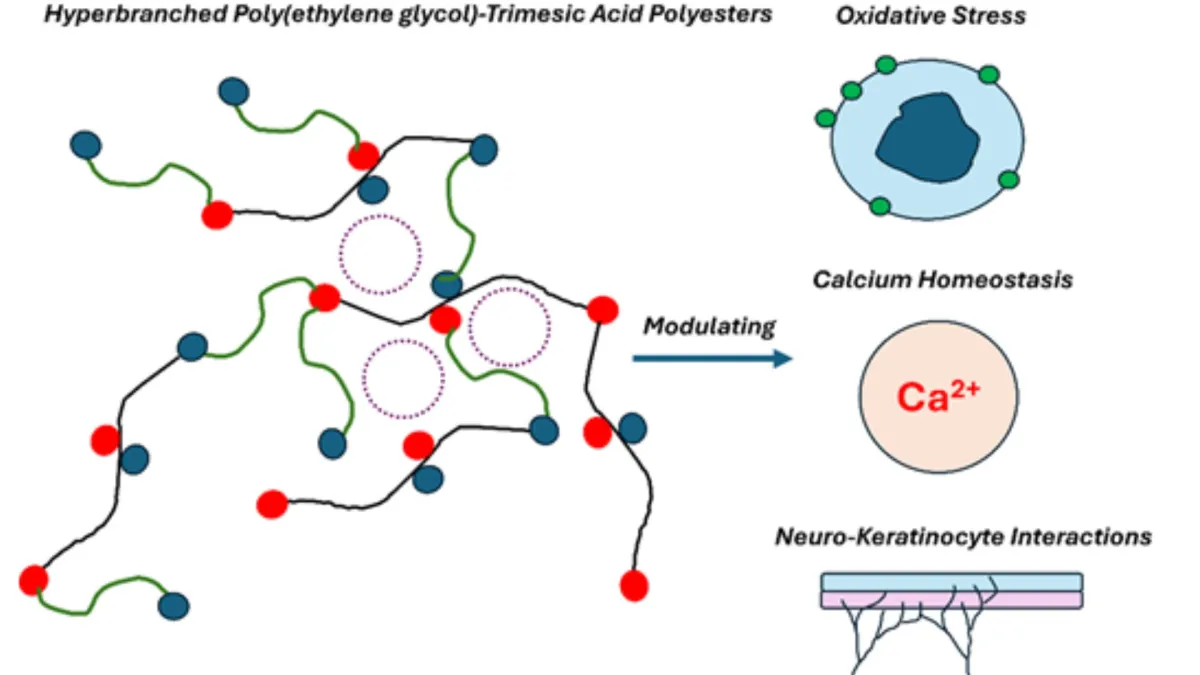
To address this, the research team turned to a sophisticated class of materials known as hyperbranched polyesters. Using poly(ethylene glycol) (PEG) as a flexible, water-friendly backbone and trimesic acid (TMA) as a trifunctional monomer, they induced a process called hyperbranching.
Unlike linear polymers, which resemble long, simple chains, hyperbranched polymers look like highly decorative trees with numerous branches and "end groups." This architecture is highly advantageous for medical applications because it creates a high density of functional sites where drugs can be attached or where cells can latch on.
The researchers developed five distinct formulations, labeled S1 through S5, by systematically varying the molar ratio of PEG to TMA from 1:0.5 to 1:5. This "tuning" allowed the team to create a spectrum of materials with wildly different physical and chemical properties.
- Lower Ratios (S1-S2): These produced smoother, more soluble surfaces with minimal crosslinking.
- Higher Ratios (S4-S5): These yielded denser, more rigid, and more porous networks, rich in carboxyl groups that influence how the material interacts with water and biological molecules.
The Gradient of Success: Analyzing the Formulations
The study’s findings revealed that the "best" material depends entirely on the specific biological goal. Two formulations, in particular, provided the most significant insights into the future of regenerative medicine.
The S3 Formulation: An "Optimal Equilibrium"
The S3 scaffold, featuring a 1:2 PEG to TMA ratio, emerged as a powerhouse for cell adhesion. The researchers described it as having an "optimal equilibrium" between its soluble branched components and its insoluble crosslinked structure. This specific architecture facilitated excellent nutrient diffusion—a vital requirement for any tissue graft.

Interestingly, S3 was found to induce high levels of mitochondrial reactive oxygen species (ROS) and mitochondrial membrane potential. In many medical contexts, "ROS" or oxidative stress is viewed as a negative. However, in the early stages of tissue engineering, the researchers observed that this "hyperactivation" actually encouraged cells to attach more robustly to the scaffold. While S3 might not be ideal for long-term nerve growth due to this high-energy state, it proved to be an exceptional platform for rapid skin cell anchoring.
The S5 Formulation: The Nerve Growth Specialist
The S5 formulation (a 1:5 ratio) proved to be the most sophisticated candidate for complex healing environments where both skin and nerves are involved. Although it was the most densely crosslinked and least porous of the group, its surface chemistry was its secret weapon.
Because of the high concentration of trimesic acid, S5 was covered in a high density of surface carboxyl groups. These chemical markers acted as "anchors" for neurites—the long projections that grow out of neurons. In co-culture environments, S5 allowed neurons to physically attach and extend their reach, a fundamental requirement for restoring sensation to damaged skin.
Biological Insights: Managing Stress and Signaling
One of the most profound aspects of this research is its focus on cellular "internal chemistry." The S5 scaffold demonstrated a remarkable ability to act as a "calmative" for stressed cells. It exhibited the lowest levels of both mitochondrial and intracellular ROS, creating a stable, low-stress environment conducive to long-term tissue survival.
Furthermore, the study highlighted the scaffold’s role in managing calcium homeostasis. Calcium ions are the primary "messengers" in cellular communication, dictating how cells move, divide, and react to their environment. The S5 scaffold was shown to stabilize basal cytosolic calcium concentrations.

By acting as a "smart platform" that synchronizes these signals, the scaffold ensures that different cell types—such as neurons and keratinocytes—can work in harmony during the healing process. This level of control moves biomaterial science away from passive "band-aids" toward active, "bio-instructive" devices.
A Collaborative Milestone
The success of this study underscores the importance of multidisciplinary and international collaboration. By combining the chemical expertise of the University of Calcutta and Lion Elastomers (USA) with the biological and material testing capabilities of NISER, KIIT, and the Hari Shankar Singhania Institute, the team was able to bridge the gap between pure chemistry and clinical application.
Earlier iterations of this research focused primarily on whether these polyesters were safe (toxicity assays) and what they looked like under a microscope. This latest study, however, dives deep into the "why" and "how," explaining the cellular signaling pathways that make these materials effective.
Clinical Implications: A New Era for Wound Care
The potential applications for this technology are vast. As the global population ages, the prevalence of chronic, non-healing wounds—such as diabetic foot ulcers and pressure sores—is skyrocketing. These conditions often involve both skin degradation and nerve damage (neuropathy), making them notoriously difficult to treat.
"The need for bio-instructive materials becomes more urgent as we face an increase in chronic wounds and peripheral nerve injuries," the study suggests.

By using a customizable PEG: TMA scaffold, doctors could theoretically "dial in" the specific properties needed for a patient’s injury. For a shallow burn where rapid skin coverage is the priority, an S3-like formulation might be used. For a deep trauma involving nerve loss, an S5-like formulation would provide the necessary cues for neurological recovery.
The Path Ahead
While the results are promising, the transition from lab-grown scaffolds to bedside treatment involves several more steps, including long-term animal studies and eventually human clinical trials. However, the proof of principle established by this team provides a clear roadmap.
The development of hyperbranched PEG: TMA scaffolds represents a move toward personalized regenerative medicine. By engineering materials that can actively intervene in biological pathways—regulating oxidative stress and balancing calcium—scientists are no longer just trying to replace what was lost; they are teaching the body how to rebuild itself more effectively.
As the field of tissue engineering continues to evolve, this study will likely be remembered as a pivotal moment when the "dialogue" between synthetic materials and living cells became a lot clearer. For patients waiting for better recovery outcomes in skin repair and nerve grafting, the future looks more promising than ever.
