

Kolkata, India – The human body, a vessel of memory and experience, often retains echoes of a past long after the mind has processed or articulated it. It remembers the weight of a soaked sari, the earthy perfume of rain-kissed cotton, the grounding sensation of soil beneath fingertips. This profound connection between the physical and the historical was at the heart of the eighth iteration of "At the Still Point" (ATSP), a community-funded dance platform dedicated to fostering critical dialogues through contemporary artistic expression. Titled "Be.long.ing," the two-day program, held on July 31st and August 1st at Kolkata’s Urban Theatre Project and Goethe-Institut, Max Mueller Bhavan, delved into performance practices deeply rooted in soil, sovereignty, nature, and community. This year’s exploration featured two compelling works: "Cotton Stainers" by the women of the Gram Art Project from Madhya Pradesh, and "Fountain," a visceral solo by Manipuri contemporary dancer and performance artist Surjit Nongmeikapam.
Weaving Narratives from the Earth: The Gram Art Project’s "Cotton Stainers"
The "Be.long.ing" program commenced with "Cotton Stainers," a deeply personal and collective testament from the women of the Gram Art Project. As Paramita Saha, the curator and director of At the Still Point, eloquently articulated the women’s intent, "We, the women, from the Gram Art Project Collective, are sharing our hopes, dreams, memories, secrets, burdens and stories of the brunt we have borne for being rural women of an average Indian village." This statement immediately set the stage for a performance that would not be an abstract interpretation of rural life, but a raw, authentic outpouring from those who inhabit it.

The women hail from Paradsinga, a village nestled in Madhya Pradesh’s Chhindwara district, a locale where the complex interplay of migration, poverty, patriarchy, aspiration, and tradition defines daily existence. Young men and women often leave in search of work, while families remain tethered to agriculture, even as its viability becomes increasingly precarious. Ancient beliefs coexist with burgeoning ambitions, creating a landscape of both resilience and struggle. The Gram Art Project’s performance offered a direct window into this reality, eschewing any romanticized or imagined portrayal of rural India, and instead speaking from within its lived complexities.
The performance itself was a powerful embodiment of these contradictions. Before the dancers took the stage, a symbolic gesture was extended to the audience: each spectator was handed a sindoori seed (Bixa orellana). This seed, sourced from the very ecosystems the women inhabit, was an invitation to engage, to connect. The audience was encouraged to hold it, dip it in water, and spend a few moments with it. For some, this prelude culminated in consuming the seed, a radical act of embodiment that transformed the atmosphere of the room. The audience was no longer mere spectators; they became participants, imbued with the essence of the earth, the sky, and the winds that had cradrom the seed’s journey. This immersive experience served as a potent metaphor for the performance to come, drawing a parallel between the seed’s potential for growth and the women’s own resilience and rootedness.

The Gram Art collective’s Tanmay Joshi and Aditi Bhattad then illuminated the significance of koos ghas, or spear grass, a hardy plant whose seeds possess an extraordinary ability to take root even in barren land. Highly inflammable, the grass can be consumed by fire, yet its roots endure, a testament to its tenacious life force. With the arrival of the first rain, the seed, as if awakening, becomes "jagruk" – conscious. It is drawn to water, it "dances," it "walks towards the rain," it "sews itself." This intrinsic intelligence, requiring no human guidance, became a central theme, resonating deeply with the spirit of "Cotton Stainers."
The 60-minute performance, held on July 31st at The Urban Theatre Project in South Kolkata’s Bhowanipore area, was profoundly unsettling, posing difficult, even terrible, questions about being tethered, untethered, and our fundamental sense of belonging. The narrative unfolded not through explicit dialogue, but through a series of carefully chosen dates and locations, marking sites within homes where acts of violence had transpired. The women, who are both farmers and artists – a duality they emphasize by asserting that "farming too is an art, a dance, isn’t it?" – wove a tapestry of unspoken trauma and quiet strength.

A particularly arresting moment saw Shweta Bhattad, one of the performers, holding a gun. As the event photographer raised his camera, a tense, suspended silence fell. For a few moments, performer and witness locked eyes, dissolving the fragile boundary between performance and reality, between the act of witnessing and the act being witnessed. The subsequent simultaneous release of two shots – one from the camera, one from the gun – reverberated through the room, leaving a lasting impression of the complex relationship between documentation, power, and vulnerability.
The Unsettled Body: Surjit Nongmeikapam’s "Fountain"
The second performance, "Fountain," by Manipuri artist Surjit Nongmeikapam, offered a starkly different yet equally resonant exploration of "Be.long.ing." Nongmeikapam, based in Imphal, has long cultivated a practice that navigates the intricate terrains of movement, memory, identity, and the cultural fabric of his homeland. He terms his approach "Yangshak Movement – The Art of Practice," a phrase that encapsulates a continuous process of research, discipline, and questioning, suggesting an ongoing, unfinished journey.

In "Fountain," Nongmeikapam’s body becomes a suspended entity, caught between worlds. The soundscape surrounding him is a visceral echo of his environment, incorporating sounds by Chaoba Thiyam and the NAF collective, with texts by Babina Chabungbam and Suresh Khurajam. Crucially, video footage from Nongmeikapam’s own works is woven into the piece, creating a multi-layered dialogue between past and present, the internal and the external.
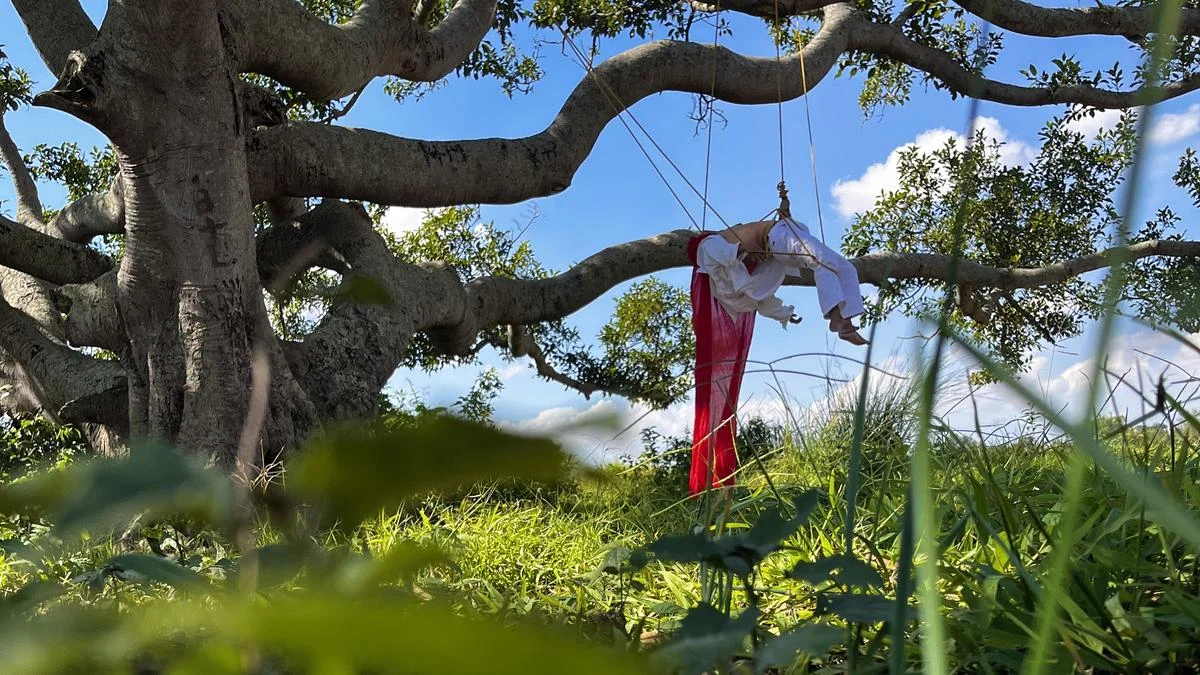
Nongmeikapam describes his work as a "body experimental performance," a form that emerges when words falter. He posits that when experiences become too arduous, too intimate, or too complex to articulate, the body finds its own potent language. This philosophy is profoundly evident in "Fountain." For significant portions of the performance, Nongmeikapam levitates, his body held in a state of ethereal suspension between the ground and the air. This striking physical image transcends mere aesthetics; it carries the profound weight of a larger reality.

The performance subtly, yet powerfully, mirrors the protracted period of unrest and instability that has plagued Manipur for years, leaving its inhabitants caught in a vortex of uncertainty and dislocation. Nongmeikapam’s suspended form embodies this very condition – unable to settle, unable to descend, held in a perpetual state of limbo. His levitation becomes a potent metaphor for a people denied the fundamental assurance of firm ground beneath their feet, a physical manifestation of a collective yearning for stability and belonging.
At the Still Point: A Platform for Essential Conversations
At the Still Point (ATSP) is not merely a performance series; it is a carefully cultivated ecosystem for artistic and social discourse. Founded by Artsforward, the artistic initiative spearheaded by Paramita Saha, ATSP proudly identifies as India’s first community-financed formal arts platform. This unique model actively invites audiences to become stakeholders in the creation and dissemination of art. Over its history, ATSP has showcased a diverse array of artists, including Mandeep Raikhy, Diya Naidu, Avantika Bahl, Satakshi Nandy, and Ronita Mookerji, each contributing to its rich tapestry of challenging and thought-provoking work.

Paramita Saha articulates a core tenet of ATSP’s mission: when commercial imperatives dictate artistic production, crucial and potentially discomforting questions often struggle to find funding and a platform. The crowd-funded model of ATSP offers an alternative, empowering communities to actively decide which artistic conversations they wish to foster and sustain. "Cotton Stainers" and "Fountain," through their distinct yet complementary approaches, embody this ethos by posing profound and often uncomfortable questions.
One performance begins with seeds placed in the hands of the audience, symbolizing potential, growth, and connection to the earth. The other commences with a body suspended, unable to find solid ground, representing displacement and uncertainty. Together, these two powerful works invite introspection on what the earth offers us and what happens when that foundational certainty is eroded. They bring together two seemingly distant worlds, allowing them to converge and resonate within the intimate, receptive space of the watching eye. In doing so, "At the Still Point" continues to provide a vital sanctuary for artistic expression that dares to probe the depths of human experience and belonging.
