

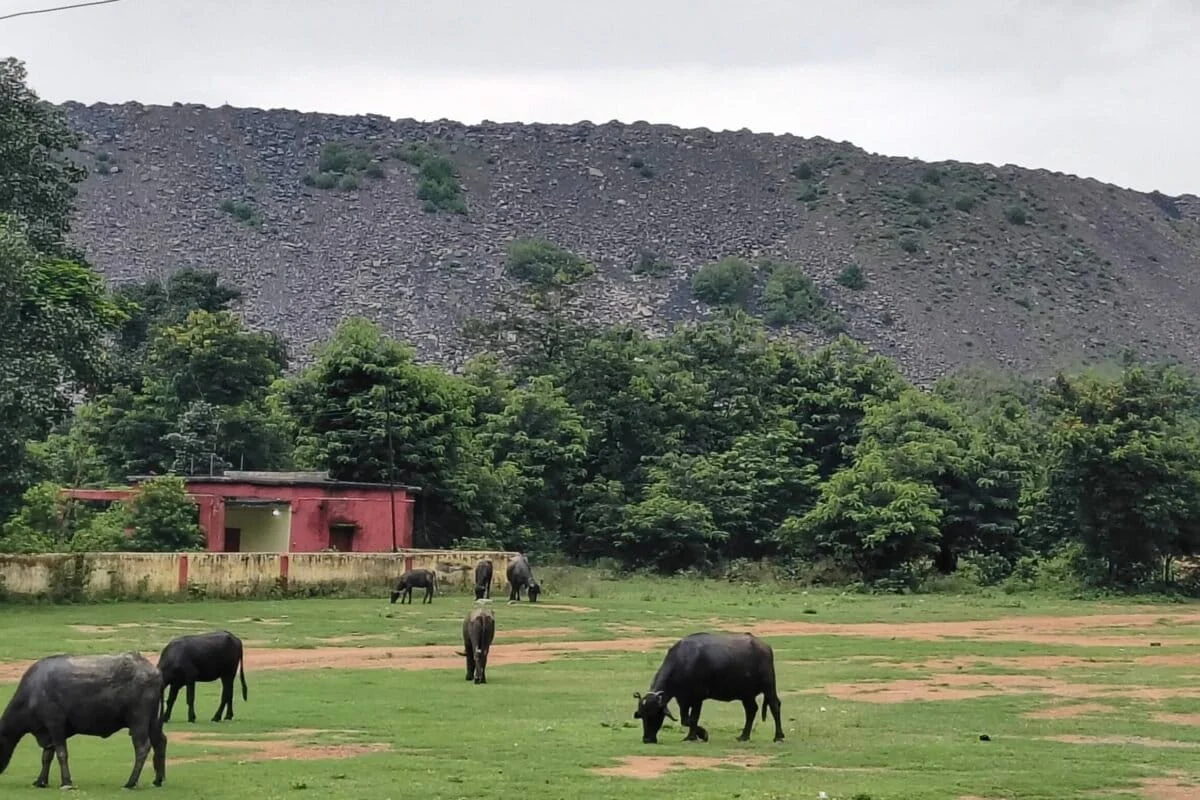
BOKARO, JHARKHAND – On a sweltering afternoon in late July, barely 50 meters from the entrance of the New Selected (NS) Dhori Underground Mine, the earth began to breathe. It was not the breath of life, but a thick, acrid smoke rising from fissures in the scorched soil. Nearby, a cluster of trees stood as skeletal remains, their trunks blackened by a subterranean fire that had recently breached the surface.
To the local residents of Makoli village, this was a terrifyingly familiar sight. To the Ministry of Coal, however, this site represents a success story.
In March 2026, the NS Dhori mine was officially certified as "scientifically closed." It is one of 42 mines highlighted in Aaroh, the Indian government’s inaugural annual report on scientific mine closure and repurposing. The report paints a picture of ecological restoration, community-oriented interventions, and the successful return of land to nature. Yet, on the ground in Jharkhand’s coal belt, the gap between official documentation and the lived reality of the community is a yawning chasm filled with smoke and uncertainty.
Main Facts: The Disconnect Between Policy and Practice
The crux of the issue lies in the definition of "closure." For the Central Coalfields Limited (CCL), a subsidiary of Coal India Limited, closure is a bureaucratic and technical milestone. For the people of Bokaro, it is a lingering environmental hazard.

The NS Dhori Underground Mine (UG) reportedly ceased active extraction nearly 15 years ago after yielding approximately 1.8 million tonnes of coal. Despite the decade-long hiatus, it was only formally listed as scientifically closed on March 25, 2026. Similarly, the Jarangdih UG mine was declared closed on March 31, 2025.
The Aaroh report claims that Jarangdih has undergone extensive restoration, including the dismantling of old structures, sealing of mine entries, and the planting of 300,000 saplings across 109 hectares. At NS Dhori, the report cites the planting of 23,500 saplings.
However, the physical evidence suggests a different narrative. Local resident Santosh Nonia, 35, describes a "foul-smelling gas" that preceded a major fire three months ago. "Several senior officials visited, and they poured water for three days to control the fire," Nonia said, pointing to the charred earth. "But the smoke is still coming out. It may become intense again very soon."
Chronology: A History of Extraction and Evolving Guidelines
The journey of these mines reflects the shifting landscape of Indian environmental policy:

- Pre-2009: Mining at NS Dhori and Jarangdih was in full swing. During this era, mine closure was often an afterthought, with many sites simply abandoned once they became economically unviable.
- 2009–2013: The Ministry of Coal introduced the first formal guidelines for mine closure, requiring companies to set aside funds for restoration.
- 2017–2018: Workers at Jarangdih were transferred as the mine was declared loss-making. Official mining activity largely ceased, though locals claim informal extraction continued.
- 2020–2022: The government tightened the framework, making mine closure an integral part of the "Mining Plan" and introducing guidelines for "legacy" mines (those closed before 2009).
- January 2025: New, more stringent guidelines were issued. These mandated that 25% of closure funds be spent on community livelihoods and 10% on "Just Transformation."
- March 2025/2026: Jarangdih and NS Dhori are officially "scientifically closed" under the new standards.
- July 2026: The Ministry releases the Aaroh report, even as smoke continues to rise from the NS Dhori site.
Supporting Data: The Technical and Social Challenge
The "scientific" aspect of closure relies heavily on the management of "voids"—the empty spaces left underground after coal is extracted. If these voids are not properly filled (usually with sand or fly ash), they can lead to land subsidence and spontaneous combustion.
Biswajit Paul, a professor at the Department of Environmental Science and Engineering at IIT (ISM) Dhanbad, argues that the technology currently in use is insufficient. "The existing ground-penetrating radar (GPR) systems can detect voids only up to about 30 meters," Paul explained. Many coal seams in Jharkhand run much deeper, leaving "invisible" hazards that can haunt a region for decades.
Furthermore, the scale of restoration claimed by the government is often difficult to verify on the ground. While the Aaroh report mentions 109 hectares of restoration at Jarangdih, local environmentalists like Gulab Chandra of the Damodar Bachao Abhiyan say they have seen no "substantially new" activity in recent years.
The social data is equally contentious. The report claims 1,000 fruit-bearing saplings were distributed to villagers near NS Dhori. Yet, in the village of Karipani, residents met the news with laughter. "No one has approached us for consultation, let alone given us saplings," said Budhan Singh, a local resident.

Official Responses: Security, Livelihoods, and Red Tape
When confronted with the lack of community engagement, officials from CCL offer a pragmatic, if cynical, defense. AKB Singh, General Manager of the CCL’s Kathara area, admitted that formal consultations are rare. "If we go to them and say we want to close the mine, nobody will agree because their livelihood, directly or indirectly, is dependent on these mines," Singh stated.
This highlights the central tension of the "Just Transition." For decades, the local economy has been built entirely around coal. Closing a mine isn’t just an environmental act; it is an economic amputation.
A senior CCL official in Ranchi, speaking on the condition of anonymity, noted that while older closures didn’t prioritize community engagement, the company is now issuing "requests for proposals" (RFPs) for eight mines to assess community needs. There are signs of progress: a former CCL parking area near NS Dhori is currently being converted into a school, a move aligned with the 2025 guidelines on repurposing mine infrastructure.
However, the official admitted that the spontaneous fires—like the one at NS Dhori—remain a persistent challenge, often exacerbated by "unauthorized" (illegal) mining by locals who have no other source of income.

Implications: The High Stakes of India’s ‘Just Transition’
The situation in Bokaro is a microcosm of the challenge facing India as the world’s second-largest coal producer. In 2024–25, India mined a record 1,047 million tonnes of coal. As the nation moves toward its net-zero commitments under the Paris Agreement, hundreds of mines will eventually need to be closed.
The implications of failing to get "scientific closure" right are profound:
1. Environmental Degradation
Unfilled voids lead to land subsidence, which can destroy homes and infrastructure. Subterranean fires release toxic gases and greenhouse gases, contributing to local respiratory illnesses and global warming. Furthermore, closed mines often continue to deplete the water table or leach heavy metals into groundwater.
2. The Livelihood Crisis
A 2025 paper in WIREs Climate Change noted that of 123 mine closures since 2008, there is "little evidence of environmental remediation." Instead, closures have frequently led to economic distress and a rise in dangerous, illegal "rat-hole" mining. Professor Paul emphasizes that closure must be a "ten-year process," not a single event. "We have to provide them with technical skills," he says. "The mine was running for 100 years; how can you stop it in one day?"

3. Policy Credibility
The RECLAIM framework, launched in 2025 by the Coal Controller Organisation, aims to integrate spiritual and community participation into mine planning. However, if the flagship reports like Aaroh continue to showcase "restored" sites that are still actively smoking and burning, the government risks losing the trust of both international climate monitors and the local populace.
4. The Need for Holistic Planning
Experts argue that mine closure cannot happen in isolation. It must be linked to District Management Plans. If a district needs a school, a hospital, or a solar farm, the post-mining land use must be legally mandated to fulfill that need.
Conclusion
As the sun sets over the waste mountains of the Kathara area, the smoke from NS Dhori continues to curl into the sky—a grey reminder that "scientific closure" on paper does not always mean safety on the ground. For the villagers of Makoli and Karipani, the end of coal mining has not brought the promised ecological rebirth. Instead, it has brought a new kind of precariousness.
The Indian government’s move toward formalizing closure is a necessary first step, but the fires in Bokaro suggest that the hardest work—the work of genuine community restoration and technological transparency—is only just beginning. Until the "invisible" voids are filled and the local voices are heard, the "scientific" closure of India’s coal mines will remain a mirage in the dust of the Jharkhand coal belt.
