

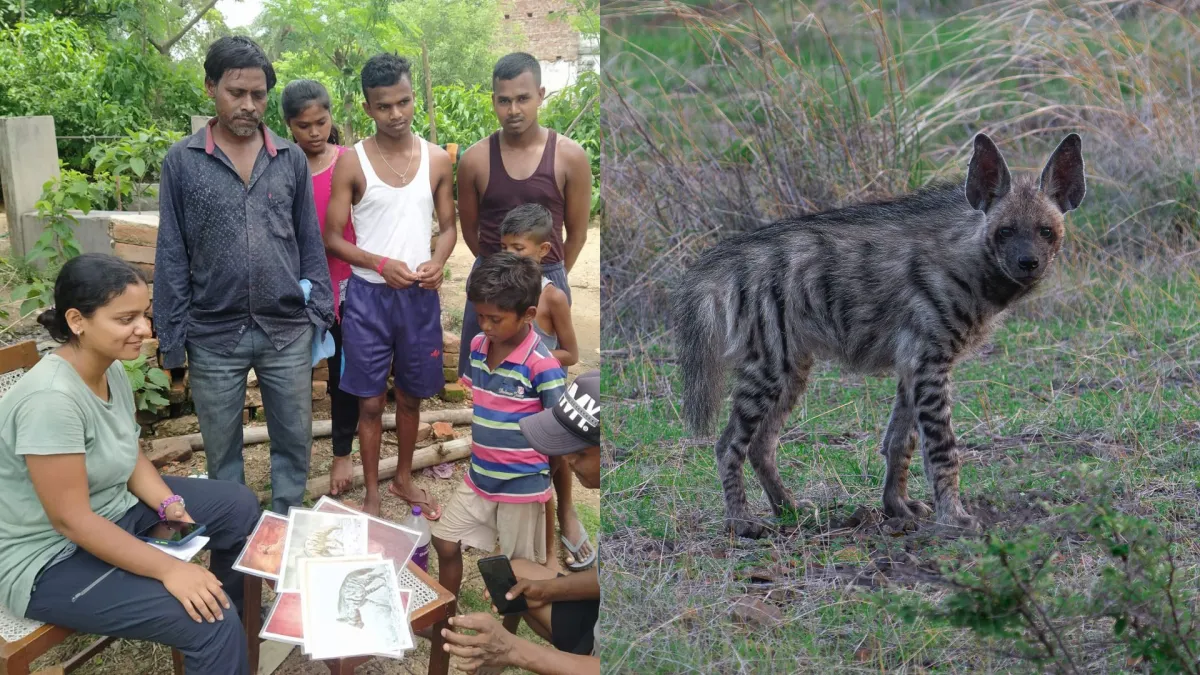
PURULIA, INDIA — For decades, a fundamental tenet of community-based conservation has been the "local knowledge" assumption: the belief that people living in close proximity to wildlife possess a deep, lived understanding of the species sharing their landscape. However, a groundbreaking study conducted in the Purulia district of West Bengal is turning this assumption on its head.
The research, a collaborative effort between the Human and Environment Alliance League (HEAL), The University of Trans-Disciplinary Health Sciences and Technology, and the National Centre for Biological Sciences (NCBS), reveals that proximity does not automatically translate to ecological literacy. Instead, the study suggests that for elusive, nocturnal species like the Striped Hyaena (Hyaena hyaena), "knowledge" is often a volatile mix of rare observations, inherited folklore, and deep-seated cultural anxieties.
Main Facts: The Visibility Gap in Ecological Literacy
The core finding of the study, recently published and based on extensive fieldwork, highlights a "visibility gap." While communities may live within the same geographical boundaries as certain predators, their actual understanding of those animals is dictated by the frequency and nature of their encounters.
In the case of the Striped Hyaena, its solitary and nocturnal nature makes it a "ghost" in the landscape. Unlike more visible carnivores such as the Golden Jackal or the Bengal Fox, which are often seen near human settlements or seen raiding poultry, the hyaena remains largely out of sight. This lack of direct observation creates a vacuum of information.
"Living in the same landscape is not necessarily the same as knowing a species," explains Vasudha Mishra, the study’s lead author and a researcher with HEAL. "Knowledge develops through repeated observation. When an animal moves alone, emerges mainly after dark, and avoids people, even neighboring communities may have very few opportunities to understand how it actually lives."
The study found that when direct observation is absent, the human mind fills the gaps. These "knowledge fillers" include inherited beliefs, media portrayals, and sensationalized accounts of rare incidents, often leading to a distorted perception of the animal’s biology and threat level.
Chronology of the Study: From Interviews to Insights
The research was structured to bridge the gap between biological reality and social perception. The team focused their efforts on two specific blocks in the Purulia district, a region known for its rugged terrain and diverse carnivore population.
The Interview Phase:
The researchers conducted 104 semi-structured interviews with local residents. The methodology was designed to be both quantitative and qualitative. Respondents were first presented with a visual identification test: photographs of five carnivores—the Leopard, Golden Jackal, Bengal Fox, Indian Grey Wolf, and the Striped Hyaena.
The Ecological Assessment:
Following the identification, respondents were asked to describe the appearance, diet, habitat, and behavior of the animals they recognized. This allowed researchers to compare local descriptions against established scientific data.
The Cultural Deep-Dive:
The final phase involved detailed conversations regarding the cultural and symbolic meanings attached to the hyaena. This qualitative approach sought to understand not just what people knew, but how they felt about the species and why certain myths persisted over others.
Supporting Data: A Tale of Two Identities
The data gathered during the interviews revealed a stark disparity in how different carnivores are perceived by the public.
Identification Rates:
While the majority of respondents had no trouble identifying the Leopard, Golden Jackal, and Bengal Fox—species that are either highly feared or frequently seen—only 39% of the 104 respondents could correctly identify the Striped Hyaena. Of the remaining group, 28 people could not name the animal at all, while 25 misidentified it as an entirely different species.
The Social vs. The Solitary:
The Golden Jackal and Bengal Fox scored high on ecological accuracy. Because these animals are social, active during twilight, and frequently interact with domestic livestock (poultry), locals have developed a "scientific" understanding of their habits. They are seen as manageable risks. In contrast, the Striped Hyaena’s elusiveness led to a fractured identity.
Gaadha vs. Kuia:
The most striking finding of the study was the emergence of two distinct cultural identities for the hyaena:
- The Gaadha (The Scavenger): 33 respondents identified the animal as "Gaadha." This identity aligns closely with science. These respondents described the animal as a solitary, nocturnal scavenger that feeds on carcasses and lives near riverbanks or cremation grounds. While they feared its "bold" refusal to run away when encountered, they generally viewed it as a non-threat to living livestock.
- The Kuia (The Mythical Predator): 11 respondents used the name "Kuia." This version of the hyaena is a creature of nightmare—a ferocious pack hunter capable of taking down elephants and sucking the blood of its victims. Most who spoke of the "Kuia" had never actually seen one; their "knowledge" was a legacy of oral traditions and fear-based storytelling.
The researchers posit that the "Kuia" identity demonstrates how a single, rare negative interaction—perhaps a hyaena defending itself or a case of mistaken identity during a livestock attack—can become "disproportionately influential" in a community that lacks regular, neutral encounters with the species.
Official Responses: Voices from the Scientific Community
The researchers involved in the study emphasize that these findings have profound implications for how we approach wildlife conservation in human-dominated landscapes.
Tiasa Adhya, co-author and Joint Secretary of HEAL, noted the psychological dimension of the findings. "The Kuia identity demonstrates how an elusive species can acquire a second life in human imagination," Adhya said. "When ordinary encounters are almost absent, one exceptional incident can become disproportionately influential. More than its ecology, the animal is remembered through fear, memory, folklore and the retelling of an event."
Arjun Srivathsa, a co-author from the National Centre for Biological Sciences (NCBS), Bangalore, cautioned against the "romanticization" of indigenous knowledge. "Community knowledge can be exceptionally detailed when people regularly observe a species. But for animals that are rarely encountered, cultural predispositions may overshadow knowledge derived from direct experience," Srivathsa stated.
Sayan Banerjee, an alumnus of the National Institute of Advanced Studies, added that conservationists must look beyond the "biological animal." He argued, "Coexistence does not depend only on reducing damage. It also requires understanding how an animal is situated within stories, memories, fears, and moral worlds."
The Scavenger’s Dilemma: Sanitation vs. Spiritual Anxiety
The study also delved into the complex social reception of the hyaena’s primary ecological role: scavenging. While the removal of carcasses is a vital ecological service that prevents the spread of disease, the local perception of this act is fraught with "cultural ambivalence."
When hyaenas scavenged livestock carcasses dumped far from villages, they were often viewed as a "natural cleaning crew." However, if this occurred near settlements, the hyaena was stigmatized as a source of "filth and contamination." Some respondents even harbored the biological misconception that eating carrion would make the hyaena "mad" or more likely to attack humans.
The most significant barrier to coexistence, however, is not economic but spiritual. The study documented deep-seated "spiritual anxiety" regarding the hyaena’s tendency to dig up shallow graves. In areas where families cannot afford cremation and opt for riverbank burials, the disturbance of a grave is seen as a catastrophic event. It is believed to prevent the soul from attaining peace and brings shame and "impurity" upon the surviving family. This association with inauspiciousness makes the hyaena a target of loathing that no simple compensation check for lost livestock can fix.
Implications: Rethinking the Coexistence Model
The findings of the HEAL/NCBS study suggest that current conservation models, which focus heavily on economic mitigation (such as compensation for livestock loss), are ill-equipped to handle the challenges facing elusive species like the Striped Hyaena.
The Need for "Cultural Conservation":
The researchers argue that for species whose primary threat is "mistaken identity" or "mythological fear," conservation must be an exercise in communication and education rather than just biology.
Locally Tailored Outreach:
The study recommends the use of audio-visual outreach programs. Showing communities high-definition footage of hyaena behavior—demonstrating their solitary nature and their role as scavengers rather than pack-hunting "blood-suckers"—could help dismantle the "Kuia" myth.
The Role of Ecological Services:
Future programs must emphasize the "sanitation service" provided by hyaenas. By reframing the scavenger not as a bringer of filth, but as a barrier against zoonotic diseases (like rabies or anthrax), conservationists can provide a practical reason for communities to tolerate their presence.
Addressing Spiritual Concerns:
Conservationists may need to engage with community leaders to find practical solutions for the "grave-digging" issue—such as promoting more secure burial practices or providing communal cremation spaces—to decouple the hyaena from themes of spiritual misfortune.
Conclusion
The Striped Hyaena of Purulia serves as a case study for a global problem: how do we protect what we do not see? As human settlements expand into wildlife corridors, the "ghosts" of the forest are increasingly being judged not by their actual behavior, but by the shadows they cast in the human imagination.
By acknowledging that folklore can be as powerful as fact, this study provides a new roadmap for conservation—one that treats cultural narratives with the same rigor as biological data. For the Striped Hyaena to survive, it must first be seen for what it truly is: a misunderstood scavenger playing a vital, albeit invisible, role in the health of the ecosystem.
