

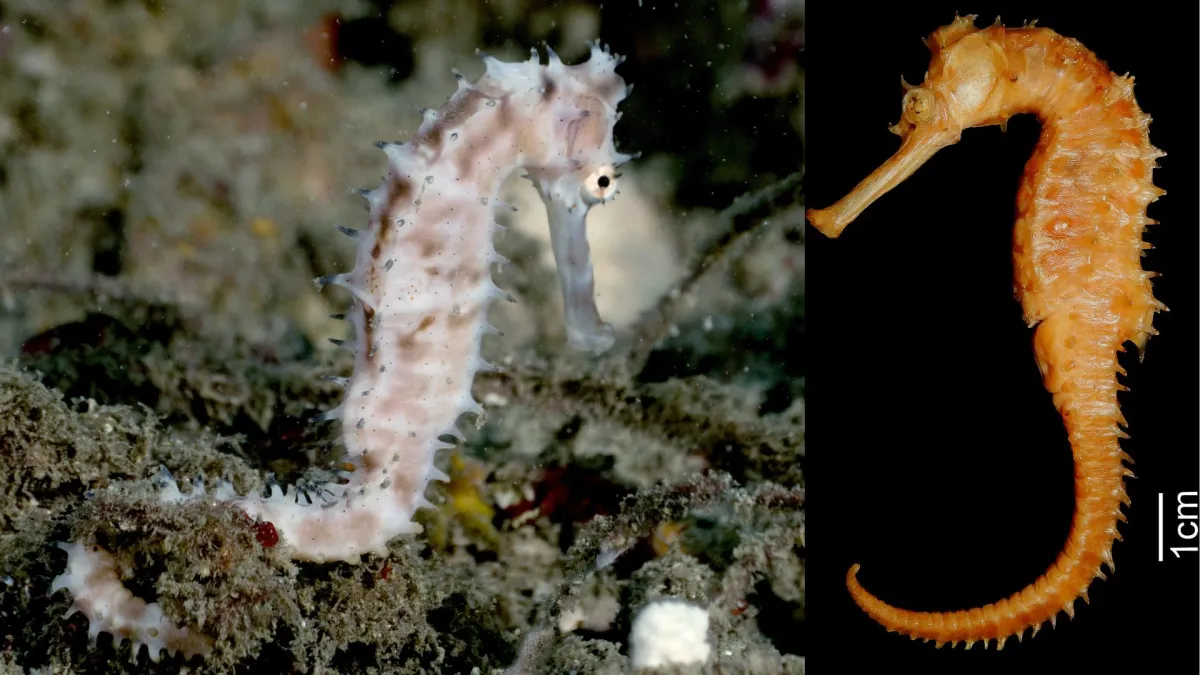
KOCHI, India – In the vast, undulating blue of the Indian Ocean, a master of disguise has lived in plain sight for millennia. For over a century, scientists and marine biologists cataloging the biodiversity of the Indo-Pacific region believed they were looking at a familiar face: the Thorny Seahorse (Hippocampus histrix). However, a groundbreaking international study has revealed that this "familiar" creature is, in fact, a distinct species entirely.
The identification of Hippocampus amandavincentae, a new species of spiny seahorse, marks a watershed moment in marine taxonomy. By combining traditional morphological analysis with cutting-edge genetic sequencing, a collaborative team of researchers from India, Australia, and the United States has finally cleared the fog of a taxonomic confusion that dates back to the late 19th century. This discovery not only adds a new member to the Syngnathidae family but also fundamentally alters our understanding of how marine life is distributed across the Indian Ocean.
Main Facts: A New Identity for an Ancient Resident
The discovery of Hippocampus amandavincentae is the result of a rigorous multi-year investigation into the "spiny seahorse" complex. While seahorses are iconic symbols of marine conservation, they are notoriously difficult to classify due to their ability to change color and grow varying lengths of skin filaments to blend into their surroundings.
Key Highlights of the Discovery:
- Species Name: Hippocampus amandavincentae (named after Dr. Amanda Vincent).
- Geographic Range: Extends from the southeastern coast of India (Tamil Nadu) through the Red Sea and down the East African coast to Madagascar and Mozambique.
- Collaborating Institutions: Kerala University of Fisheries and Ocean Studies (KUFOS), the Australian Museum Research Institute, the California Academy of Sciences, and the Burke Museum.
- Methodology: Integrated taxonomy, utilizing both physical measurements (morphometrics) and DNA barcoding of the mitochondrial COI gene.
For decades, any spiny seahorse found in the Indian Ocean was often lumped into the H. histrix category, a species originally described from the Pacific Ocean. The study proves that H. histrix is largely confined to the Pacific, while H. amandavincentae claims the Indian Ocean as its primary domain.
Chronology: From Fishing Bycatch to Scientific Breakthrough
The journey to identifying H. amandavincentae did not begin in a high-tech laboratory, but rather on the decks of fishing vessels off the coast of Tamil Nadu, India.

The Collection Phase (2020–2022)
The researchers began by examining specimens collected from "bycatch"—the incidental capture of non-target species in commercial fishing nets. Seahorses are frequently caught in bottom trawls, a practice that has devastated their populations globally. In the Palk Bay and Gulf of Mannar regions, researchers noticed subtle physical discrepancies in the spiny seahorses being pulled from the water compared to the established descriptions of H. histrix.
The Archival Deep Dive (2023)
Suspecting a potential new species, the team expanded their scope. They didn’t just look at fresh specimens; they revisited museum archives across the globe. By examining preserved specimens in the Australian Museum and records from the California Academy of Sciences, the researchers realized that these "unusual" seahorses had been collected for over a hundred years but had been consistently mislabeled in catalogs.
The Genetic Revelation (2024–2025)
The final piece of the puzzle fell into place with DNA barcoding. By extracting genetic material from the specimens, the team was able to compare the "genetic fingerprint" of the Indian Ocean seahorses with those from the Pacific. The results were definitive: the genetic distance between the two groups was far too wide for them to be the same species.
Supporting Data: The Anatomy of a Hidden Species
What makes Hippocampus amandavincentae different from its cousins? To the casual observer, one spiny seahorse looks much like another, but to a taxonomist, the differences are as clear as day.
Morphological Distinctions
The researchers identified three primary physical traits that distinguish the new species:

- The Coronet Structure: The "coronet" is the crown-like structure on top of a seahorse’s head. H. amandavincentae possesses five distinct, sharp spines on its coronet. In contrast, its Pacific relative, H. histrix, typically has only four.
- Tail Ring Spination: Seahorses have bodies made of bony rings. A defining feature of the new species is the presence of sharp spines on every single ring of its tail. This differentiates it from H. jayakari, a species found in the Arabian Sea, which only features spines on every second tail ring.
- Snout Proportions: The new species has a notably shorter and stouter snout compared to the elongated, needle-like snout of the true H. histrix.
Genetic Divergence
The DNA barcoding focused on the Cytochrome c Oxidase subunit I (COI) gene. The analysis showed a genetic divergence of over 5% between the Indian Ocean specimens and the Pacific H. histrix. In the world of marine biology, a 2% divergence is often enough to suggest a species-level split, making the 5% gap a "smoking gun" for the research team.
Official Responses and the Naming Tribute
The naming of the species carries significant weight in the scientific community. The researchers chose the name Hippocampus amandavincentae to honor Dr. Amanda Vincent, a professor at the University of British Columbia and co-founder of Project Seahorse.
A Tribute to Conservation
"Dr. Vincent’s work has been instrumental in bringing seahorses to the forefront of global conservation policy," stated one of the lead researchers from KUFOS. "By naming this species after her, we recognize her tireless efforts to ensure these animals do not vanish from our oceans before we even truly understand their diversity."
Dr. Vincent herself responded to the news with a call to action, noting that while the discovery is a "scientific triumph," it also highlights how little we know about the "hidden biodiversity" of our oceans. She emphasized that taxonomy is not just about naming things—it is the foundation upon which all conservation laws are built.
The Regional Impact
Officials from the Indian Ministry of Environment, Forest and Climate Change have welcomed the discovery. There is an emerging consensus that regional biodiversity registers must be updated to reflect this new data, which could lead to more localized and effective marine protected areas (MPAs) in the Gulf of Mannar and beyond.

Implications: Why This Discovery Matters for the Future
The identification of H. amandavincentae is far more than a footnote in a biology textbook; it has profound implications for international law, ecology, and conservation strategy.
1. Accuracy in CITES Regulations
Seahorses are protected under Appendix II of the Convention on International Trade in Endangered Species of Wild Fauna and Flora (CITES). However, if two different species are managed as one, conservation efforts can fail. For example, a population in the Indian Ocean might be crashing while a Pacific population remains stable. By recognizing them as separate species, CITES can now implement trade quotas and monitoring programs that are specific to the health of H. amandavincentae.
2. The Bycatch Crisis
The fact that this species was identified through fishing bycatch highlights a grim reality. Seahorses are "canaries in the coal mine" for reef health. Their presence in heavy bottom-trawl nets indicates that these industrial fishing methods are scraping the seafloor bare. This discovery provides Indian and East African authorities with more leverage to advocate for "seahorse-safe" fishing zones and the regulation of bottom trawling.
3. Redefining Evolutionary History
This discovery suggests that the Indian Ocean has acted as a unique "evolutionary cradle" for certain marine lineages. It challenges the older "Indo-Pacific" model which assumed that most species were distributed uniformly from Hawaii to South Africa. Instead, it supports a more complex model of "biogeographic provinces," where different oceans foster their own unique versions of similar-looking life.
4. A Baseline for Future Research
Now that scientists know what to look for, they can begin to study the specific ecology of H. amandavincentae. What does it eat? What are its preferred seagrass or coral habitats? How does its reproductive cycle differ from other spiny seahorses? These questions are essential for ensuring the species’ survival in an era of rapidly warming oceans and habitat loss.

Conclusion
The story of Hippocampus amandavincentae is a reminder that the Age of Discovery is far from over. Even in an era of satellite mapping and deep-sea submersibles, some of nature’s most fascinating secrets are hidden in museum drawers and the incidental catches of local fishermen.
As the sun sets over the Palk Bay, the newly christened spiny seahorse continues to cling to its seagrass home, unaware that it has finally been "found" by the world of science. For the researchers involved, the work is just beginning. This discovery is a call to protect the vibrant, fragile, and often invisible threads that hold the Indian Ocean’s ecosystem together. By giving this creature a name, they have given it a fighting chance at a future.
