


In an era of relentless digital inundation, the very fabric of our communication and the essence of our identity are being subtly, yet profoundly, sculpted by the environments we inhabit. This is not a novel revelation, but an ancient philosophical insight amplified by the pervasive influence of modern media.
Introduction: The Intertwined Dance of Self and Surroundings

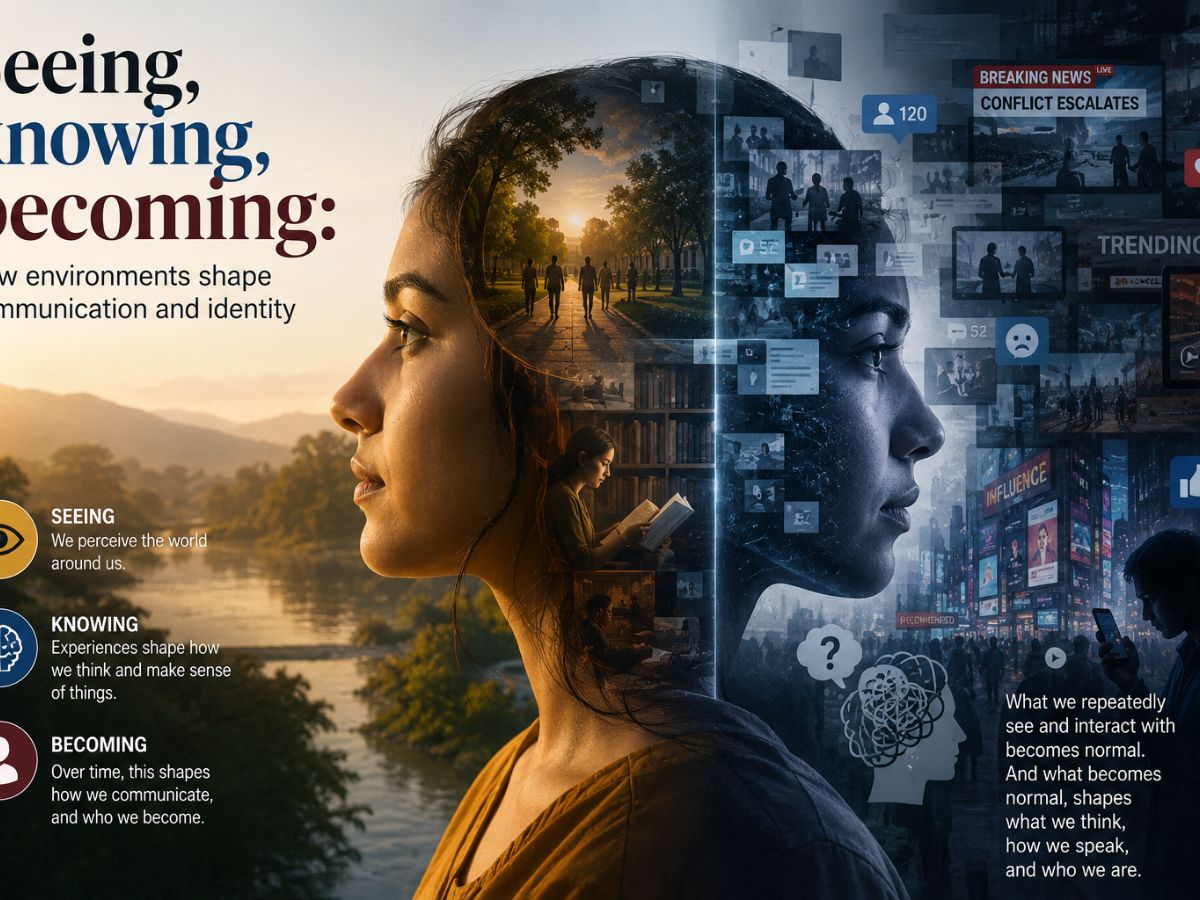
We often perceive communication as a direct outward expression of internal thoughts and identity as a stable, self-generated core. However, this perspective overlooks a fundamental truth: both are dynamic, continuously shaped by our external experiences. What we repeatedly see, hear, and engage with doesn’t merely inform our knowledge; it fundamentally structures our thinking, our language, and ultimately, our very being. This deep connection between our environment and our internal world, recognized in ancient philosophical traditions, has taken on unprecedented urgency in our hyper-connected, media-saturated age.
The question is no longer if our environments influence us, but how deeply this influence permeates, and what its implications are in a world where exposure is constant, often curated, and frequently goes unexamined. This article delves into this intricate relationship, drawing on ancient wisdom and contemporary observations to illuminate the unseen architects of our communication and identity.
)
H2: Echoes from Antiquity: Philosophical Roots of Environmental Influence
The notion that external realities shape internal states is far from a modern discovery. Ancient philosophical systems, particularly in India, grappled with this very concept, laying the groundwork for our understanding.

H3: The Nyaya Sutra: Perception as the Gateway to Knowledge
The Nyaya Sutra, a cornerstone of Indian logic and epistemology, identifies pratyaksha (perception) as the primary conduit for acquiring valid knowledge. It posits that knowledge originates from the direct contact between our senses and the external world. What we visually perceive, audibly hear, and sensorially experience forms the bedrock upon which we build our inferences, judgments, and reasoning processes.
This foundational principle establishes a clear sequence: stimulus precedes cognition, and cognition, in turn, informs articulation. Our interaction with the world is the initial spark that ignites our mental processes, leading to the formulation of thoughts and their subsequent expression.
)
H3: The Yoga Sutra: Impressions, Tendencies, and the Accumulation of Self
Extending this insight, the Yoga Sutra delves into the formation of the mind, defining it as a dynamic interplay of vrittis (fluctuations or modifications). As famously stated in the sutra "yogah chittavrittinirodhah" (Yoga Sutra 1.2), the goal of yoga is to still these mental fluctuations. These fluctuations, it explains, arise from impressions (samskaras) formed through sensory engagement and lived experiences.
With repeated exposure, these impressions deepen, solidifying into tendencies, preferences, and ingrained patterns of response. Identity, from this perspective, is not a pre-ordained, immutable entity. Instead, it is an accumulation, a layered construction built from the cumulative impact of our environmental encounters. This philosophical lens offers a powerful framework for understanding how external realities forge our internal landscapes.
)
H2: The Modern Crucible: Media’s Amplified Influence
While the philosophical underpinnings are ancient, the contemporary media environment has dramatically amplified the impact of environmental influence on communication and identity. We are now immersed in a constant stream of curated content, digital platforms, and algorithmically driven feeds that actively shape our perceptions.
)
H3: The Intensified Stimulus Environment
Today’s individuals navigate an environment dense with an unprecedented volume of stimuli. Social media feeds, news aggregations, streaming services, and digital advertising bombard us with information, images, and narratives. This constant barrage is not benign; it actively prioritizes certain forms of expression, amplifies particular linguistic styles, and normalizes specific worldviews.
H3: The Standardization of Language and the Construction of Identity
One of the most visible manifestations of this influence is the increasing standardization of language across digital platforms. Words, phrases, and expressions circulate rapidly, acquiring shared meanings and serving as markers of belonging within online communities. What might begin as a descriptive term or a casual observation can, through repeated exposure and adoption, evolve into a fundamental aspect of self-definition. Terms that once denoted a preference or an activity now function as powerful signifiers of identity, a testament to the power of linguistic repetition.
)
This shift is not accidental. It is a direct consequence of sustained exposure to particular linguistic patterns, which, over time, begin to feel natural, expected, and even essential for effective participation in these digital spaces. The very language we use to describe ourselves and the world around us is being subtly reshaped by the collective discourse.
H3: The Narrowing of Perspectives and the Shaping of Opinion
The formation of opinions and the adoption of particular stances are also profoundly influenced by our exposure. When individuals are primarily exposed to a narrow range of perspectives, it can foster an illusion of consensus, even when diverse viewpoints exist. Conversely, constant engagement with specific narratives can significantly shape what individuals deem credible, legitimate, or even factual.
)
The Nyaya emphasis on perception as the starting point of knowledge is particularly relevant here. If the scope of what we perceive is limited, then the scope of what we can reason about also contracts. Our ability to engage in nuanced thought and critical analysis is directly tethered to the breadth of information and perspectives we encounter. In essence, our thought processes often follow the contours of our exposure.
H2: The Mechanics of Formation: Repetition and Deepened Impact
)
The Yoga Sutra’s insights into samskaras offer a crucial layer to this analysis, highlighting the role of repetition in solidifying environmental influence.
H3: From Information to Imprint: The Power of Sustained Exposure
A single exposure to an idea or a narrative might inform us, but it is sustained exposure that truly forms us. Over time, repeated patterns of interaction, whether in real life or through media consumption, leave indelible cognitive and emotional residues. These residues, the deepened impressions, subtly influence our subsequent behaviors, preferences, and even our fundamental beliefs.
)
What might initially be a conscious choice or a fleeting preference can, through repeated reinforcement, begin to feel intrinsic, an inherent part of our personality, even when it is the direct result of accumulated environmental input. Similarly, our identity can appear stable and self-derived, masking the continuous, often unconscious, shaping it undergoes.
H2: Implications for Institutions: The Responsibility of Environment Design
)
The profound influence of environments on thought and expression carries significant implications for institutions, particularly those involved in education and communication. If our surroundings are indeed shaping our minds, then the deliberate design of these environments becomes a critical imperative.
H3: Education’s Unseen Curriculum: Beyond Content Delivery
Higher education institutions, for example, often focus heavily on curriculum content and skill development. However, less attention is frequently paid to the communicative environment within which learning takes place. If exposure fundamentally shapes cognition, then the quality of discourse, the diversity of perspectives presented, and the nature of intellectual engagement within an educational setting become paramount. These factors can profoundly influence not only what students know but also how they think and articulate their understanding.
)
H3: Media and Public Discourse: The Compression of Complexity
The media landscape faces a similar challenge. The increasing compression of information into short, easily digestible formats, while enhancing accessibility, risks diminishing complexity and nuance. When exposure is predominantly limited to simplified representations of complex issues, the capacity for nuanced thought can erode. Communication may become more efficient, but it may also become less substantive, sacrificing depth for immediate comprehension.
H2: Cultivating Awareness: Navigating the Influenced Landscape
)
The challenge in our media-saturated world is not to eliminate external influence altogether, as this is an impossible task. Instead, the imperative lies in cultivating awareness of its pervasive nature and its mechanisms.
H3: Recognizing the Influence: From Seeing to Thinking to Speaking
We must acknowledge that what we repeatedly see will inevitably shape what we think, and what we think will, in turn, shape what we say. In an era where our environments are increasingly mediated and intentionally curated, this awareness is not merely beneficial; it is essential for intellectual autonomy.
)
Communication and identity are not solitary creations. They emerge and evolve at the complex intersection of exposure, interpretation, and repetition. The fundamental question is not whether we are influenced by the world around us, but whether we are attentive to how that influence operates. Furthermore, it is about our capacity to be deliberate in shaping the very environments that, in turn, are shaping us. This conscious engagement with our surroundings is the key to fostering more robust, nuanced, and authentic communication and a more self-aware and resilient sense of identity.
