

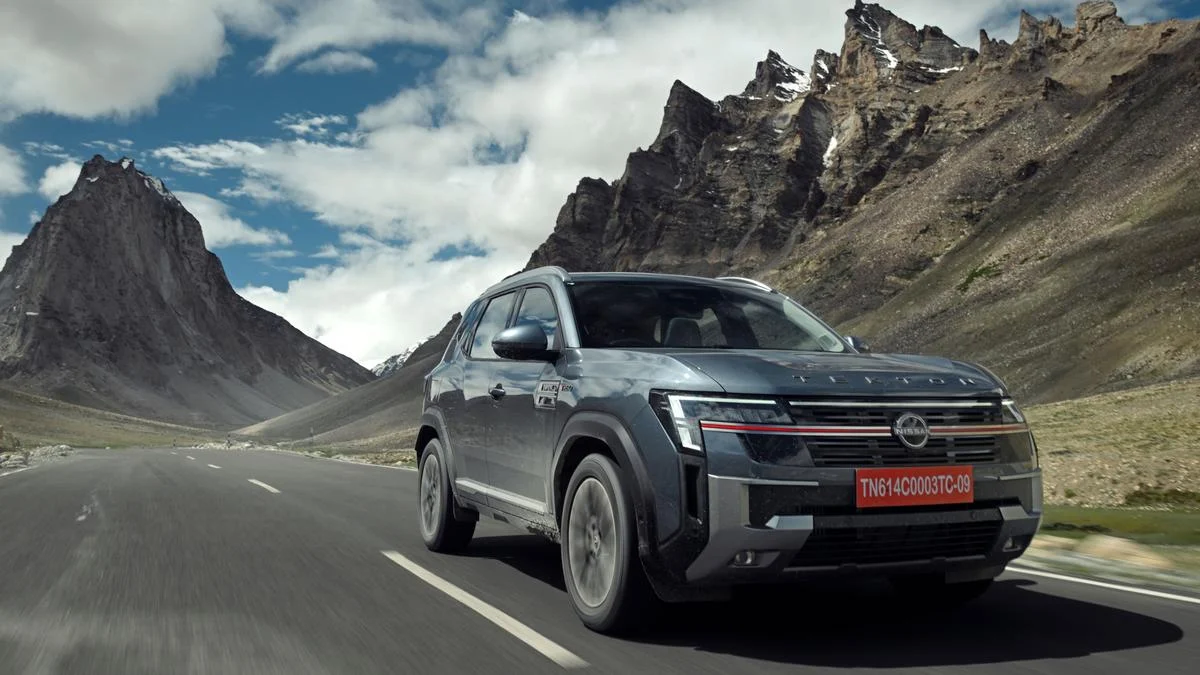
CHANDIGARH – In the hyper-competitive landscape of the Indian mid-size SUV segment, the arrival of a new contender often sparks a singular question: is this a truly original machine or a clever exercise in badge engineering? With the launch of the Nissan Tekton, the question is inevitable. Sharing its platform, powertrains, and core engineering with the Renault Duster, the Tekton enters the market under the shadow of its sibling. However, after an exhaustive 700-kilometer test drive from the plains of Chandigarh to the high-altitude passes leading toward Leh, it has become evident that Nissan has crafted a vehicle that is far more than the sum of its shared parts.
The Tekton represents a strategic pivot for Nissan in India, moving away from mass-market ubiquity toward a more "premium-aspirational" positioning. By focusing on distinctive aesthetics, a high-tech cabin, and a chassis tuned for the rigors of the subcontinent’s varied terrain, Nissan aims to capture a demographic that values rugged capability without sacrificing interior sophistication.
I. Main Facts: The Tekton at a Glance
The Nissan Tekton is positioned as a premium mid-size SUV, designed to bridge the gap between urban commuters and long-distance tourers. Below are the foundational specifications and market details:
- Price Range: ₹10.49 lakh to ₹18.59 lakh (ex-showroom).
- Platform: Shared CMF-B platform (Renault-Nissan-Mitsubishi Alliance).
- Engine Options:
- T160: 1.0-litre, 3-cylinder turbo-petrol (100PS / 166Nm).
- T280: 1.3-litre, 4-cylinder direct-injection turbo-petrol (163PS / 280Nm).
- Transmission: 6-speed Manual; 6-speed Dual-Clutch Transmission (DCT).
- Safety: 5-star Bharat NCAP rating; 6 airbags standard.
- Key Dimensions: 212mm ground clearance; 518-litre boot capacity.
- Primary Competitors: Hyundai Creta, Kia Seltos, Volkswagen Taigun, Skoda Kushaq, and the Renault Duster.
II. Chronology of a High-Altitude Trial: Chandigarh to Leh
To truly understand if the Tekton could stand on its own, the vehicle was subjected to one of the most demanding driving routes in the world. The 700km journey from Chandigarh to the gates of Ladakh serves as a multi-stage gauntlet for any vehicle.

Phase 1: The Himalayan Foothills and Highways
Leaving Chandigarh, the Tekton first encountered smooth multi-lane highways and the sweeping curves of the lower Himalayan foothills. In this environment, the T280 engine’s highway manners were the focus. The 1.3-litre unit allowed for effortless cruising at triple-digit speeds. The cabin insulation proved effective, isolating occupants from wind noise, while the 18-inch alloys provided a planted feel during high-speed lane changes.
Phase 2: The Ascent and Broken Tarmac
As the elevation increased and the "National Highway" dissolved into patches of gravel, slush, and broken tarmac, the Tekton’s 212mm ground clearance became its most valuable asset. Unlike many urban-centric SUVs that require a cautious approach to ruts and potholes, the Tekton’s suspension—inherited from the robust Duster lineage but refined by Nissan—absorbed sharp-edged imperfections with remarkable composure.
Phase 3: High-Altitude Technical Climbing
The final leg toward Leh involved steep gradients and hairpin bends where the air grows thin. Here, the turbocharger was put to the test. While "turbo lag" was noted at lower revs, the mid-range torque of 280Nm provided the necessary punch to overtake slow-moving truck convoys on narrow mountain passes. The descent into the valleys tested the braking hardware, which remained progressive and fade-free despite the sustained load.
III. Supporting Data: Design, Interior, and Engineering
A Bold Visual Identity
Nissan’s design team deliberately avoided a "copy-paste" approach. The Tekton draws heavy inspiration from the Nissan Patrol, the brand’s flagship global SUV.

- The Front Facade: Features a broad, upright stance with a prominent grille and sculpted bonnet. The C-shaped LED daytime running lights (DRLs) and connected lighting treatment give it a modern, tech-forward face.
- Profile and Rear: Chunky wheel arches emphasize its 212mm clearance. A signature Nissan touch is the pillar-mounted rear door handle, a nod to the brand’s design heritage. The rear lighting also mimics the premium aesthetic of the Patrol, ensuring the vehicle looks substantial from every angle.
The "Purple" Interior Strategy
Inside, Nissan has taken a calculated risk. While the segment is dominated by safe black and beige palettes, the Tekton introduces distinctive purple detailing.
- Ambience: This color choice, used on the dashboard and upholstery accents, provides a unique character that differentiates it from the Renault Duster’s more utilitarian interior.
- Technology Suite: The Tekton is equipped with a 10.1-inch infotainment touchscreen and a 10.25-inch digital instrument cluster. It features wireless Apple CarPlay and Android Auto, a panoramic sunroof, and dual-zone climate control.
- Connectivity: Higher variants include "Google built-in," allowing for seamless integration of Maps and Assistant without needing a smartphone tether.
Powertrain Performance Metrics
The T280 variant is clearly the flagship performer. Nissan’s internal testing reveals a 0-100kph sprint in 9.51 seconds for the manual and 9.89 seconds for the DCT.
- Efficiency: Despite the performance, the T280 claims 17.8kpl (MT) and 18.5kpl (DCT).
- The T160 Alternative: The 1.0-litre turbo-petrol is aimed at the value-conscious urban buyer. While adequate for city traffic, our testing suggests it lacks the "legs" required for high-altitude touring when fully loaded with four adults and luggage.
IV. Official Strategic Positioning: Nissan’s Market Logic
While Nissan has not issued a singular press release covering every nuance of the Chandigarh-Leh drive, their official product strategy for the Tekton can be synthesized from their launch presentations and executive briefings.
1. Differentiation through "Premium Ruggedness"
Nissan’s official stance is that the Tekton is not a rival to the Duster, but a premium alternative. By pricing it up to ₹18.59 lakh, they are targeting customers who want the "go-anywhere" confidence of the Duster platform but refuse to compromise on features like ADAS (Advanced Driver Assistance Systems) or a 3D Around View Monitor.

2. Safety as a Pillar
Nissan has emphasized the Tekton’s 5-star Bharat NCAP rating. In a market where safety is becoming a primary differentiator, the inclusion of six airbags as standard across the range is a clear signal of Nissan’s intent to compete with European rivals like the Taigun and Kushaq.
3. The Omission of Hybrid Tech
Addressing the lack of a hybrid powertrain—a segment trend led by Toyota and Maruti Suzuki—Nissan’s engineers have leaned into "Turbo-Petrol" efficiency. Their official response to the "Hybrid Question" focuses on the T280’s direct-injection technology, which they claim offers a superior balance of power-to-weight and highway efficiency compared to heavy hybrid systems in mountainous terrain.
V. Implications: The Tekton’s Role in the SUV Evolution
The introduction of the Nissan Tekton has several significant implications for the Indian automotive market and the brand’s future.
For the Indian Consumer
The Tekton fills a specific niche: the "Touring SUV." While the Hyundai Creta and Kia Seltos offer more interior "bling" and features, the Tekton offers superior ride quality on broken roads. For the growing community of Indian road-trippers who frequent routes like Spiti or Ladakh, the Tekton’s mechanical robustness and high ground clearance make it a more logical choice than its more "car-like" competitors.

For the Nissan-Renault Alliance
The Tekton proves that the Alliance can successfully market two versions of the same vehicle without cannibalizing sales, provided the "skin" and "soul" of the interior are sufficiently different. The Tekton’s success will likely dictate how future shared platforms—including potential electric vehicles—are rolled out in India.
Challenges Ahead
Despite its strengths, the Tekton faces hurdles.
- The Hybrid Gap: As fuel prices remain volatile, the lack of a strong hybrid or diesel option may deter high-mileage urban users.
- The Turbo-Lag Hurdle: In stop-and-go traffic, the T280’s initial sluggishness before the turbo kicks in might be a point of contention for some drivers.
- Brand Perception: Nissan must work to ensure that the Tekton is perceived as a "Patrol-lite" rather than a "Duster-plus."
Final Verdict
The road to Leh is a place where marketing jargon goes to die and only engineering substance survives. By the time the Tekton reached the high-altitude passes, it had proved that its foundations are among the best in the business. It is a vehicle that rewards the driver who looks beyond the spec sheet.
With its excellent ride quality, substantial boot space (518 litres), and a design that commands respect on the road, the Nissan Tekton is a formidable contender. It may have borrowed the Duster’s bones, but Nissan has given it a heart and a wardrobe that are entirely its own. For those who value the journey as much as the destination, the Tekton is a compelling, rugged, and sophisticated companion.

This report was compiled in association with Motorscribes and The Hindu. For more updates on the latest automotive trends, follow @motorscribes on Instagram.
