

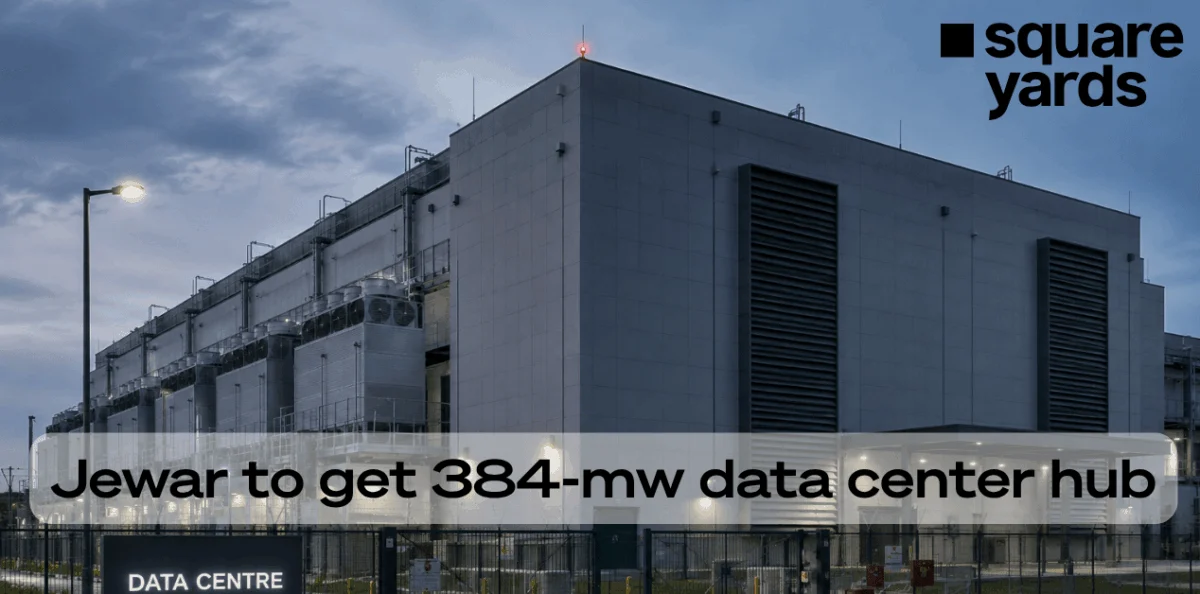
JEWAR, GREATER NOIDA — In a move that signals the rapid evolution of the Yamuna Expressway region from an emerging transport node into a global technological powerhouse, the AM Group has announced a massive ₹26,910 crore investment for the first phase of a mega data center hub in Sector 28. This development, sanctioned under the Yamuna Expressway Industrial Development Authority (YEIDA), is poised to become one of the largest Artificial Intelligence (AI) and High-Performance Computing (HPC) facilities in South Asia.
The project represents a pivotal shift in the regional economic landscape. While the Noida International Airport has been the primary catalyst for growth over the last decade, the introduction of a 1-Gigawatt (GW) capacity data center ecosystem positions Jewar as a critical "nerve center" for India’s burgeoning digital economy.
Main Facts: A Massive Leap in Digital Infrastructure
The scale of the AM Group’s proposal is unprecedented for the region. Spanning approximately 114 acres in Sector 28, the first phase of the project is designed to deliver a capacity of 384 Megawatts (MW). To put this in perspective, this single phase nearly doubles the total committed capacity of many other industrial zones in the state.
Key Project Specifications:
- Total Planned Investment: Over ₹26,910 crore (Phase 1).
- Capacity: 384 MW in Phase 1, scaling up to a total of 1 GW by 2030.
- Land Parcel: Approximately 114 acres in YEIDA Sector 28.
- Focus Areas: AI workloads, High-Performance Computing (HPC), and Cloud Services.
- Operational Timeline: Phase 1 completion targeted for 2028; full capacity by 2030.
Sector 28 was strategically chosen by YEIDA due to its proximity to the Noida International Airport and its access to robust power grids. Unlike traditional industrial units, data centers require massive, uninterrupted power supplies and high-speed fiber connectivity—infrastructure that YEIDA has been aggressively developing as part of its Master Plan 2041.
Chronology: The Road to a Digital Hub
The emergence of Sector 28 as a data center destination is the result of a multi-year strategy by the Uttar Pradesh government to diversify the state’s industrial base.
- 2021–2022: The Uttar Pradesh government unveils its dedicated Data Centre Policy, offering lucrative incentives to developers, including capital subsidies and electricity duty exemptions.
- Early 2023: YEIDA begins the initial allotment of smaller plots in Sector 28. Sify Infinit Spaces and the Jackson Group are allotted two 20,000-square-meter plots with a combined investment of approximately ₹1,757 crore.
- March 2026: The first phase of the Noida International Airport is inaugurated. With an investment of ₹11,282 crore, the airport becomes operational, providing the necessary logistics and cargo infrastructure to support high-tech industries.
- June 2026: Reports confirm that Uttar Pradesh has reached a milestone of six operational data center parks and two operational units, with 644 MW of capacity already under development.
- September 2026: AM Group announces its massive ₹26,910 crore commitment, signaling a transition from "mid-scale" facilities to "hyperscale" data centers in Jewar.
Supporting Data: Fueling the 2 GW Vision
The AM Group project is the cornerstone of Uttar Pradesh’s broader ambition to develop more than 2 GW of additional data center capacity by the end of the decade. The data center industry in India is currently undergoing a "hyperscale" revolution, driven by the localization of data and the explosion of AI.
The AI and HPC Factor
The Sector 28 hub is specifically designed for AI and HPC. Traditional data centers often struggle with the power density required for modern AI chips (like those from NVIDIA). The AM Group facility is being engineered to handle these high-density workloads, which require specialized cooling systems and renewable energy integration.
Economic Impact Metrics
According to a comprehensive research report by Square Yards, the ripple effects of such digital infrastructure are profound:
- Job Creation: Every 1 MW of data center capacity is estimated to support a specific number of direct and indirect jobs. India’s proposed 9,030 MW pipeline is expected to generate 4.33 lakh ecosystem jobs by 2030.
- Housing Demand: The same report suggests that the data center boom could drive demand for approximately 195 million square feet of residential space across India by 2030.
- The "Golden Ring" Effect: Real estate experts have identified a "Golden Ring" of development—a 5 km to 15 km radius around major data centers—where demand for housing, retail, and mixed-use commercial space spikes due to the influx of high-income tech professionals.
Official Responses and Policy Context
The Uttar Pradesh government has been vocal about its desire to turn the Noida-Greater Noida-Jewar corridor into the "Data Capital of North India."
Officials from YEIDA have noted that the authority is not merely providing land but is building an "ecosystem." This includes the development of a dedicated 220 kV substation for Sector 28 to ensure the "five-nines" (99.999%) reliability required by data center operators.
"The entry of large-scale players like the AM Group validates our strategy of integrating the airport with high-tech industrial clusters," a senior YEIDA official stated. "We are moving away from being just a residential or manufacturing corridor. Sector 28 will be the brain of the region, powering the digital services used by millions."
Furthermore, the state’s focus on sustainability has mandated that new data center parks incorporate renewable energy sources. The AM Group has confirmed that its facility will prioritize green energy to meet the ESG (Environmental, Social, and Governance) goals of its global cloud clients.
Implications: A New Era for Real Estate and Business
The announcement of a ₹26,910 crore project has sent shockwaves through the regional real estate market, shifting the narrative from speculative land buying to institutional investment.
1. The Real Estate Paradigm Shift
The presence of a 1 GW data center hub transforms the surrounding localities.
- Jewar: Once a rural outpost, Jewar is now the epicenter of a high-tech zone. The proximity to the data center and the airport will likely see a surge in premium residential projects and "serviced apartments" catering to transit tech professionals.
- Yamuna Expressway Sectors: These sectors will likely evolve into logistics and support hubs. With the Film City and Medical Device Park also in the vicinity, the demand for "walk-to-work" housing is expected to rise exponentially.
- Greater Noida: As an established urban center, Greater Noida will serve as the primary residential and educational base for the workforce employed in the Jewar tech hub.
2. Synergy with Noida International Airport
The synergy between the data center and the airport cannot be overstated. Data centers require constant maintenance and frequent hardware upgrades. The airport’s cargo terminal, inaugurated in early 2026, ensures that high-value server components and cooling machinery can be imported and transported with minimal downtime.
3. Boosting the Logistics and Service Sector
Data centers are not standalone entities; they require a massive support network. This includes cybersecurity firms, hardware maintenance providers, and specialized construction companies. This "ancillary boom" is expected to occupy significant commercial office space in the YEIDA region over the next five years.
4. Transformation into a "Tech-Industrial" Zone
For decades, the Yamuna Expressway was viewed as a "real estate play" focused on residential plots. The AM Group’s investment, alongside the Medical Device Park and the International Film City, confirms the region’s transition into a diversified industrial and technology zone. This reduces the region’s vulnerability to real estate market cycles and provides a stable, long-term economic foundation.
Conclusion: Setting the Stage for 2030
As the first phase of the AM Group’s data center hub moves toward its 2028 completion target, the Jewar region is setting a benchmark for infrastructure-led growth in India. The convergence of the Noida International Airport, a ₹26,000-crore digital hub, and state-backed industrial parks creates a unique economic triangle.
By 2030, when the facility reaches its full 1 GW capacity, Sector 28 will not just be a plot on a map—it will be a global digital landmark, driving the next generation of AI-driven economic growth for Uttar Pradesh and the nation at large. For investors, businesses, and residents, the message is clear: the future of India’s digital infrastructure has found its home in Jewar.
