

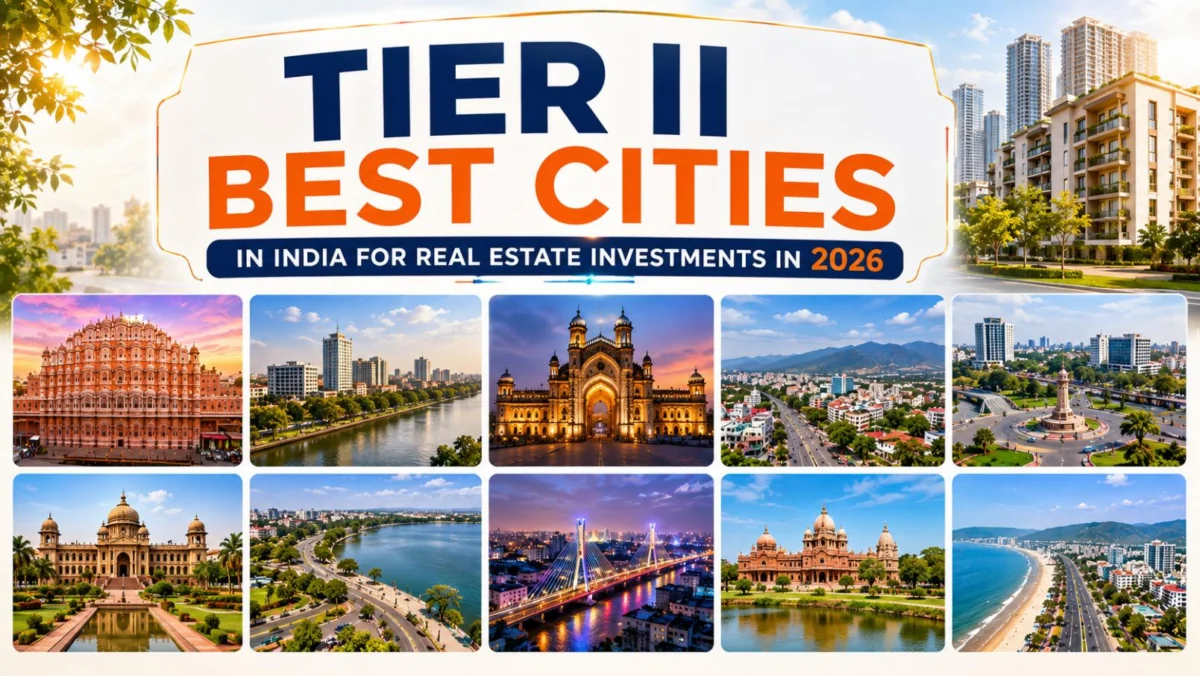
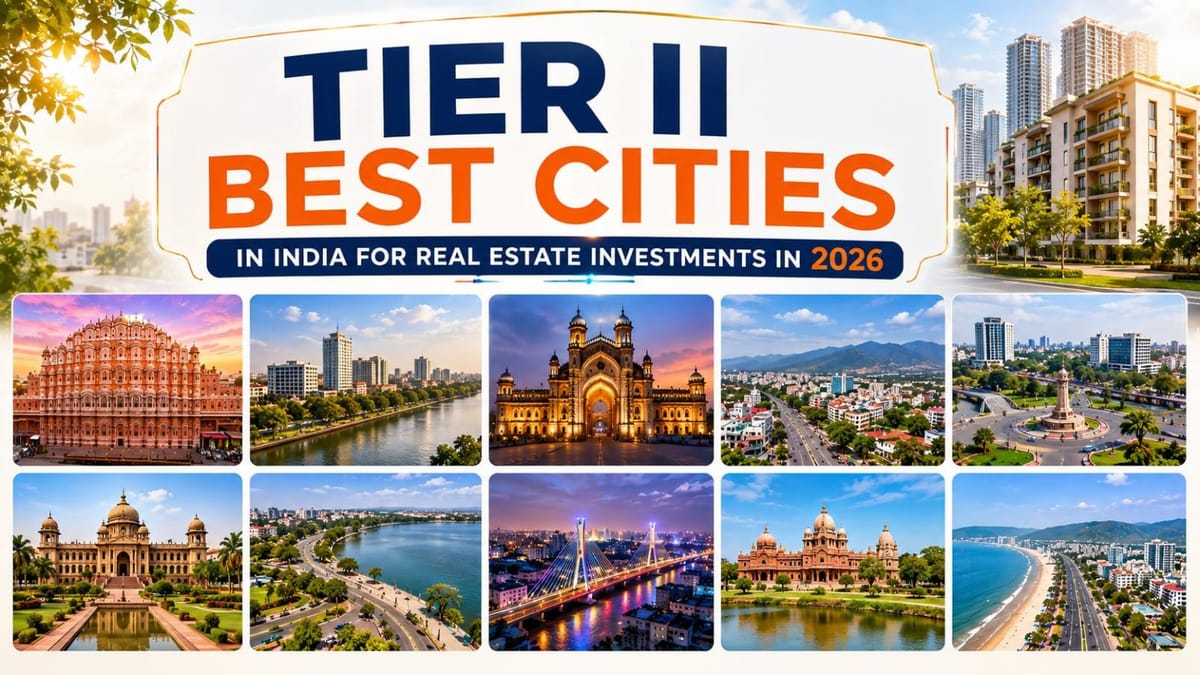
The Indian real estate landscape is undergoing a seismic shift. For decades, the narrative of property investment was dominated by the "Big Seven" metros—Mumbai, Delhi-NCR, Bengaluru, Pune, Chennai, Hyderabad, and Kolkata. However, as 2026 approaches, the spotlight has decisively shifted toward Tier 2 cities. Driven by massive infrastructure projects, corporate decentralization, and an improved quality of life, these emerging urban centers are offering capital appreciation and rental yields that often outpace their Tier 1 counterparts.
This comprehensive report analyzes the top 10 Tier 2 cities poised for a real estate explosion by 2026, backed by market data, infrastructure milestones, and socio-economic trends.
1. The Chronology of the Tier 2 Ascent
The rise of Tier 2 cities is not an overnight phenomenon but the result of a decade-long strategic evolution:
- 2014–2017: The Policy Foundation: The launch of the "Smart Cities Mission" and the "Pradhan Mantri Awas Yojana" (PMAY) provided the initial impetus. The implementation of RERA (Real Estate Regulatory Authority) in 2016 brought transparency to markets that were previously considered "wild west" territories for investors.
- 2018–2020: Infrastructure Connectivity: The expansion of the Bharatmala and Sagarmala projects began connecting regional hubs with high-speed expressways and modernized ports. Regional Connectivity Schemes (UDAN) made smaller cities accessible via air.
- 2021–2024: The Pandemic Pivot: COVID-19 acted as a catalyst. The "Work from Anywhere" culture allowed professionals to migrate back to their hometowns. Corporates followed suit, setting up satellite offices in cities like Indore, Jaipur, and Kochi to tap into regional talent and reduce operational costs.
- 2025–2026 (The Horizon): We are now entering the "Consolidation Phase," where Tier 2 cities are no longer just residential alternatives but are evolving into self-sustained economic powerhouses with high-end retail, international schools, and advanced healthcare.
2. Top 10 Tier 2 Cities for Investment in 2026
1. Lucknow (Uttar Pradesh)
Lucknow has transformed from a traditional administrative capital into a modern metropolis.
- Market Overview: Typical prices range from INR 6,000 – 7,000 / sq. ft.
- Key Advantage: Exceptional price appreciation (approx. 23.7%) and governance hub status.
- Growth Drivers: The expansion of the IT City on Sultanpur Road, the operationalization of the Outer Ring Road, and the massive investment flowing into the Uttar Pradesh Defense Industrial Corridor. Gomti Nagar Extension and Sushant Golf City remain the most coveted micro-markets.
2. Jaipur (Rajasthan)
The "Pink City" is leveraging its proximity to the Delhi-NCR region while maintaining its cultural identity.
- Market Overview: Typical prices range from INR 4,000 – 6,500 / sq. ft.
- Key Advantage: Tourism boom and expanding IT/ITeS parks.
- Growth Drivers: The Delhi-Mumbai Expressway (DME) has drastically reduced travel time to the national capital. The Jaipur Metro expansion and the growth of the Mahindra World City (SEZ) are driving demand in Jagatpura and Ajmer Road.
3. Indore (Madhya Pradesh)
Voted India’s cleanest city for seven consecutive years, Indore is the financial nerve center of Central India.
- Market Overview: Typical prices range from INR 4,200 – 6,800 / sq. ft.
- Key Advantage: Education hub (only city with both IIT and IIM) and industrial stability.
- Growth Drivers: The Super Corridor project is the primary magnet for investors, attracting tech giants like TCS and Infosys. The upcoming Metro Rail and the proximity to the Pithampur Industrial area ensure a steady influx of working professionals.
4. Kochi (Kerala)
A coastal powerhouse, Kochi is the preferred destination for Non-Resident Indian (NRI) capital.
- Market Overview: Typical prices range from INR 4,500 – 7,500 / sq. ft.
- Key Advantage: Strong port activity and high NRI investment interest.
- Growth Drivers: The Kochi Smart City and Infopark Phase II are generating thousands of high-paying jobs. The expansion of the Kochi Metro and the development of the Water Metro are redefining urban mobility in micro-markets like Kakkanad and Edappally.
5. Chandigarh Region (Punjab / Haryana / UT)
While Chandigarh city is land-locked, its periphery—Mohali, Zirakpur, and New Chandigarh—is witnessing unprecedented growth.
- Market Overview: Typical prices range from INR 3,800 – 6,200 / sq. ft.
- Key Advantage: Meticulously planned layout and logistics hub.
- Growth Drivers: Mohali’s emergence as an IT and Aerospace hub is the primary driver. The presence of an International Airport and world-class healthcare facilities like Medicity are attracting retirees and young professionals alike.
6. Coimbatore (Tamil Nadu)
Known as the "Manchester of South India," Coimbatore is a diversified economy.
- Market Overview: Typical prices range from INR 4,000 – 6,000 / sq. ft.
- Key Advantage: Textile, manufacturing, and healthcare excellence.
- Growth Drivers: The expansion of the TIDEL Park and the Coimbatore-Salem Industrial Corridor. Popular areas like Avinashi Road are seeing a surge in luxury villa projects, catering to the wealthy manufacturing community.
7. Surat (Gujarat)
Surat is one of the fastest-growing cities in the world, transitioning from a trading hub to a corporate center.
- Market Overview: Typical prices range from INR 4,500 – 7,000 / sq. ft.
- Key Advantage: Diamond and textile trading capital.
- Growth Drivers: The Surat Diamond Bourse (the world’s largest office building) and the DREAM City (Diamond Research and Mercantile City) project are massive catalysts. The upcoming Bullet Train station will further integrate Surat with Mumbai’s economy.
8. Nagpur (Maharashtra)
Located at the exact geographic center of India, Nagpur is the country’s logistical heart.
- Market Overview: Typical prices range from INR 3,500 – 5,500 / sq. ft.
- Key Advantage: Multi-modal International Cargo Hub and Airport (MIHAN).
- Growth Drivers: The Samruddhi Mahamarg (Mumbai-Nagpur Expressway) has revolutionized connectivity. MIHAN continues to attract global players like Dassault and HCL, driving residential demand in Wardha Road and Besa.
9. Vadodara (Gujarat)
Often overshadowed by Ahmedabad, Vadodara offers a more balanced, "livable" urban ecosystem.
- Market Overview: Typical prices range from INR 3,200 – 5,000 / sq. ft.
- Key Advantage: Strong industrial and petrochemical base.
- Growth Drivers: The Mumbai-Ahmedabad Bullet Train project and the development of the Delhi-Mumbai Industrial Corridor (DMIC). Vasna-Bhayli Road has emerged as a premium residential corridor with high-end amenities.
10. Visakhapatnam (Andhra Pradesh)
The "City of Destiny" is the jewel of the eastern coast.
- Market Overview: Typical prices range from INR 4,000 – 6,200 / sq. ft.
- Key Advantage: Coastal commercial center and naval base.
- Growth Drivers: Its designation as the executive capital (proposed) and the development of the Bhogapuram International Airport. The IT SEZ at Madhurawada is a significant employment generator, boosting local housing demand.
3. Supporting Data: The ROI Factor
According to recent industry reports, the average capital appreciation in these Tier 2 cities has hovered between 12% and 18% annually over the last three years, compared to 5% to 8% in Tier 1 cities.
| City | 3-Year Appreciation (Avg) | Rental Yield (Avg) |
|---|---|---|
| Lucknow | 23% | 3.5% |
| Indore | 19% | 3.2% |
| Surat | 17% | 3.0% |
| Coimbatore | 14% | 4.1% |
Data Source: Magicbricks Research / Industry Aggregates
Furthermore, the "Entry Barrier" is significantly lower. An investor can acquire a 3BHK premium apartment in a Tier 2 city for the price of a 1BHK studio in suburban Mumbai, offering a much higher "quality of life per square foot."
4. Official Responses and Industry Perspectives
Real estate developers and analysts are increasingly bullish on these markets.
A Senior Analyst at a leading Real Estate Consultancy noted:
"We are seeing a ‘flight to quality’ in Tier 2 cities. Investors are no longer looking for just plots of land; they want gated communities with clubhouses, 24/7 security, and sustainable features. The demand for ‘Grade A’ developers in cities like Jaipur and Lucknow is at an all-time high."
Government Perspective:
Officials from the Ministry of Housing and Urban Affairs (MoHUA) have highlighted that the "Gati Shakti" Master Plan is specifically designed to reduce logistics costs and improve the ease of living in these secondary hubs, effectively "de-congesting" the metros by creating viable economic alternatives.
5. Implications for 2026 and Beyond
The rise of Tier 2 cities carries profound implications for India’s future:
- Economic Decentralization: Wealth creation is moving beyond the traditional corridors. This leads to a more balanced national economy and reduces the burden on Tier 1 infrastructure.
- Reverse Brain Drain: As high-paying jobs move to cities like Indore and Kochi, talent no longer feels the need to migrate to Bengaluru or Gurgaon, keeping local economies vibrant.
- Digital Transformation: The penetration of 5G and high-speed internet has leveled the playing field, allowing startups to flourish in Vadodara or Nagpur just as easily as in Hyderabad.
- Sustainability: Many Tier 2 cities are being developed with "Smart" infrastructure from the ground up, allowing for better waste management and water conservation compared to the aging systems of older metros.
Final Verdict for Investors
For those looking at 2026, the strategy is clear: Follow the Infrastructure. Cities that are landing points for new Expressways, Metro lines, or International Airports are the safest and most lucrative bets. While Tier 1 cities remain stable for wealth preservation, Tier 2 cities are the undisputed champions for wealth creation.
Disclaimer: Real estate investments are subject to market risks. Prospective buyers are advised to verify all project details, RERA registrations, and local land laws before committing capital.
