

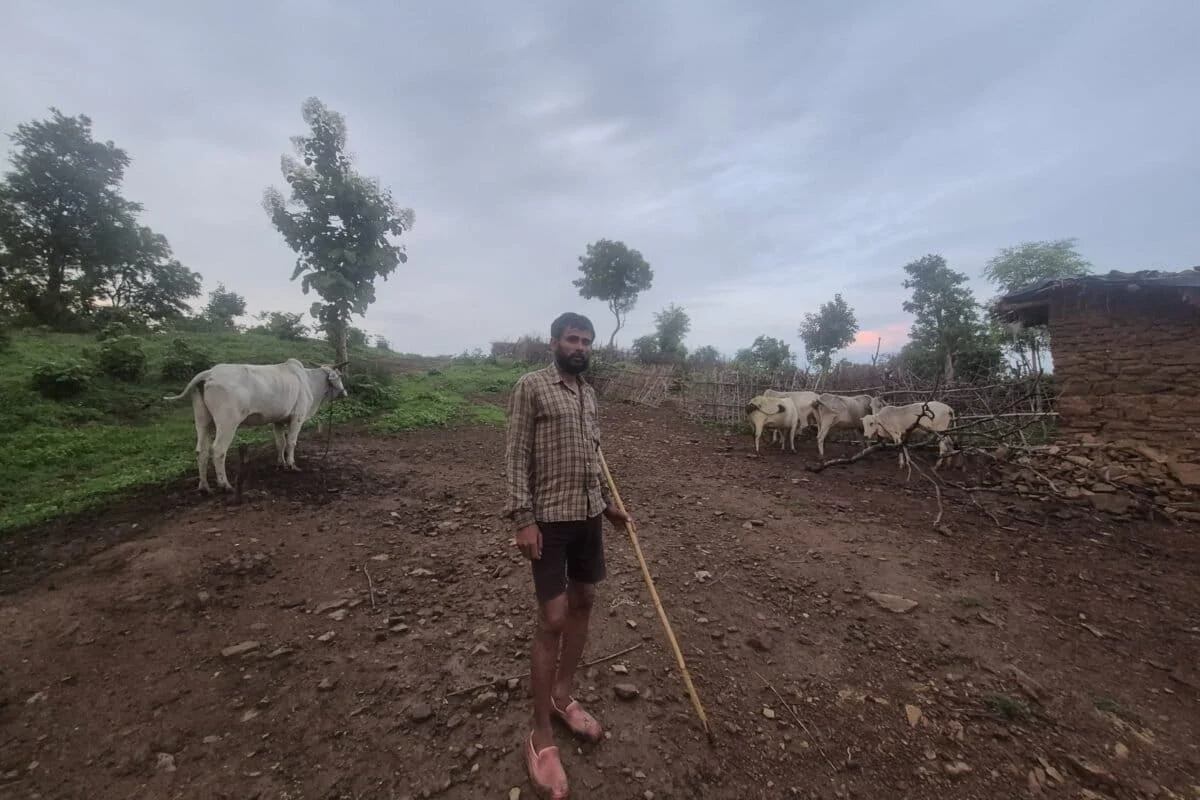
BUNDELKHAND, INDIA — In the arid expanse of Doda Mafi village, tucked within the Manikpur block of Chitrakoot district, the silence of the forest carries a heavy toll. For more than three months, the family of 65-year-old Faujdar Singh Yadav has been waiting for a return that feels increasingly unlikely.
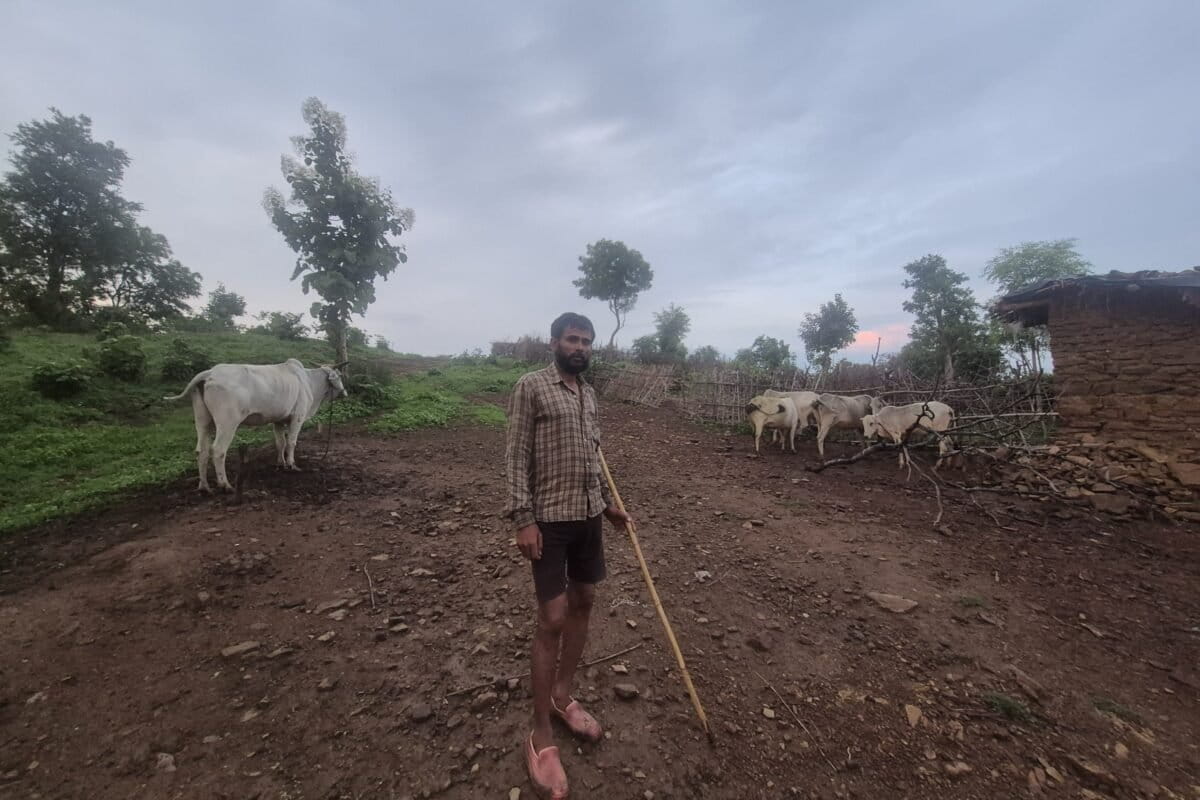
Yadav, a seasoned livestock farmer, disappeared in the third week of April while searching for his 14 cattle. In the peak of the summer heat, with fodder stocks at home depleted, he had ventured deep into the forest to find grazing ground. The cattle eventually found their way back to the village by evening; their master did not.
"The cattle went deeper into the forest in search of food and disappeared from his sight," explains his son, Rama Shankar. "While searching for them, he probably got lost too. We registered an FIR, but there is still no information. My father is gone, and our livelihood is hanging by a thread."
Yadav’s disappearance is not merely a local tragedy; it is a grim symptom of a systemic collapse. Across Bundelkhand—a region straddling the borders of Uttar Pradesh and Madhya Pradesh—a perfect storm of recurring drought, climate volatility, and failed policy implementation is pushing livestock farmers to the brink of extinction.
Main Facts: A Region Under Siege
Bundelkhand is historically identified as a drought-prone zone, but the frequency and intensity of these events have accelerated. What was once a decadal occurrence is now a recurring nightmare every five to seven years. This shift has decimated the rural economy, which relies almost exclusively on the symbiotic relationship between crop production and livestock rearing.
The crisis is defined by several critical factors:
- The Fodder Deficit: The region faces a dry matter deficit of approximately 42%. In districts like Banda, Mahoba, and Chitrakoot, availability often drops below 40% of the required amount.
- Livestock Decline: In Chitrakoot alone, the cattle and buffalo population plummeted from 519,428 in 2019 to 419,678 in 2024—a loss of nearly 100,000 animals in just five years.
- Anna Pratha: A traditional practice of "free grazing" or abandoning cattle during lean months has transformed from a seasonal management strategy into a desperate act of survival, leading to massive crop damage and social friction.
- Climatic Volatility: 2024 has seen rainfall deficits as high as 43% in Mahoba, exacerbated by El Niño conditions that have disrupted the southwest monsoon.
Chronology: From the 2015 Crisis to the Present Collapse
To understand the current desperation, one must look back at the landmark drought of 2015-16. This period serves as the "Ground Zero" for the current livestock crisis.
2015–2016: The Great Dying
During the peak of the 2016 summer, thousands of cattle perished across Bundelkhand due to dehydration and starvation. A study by Swaraj Abhiyan and Parmarth at the time revealed that 77% of cattle-owning households were forced to reduce feed, and 40% engaged in distress sales.
Kalka Prasad, a 55-year-old farmer from Mahoba, recalls this period as the beginning of the end. "A decade ago, I had six cattle. Two died in the 2015-16 drought. One survived, but I eventually abandoned her because there was nothing left to feed her. Now, I am down to three buffaloes, and even they are struggling."
2017–2021: The Research-Reality Gap
Following the 2016 disaster, institutions like the Indian Council of Agricultural Research (ICAR) and the Indian Grassland and Fodder Research Institute (IGFRI) intensified efforts to develop drought-tolerant fodder varieties. Plans were drafted, and new seeds were engineered. However, as the timeline moved forward, these innovations largely remained confined to research plots and government booklets, failing to reach the remote villages of Manikpur or Jaitpur.
2023–2024: The Current Shortfall
The last two years have seen a return to severe water stress. In 2023, while some areas saw decent rainfall, the lack of late-season rain prevented the sowing of paddy in many districts. By the summer of 2024, the absence of paddy straw (a vital secondary fodder source) created an acute shortage. With the India Meteorological Department (IMD) projecting below-normal rainfall for September 2026, the cycle of scarcity is poised to intensify.
Supporting Data: The Economics of Starvation
The livestock crisis in Bundelkhand is quantifiable through the lens of productivity and land use. According to a 2020 study by the International Crops Research Institute for Semi-Arid Tropics (ICRISAT), the dairy sector in the region is failing because of the lack of a "closed" feeding system.

The Milk Yield Collapse
Fodder scarcity has a direct, immediate impact on milk production. Kalka Prasad notes that during the dry months (March to June), a buffalo that typically produces 5 to 6 liters of milk drops to just 2 or 2.5 liters. This 60% reduction in output strips farmers of their daily cash flow, making it impossible to purchase expensive commercial feed (mustard cake) or wheat straw (bhusa), the prices of which skyrocket during shortages.
The Cost of "Anna Pratha"
When farmers can no longer afford to stall-feed their animals, they resort to Anna Pratha—releasing cattle to forage on their own. While this saves the farmer from immediate feed costs, it creates a regional catastrophe. ICRISAT data suggests that free-roaming cattle damage 25% to 35% of the Kharif (monsoon) crops annually. This creates a vicious cycle: crop damage leads to lower yields, which leads to less crop residue for fodder, which leads to more cattle being abandoned.
Land and Irrigation Barriers
The ICAR-IGFRI study of 2017 highlighted that 84.1% of farmers cite small landholdings as a barrier to fodder cultivation, while 78.87% cite a lack of irrigation. Green fodder, such as Berseem or Napier grass, requires consistent watering. In a region where canals often run dry and groundwater is receding, growing "food for animals" is seen as a luxury that competes with "food for humans."
Official Responses: Policy vs. Practice
The government’s response to the looming fodder crisis has been characterized by high-level directives that often dissipate before reaching the village level.
The Union Government’s Directive
Anticipating the impact of a weak monsoon, the Union government recently directed state and district administrations to:
- Overstock fodder and arrange supplies from surplus regions.
- Identify alternative feed sources.
- Curb hoarding and black marketing of straw.
The Local Reality
On the ground, these directives appear as mere suggestions. Jitendra Singh, the Chief Veterinary Officer (CVO) of Chitrakoot, admitted that the department distributes Napier grass roots to only "five farmers every year" per district. At this rate, farmers like Bharat Kumar of Paikora Gram Panchayat point out that it would take decades to cover the region.

Furthermore, the concept of "Fodder Banks"—recommended by the ICAR-CRIDA District Agriculture Contingency Plan—remains largely theoretical. P.C. Vishwakarma, Mahoba’s Soil Conservation Officer, confirmed the gap: "We stock dry fodder in gaushalas (government cow shelters), but we don’t have enough to preserve for the general farming population. Our district lacks the irrigation to even start a conservation system."
While scientists like Arun Kumar Shukla and Sitaram Kantwa of ICAR-IGFRI emphasize the availability of drought-tolerant varieties like Anjan and Dhaman grass, the awareness of these seeds is near zero among the actual livestock rearers. "What are these names? No one in the village knows them," says Kalka Prasad when asked about the new Bundel Berseem-9 variety.
Implications: A Culture and Economy at Risk
The implications of Bundelkhand’s fodder crisis extend far beyond the agricultural sector; they touch upon the very social fabric of rural India.
1. The Erosion of the Rural Safety Net
Livestock has traditionally served as a "living bank" for Indian farmers—an asset that can be sold in times of medical or social emergency. With 100,000 cattle lost in five years in Chitrakoot alone, the financial resilience of thousands of families has been wiped out.
2. Human Safety and Migration
As seen in the case of Faujdar Singh Yadav, the search for fodder is becoming a physically dangerous endeavor. As the "fodder frontier" moves deeper into forests and hazardous terrain, elderly farmers are at increasing risk. This desperation is a primary driver of distress migration, as younger generations abandon the cattle economy for low-wage labor in cities like Delhi or Mumbai.
3. The Failure of the Dairy Dream
India is the world’s largest milk producer, yet regions like Bundelkhand are seeing a "de-dairyfication." Without a localized, sustainable fodder supply chain, the government’s goals for doubling farmers’ income remain unattainable. The transition from a livestock-rich region to one of abandoned animals and empty sheds is a warning for other semi-arid zones in India.
4. Ecological Consequences
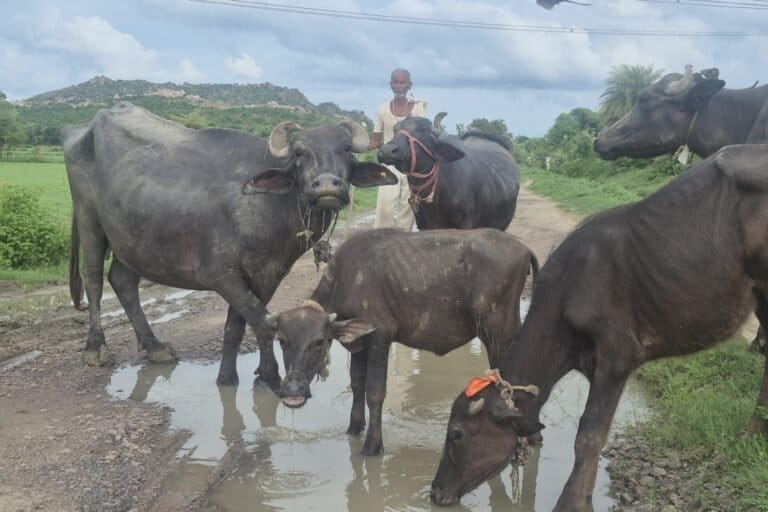
The practice of Anna Pratha and the overgrazing of forest lands lead to soil erosion and the loss of local biodiversity. When cattle are left to drink from roadside potholes or contaminated puddles, the risk of zoonotic diseases increases, further threatening the health of the remaining herds.
Conclusion
The tragedy of Faujdar Singh Yadav is a haunting reminder that climate change in Bundelkhand is not a future threat—it is a present-day predator. While scientific solutions exist in the form of new seed varieties and preservation techniques like silage and hay-making, the bridge between the laboratory and the cowshed is broken.
Unless there is a massive scaling of irrigation facilities, a localized network of fodder banks, and a grassroots-level extension program to educate farmers on drought-tolerant crops, the "cattle economy" of Bundelkhand may soon become a thing of the past. For the family of Yadav, and thousands like them, the wait for a solution is as agonizing as the wait for a missing father.
