

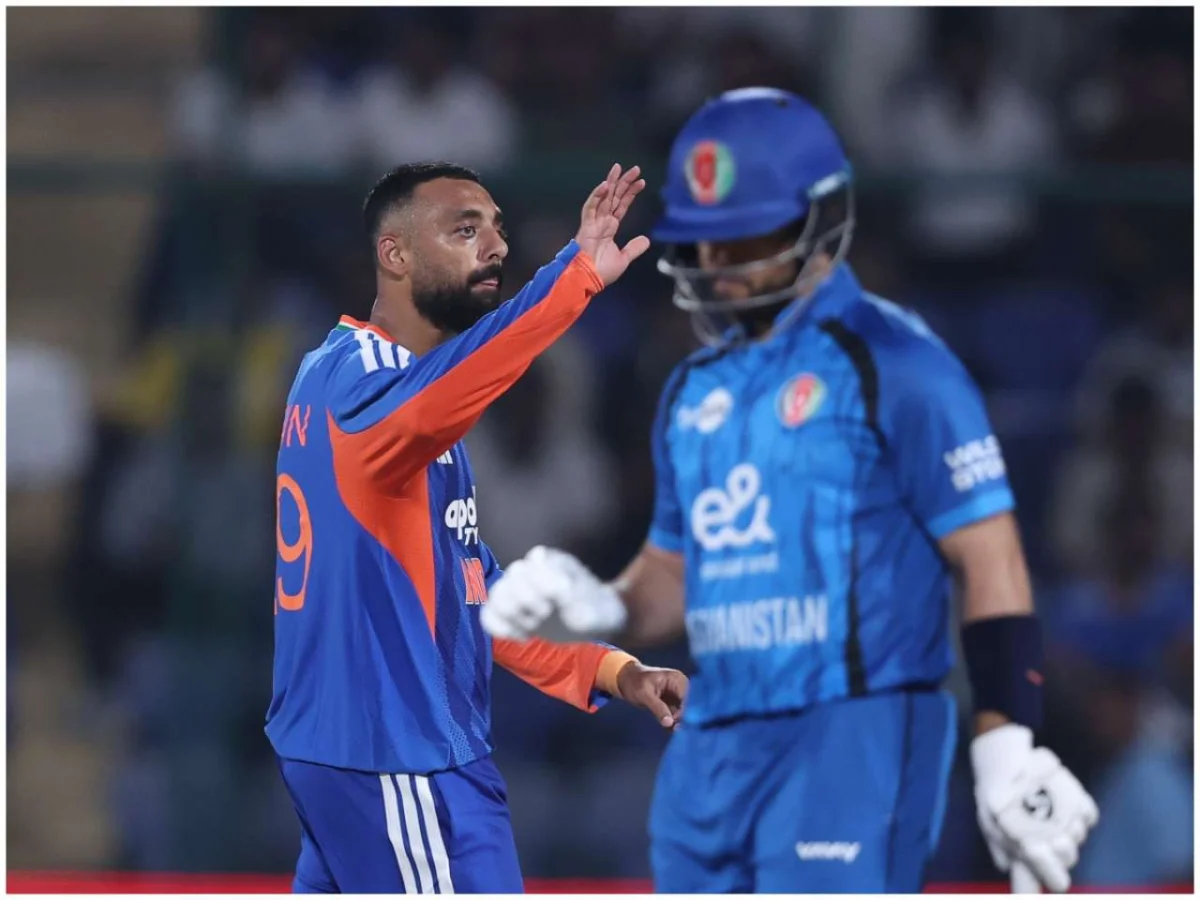
NEW DELHI, India – In a significant setback for the Indian cricket team, mystery spinner Varun Chakaravarthy has been officially ruled out of the remainder of the three-match T20 International series against Afghanistan. The unfortunate news comes just days after Chakaravarthy delivered a stellar and economical performance in the series opener on Sunday, where India secured a dominant seven-wicket victory at the Arun Jaitley Stadium in Delhi.
Chakaravarthy, who had only recently returned to competitive cricket following a prolonged battle with injuries, sustained a fresh side strain after the first T20I. This latest physical challenge forces him to withdraw from the squad, leaving a crucial void in India’s spin attack ahead of the second T20I, scheduled for Tuesday, September 15, at the same venue. The Board of Control for Cricket in India (BCCI) is expected to announce a replacement shortly, with Ravi Bishnoi and Washington Sundar emerging as frontrunners to step into the Playing XI.
Main Facts: A Promising Return Cut Short
Team India’s campaign in the three-match T20I series against Afghanistan has encountered an unexpected hurdle with the premature exit of one of its key spin exponents, Varun Chakaravarthy. The 32-year-old spinner, renowned for his deceptive variations and tight lines, showcased his value immediately upon his return to the international arena. In the series opener on Sunday, Chakaravarthy bowled a commendable spell, picking up one wicket for a mere 16 runs in his allotted four overs, effectively stifling the Afghan middle order. His performance was instrumental in restricting Afghanistan to a chaseable total of 156/8.
However, the joy of a successful comeback and an impressive individual display was short-lived. Reports confirmed that Chakaravarthy suffered a fresh side strain post-match, rendering him unfit to participate in the remaining two fixtures of the series. This injury marks another chapter in a frustrating series of physical setbacks for the talented spinner, raising concerns about his long-term fitness and availability for crucial international assignments.
)
The Men in Blue, under the captaincy of Shreyas Iyer for this series, had comfortably won the first T20I, chasing down Afghanistan’s total with 7 wickets in hand and considerable overs to spare. Opener Abhishek Sharma was the star of the chase, smashing a scintillating 82 runs off just 32 balls, earning him the Player of the Match award. While the team’s batting depth proved more than capable in the opener, the loss of Chakaravarthy necessitates a tactical reshuffle in the bowling department, particularly in a series designed to test India’s bench strength and fine-tune combinations. The team management now faces the immediate task of integrating a new spinner seamlessly into the playing XI for the crucial second T20I.
Chronology of Events: A Rollercoaster of Recovery and Relapse
Varun Chakaravarthy’s journey leading up to and during this Afghanistan series has been a microcosm of his recent career – a testament to his talent punctuated by persistent injury woes.

Prior to the Afghanistan Series: A History of Setbacks and a Resilient Comeback
Chakaravarthy’s recent past has been marred by a series of debilitating injuries. He had only recently completed a rigorous rehabilitation program after sustaining a Grade 2 left hamstring injury. This particular injury had forced him to miss the latter part of the home T20I series against England and subsequently ruled him out of the tour to Zimbabwe. His absence from these crucial series underscored the severity of his hamstring issue and the caution exercised by the team management regarding his return. Beyond the hamstring, Chakaravarthy has also battled other physical ailments, including a hairline fracture in his foot and a hand injury, both sustained during his Indian Premier League (IPL) campaigns with the Kolkata Knight Riders (KKR) in recent seasons. Each recovery period has been a test of his mental fortitude, requiring him to regain fitness and rhythm repeatedly. His selection for the Afghanistan series was seen as a positive sign, indicating he had successfully navigated his latest recovery phase and was deemed fit for international duty once more.
The First T20I: A Glimmer of Hope
On Sunday, September 12th, at the Arun Jaitley Stadium, Varun Chakaravarthy made his much-anticipated return to the Indian T20I side. Captain Shreyas Iyer won the toss and elected to bowl first, a decision that allowed India’s bowlers to set the tone. Afghanistan, batting first, posted a challenging yet chaseable total of 156/8 in their 20 overs, largely thanks to Azmatullah Omarzai’s resilient 64 off 44 balls.
Chakaravarthy was introduced into the attack during the middle overs, and he immediately made an impact. His unique bowling action and array of variations, including the carrom ball and slider, proved difficult for the Afghan batsmen to read. He maintained tight lines, restricting the flow of runs, and crucially picked up the wicket of Darwish Rasooli, showcasing his ability to break partnerships and exert pressure. His figures of 1/16 from four overs were the most economical among the Indian bowlers, a performance that reaffirmed his status as a valuable asset in the T20 format and gave fans hope for a consistent run of form.
)
Post-Match: The Unfortunate Relapse
The optimism surrounding Chakaravarthy’s return quickly dissipated. Following the conclusion of the first T20I, medical assessments revealed that the spinner had sustained a fresh side strain. A side strain, particularly in a bowler, can be a painful and disruptive injury, often requiring rest and careful rehabilitation to prevent recurrence. The immediate diagnosis led to the unfortunate decision to rule him out of the remainder of the Afghanistan series, effectively ending his participation after just one match. The news, initially reported by ANI, was a stark reminder of the physical demands of elite cricket and the thin line between peak performance and injury.
Ahead of the Second T20I: The Search for a Replacement
With the second T20I scheduled for Tuesday, September 15th, the Indian team management now faces the urgent task of identifying and integrating a suitable replacement. The abrupt nature of Chakaravarthy’s withdrawal leaves little time for contemplation, necessitating a swift decision to maintain the team’s balance and bowling strength. The focus immediately shifts to the reserve spinners in the squad, primarily Ravi Bishnoi and Washington Sundar, who now find themselves in contention for a spot in the Playing XI.
)
Supporting Data and Context: Varun Chakaravarthy’s Journey and India’s Spin Depth
Varun Chakaravarthy’s career has been an intriguing narrative of talent, resilience, and the relentless challenge of maintaining peak physical condition in professional cricket. His initial rise was meteoric, captivating audiences and selectors alike with his enigmatic "mystery spin."
The Rise of the Mystery Spinner:
Chakaravarthy first burst onto the scene in the Indian Premier League, where his unique blend of off-spin, leg-spin, and carrom balls made him a formidable opponent. His stint with the Kolkata Knight Riders, particularly from the 2020 season onwards, showcased his ability to pick up crucial wickets in the middle overs and stem the flow of runs. In recent T20 matches, he has consistently been among the wicket-takers, demonstrating his effectiveness across various conditions. For instance, the original article mentions that in the recent past (likely implying the 2023-2024 season or specific tournaments), he has scalped 20 wickets in 16 T20Is at an average of 24.15 with best figures of 3/7. These statistics highlight his wicket-taking prowess and impact when fully fit and firing. His ability to deliver a sensational spell of 1/16 in the first T20I against Afghanistan, following a long layoff, further underscores his innate talent and match-winning potential.
)
The Impact of Recurring Injuries:
However, the same intensity and unique bowling action that make Chakaravarthy so effective also seem to predispose him to injuries. His body has struggled to cope with the rigorous demands of international and franchise cricket. The recurring nature of his injuries – from hamstring issues to foot fractures and now a side strain – has been a source of immense frustration for both the player and the team management. Each injury forces him out of contention, disrupts his rhythm, and places him back in the arduous cycle of rehabilitation. This pattern is particularly detrimental for a spinner who relies heavily on subtle variations and consistent release points, elements that are often compromised during periods of physical discomfort or recovery.
India’s Robust Spin Armory:
Despite Chakaravarthy’s unfortunate withdrawal, India possesses a formidable and diverse spin attack. The current squad, even without him, boasts significant depth, providing the team management with multiple options.
)
- Ravi Bishnoi: A young, aggressive leg-spinner known for his quick arm action and deceptive googlies. Bishnoi has quickly established himself as a potent force in T20I cricket, capable of picking up wickets in the powerplay and middle overs. His inclusion would offer a different kind of challenge to the Afghan batsmen compared to Chakaravarthy’s mystery spin.
- Washington Sundar: An off-spinner who also provides valuable batting depth in the lower order. Sundar’s ability to bowl economically in the powerplay and his composed batting makes him an attractive all-round option, especially if the team is looking for a longer tail or more stability with the bat. His control and ability to absorb pressure could be vital.
- Other Established Spinners: India’s broader spin pool includes world-class talents like Kuldeep Yadav (left-arm wrist-spinner), Yuzvendra Chahal (leg-spinner), Axar Patel (left-arm orthodox), and Ravindra Jadeja (left-arm orthodox all-rounder). While not all are part of this specific series squad, their existence highlights the rich talent available, ensuring that even with injuries to key players, the national team has ample quality to fall back on.
The decision between Bishnoi and Sundar for the second T20I will likely hinge on the team’s tactical approach: whether they prioritize an attacking, wicket-taking leg-spinner (Bishnoi) or a more all-round option offering both economy and batting support (Sundar). The Arun Jaitley Stadium pitch conditions, which generally offer some assistance to spinners as the game progresses, will also play a role in this crucial selection.
Official Responses and Statements: Managing the Setback
While direct quotes from official sources regarding Varun Chakaravarthy’s specific injury and withdrawal are often succinct in breaking news, the underlying sentiments and standard operating procedures within the Board of Control for Cricket in India (BCCI) and team management can be inferred. The initial report from ANI serves as the primary official confirmation of his exit.
)
BCCI’s Stance:
The BCCI, responsible for player welfare and team selections, would typically express regret over the loss of a player due to injury, especially one who has shown such promise on his return. A hypothetical statement from a BCCI official might read: "We regret to announce that Varun Chakaravarthy has been ruled out of the remainder of the T20I series against Afghanistan due to a fresh side strain sustained after the first match. The medical team is closely monitoring his condition, and he will undergo a comprehensive rehabilitation program. We wish Varun a speedy recovery and have full confidence in the depth of our squad to manage this unforeseen situation." This statement would underscore the board’s commitment to player health and its belief in the available talent.
Team Management’s Perspective (Captain/Coach):
Captain Shreyas Iyer and the coaching staff would undoubtedly acknowledge Chakaravarthy’s impact and the void his absence creates. Their focus, however, would immediately shift to the task at hand and instilling confidence in the replacement player. A plausible statement from Captain Iyer might be: "It’s certainly unfortunate to lose Varun after such a fantastic comeback performance. He was brilliant in the first game. Injuries are part and parcel of the sport, and we wish him a quick recovery. We have a strong pool of talent, and we are confident that whoever steps in will perform to the best of their abilities and contribute to the team’s success. Our focus remains firmly on winning the series." Such a statement would blend empathy for the injured player with a clear message of resilience and preparedness for the upcoming matches.
)
Medical Team’s Insight:
While medical teams rarely issue public statements, their internal assessment would detail the nature of the side strain, the estimated recovery timeline, and the prescribed rehabilitation protocol. A side strain, particularly for a bowler, can often mean a layoff of several weeks, depending on its severity. The immediate concern would be to manage pain and inflammation, followed by a gradual return to activity and strengthening exercises. The emphasis would be on ensuring a complete recovery to prevent future recurrences, especially given Chakaravarthy’s history of injuries.
Player’s Personal Sentiment (Inferred):
From Varun Chakaravarthy’s perspective, this latest injury would undoubtedly be a source of immense frustration. After working tirelessly to recover from previous setbacks and making such a strong return, to be sidelined again so quickly is a harsh blow. One can infer a sense of disappointment and a renewed determination to overcome this challenge. He would likely be focused on following his rehabilitation diligently, aiming to return stronger and fitter to stake his claim for a regular spot in the national side. His journey is a testament to the mental toughness required to navigate the highs and lows of professional sport.
)
Implications and Future Outlook: A Test of Depth and Resilience
Varun Chakaravarthy’s injury and subsequent withdrawal carry significant implications, not only for the ongoing series against Afghanistan but also for his personal career trajectory and India’s broader strategic planning in T20 cricket.
Immediate Impact on the Current Series:
The most immediate consequence is the need for a tactical adjustment for the second T20I. Chakaravarthy’s mystery spin provides a unique dimension that few other Indian spinners possess. His ability to bowl economically and pick up wickets in the middle overs without giving much pace on the ball is invaluable. The team management must now decide between Ravi Bishnoi’s attacking leg-spin and Washington Sundar’s all-round capabilities.
)
- If Bishnoi plays: India gains an aggressive, wicket-taking option. However, Bishnoi’s style is more conventional than Chakaravarthy’s, and he might offer less of the "mystery" element. His inclusion would mean India relies on a leg-spin-dominated attack alongside perhaps another wrist-spinner or left-arm orthodox.
- If Sundar plays: India’s batting depth increases, and they gain an economical off-spinner who can bowl in the powerplay. However, Sundar might not provide the same wicket-taking threat in the middle overs as Chakaravarthy or Bishnoi. The choice will reflect the team’s assessment of the pitch, the opponent’s batting lineup, and their desired balance between attack, economy, and batting solidity. Regardless of the choice, the team will need to adapt quickly to the change in bowling dynamics.
Long-Term Impact on Varun Chakaravarthy’s Career:
This latest injury is a significant concern for Chakaravarthy’s international aspirations. Recurring injuries, especially those that force a player out shortly after a comeback, can erode confidence and make it challenging to maintain a consistent run of form.
- Fitness Concerns: The primary implication is the ongoing question mark over his fitness. Selectors and team management prioritize players who are consistently available and robust. Chakaravarthy’s inability to stay fit for extended periods, despite his undeniable talent, could hinder his chances of cementing a permanent spot in the national squad.
- Competition for Places: India’s spin department is fiercely competitive. With a strong pool of established and emerging talent, every absence provides an opportunity for another player to stake their claim. Chakaravarthy will face an uphill battle to regain his place once fit, needing to outperform others who might have seized their chances in his absence.
- Mental Fortitude: Battling successive injuries is mentally taxing. Chakaravarthy will need immense mental strength to go through another rehabilitation phase and return with the same hunger and confidence. His focus must now shift to a comprehensive and long-term fitness regimen designed to prevent future breakdowns.
Broader Implications for Indian Cricket:
Chakaravarthy’s situation highlights broader issues within Indian cricket regarding player workload management and the demands placed on athletes.
)
- Workload Management: The sheer volume of international and franchise cricket (IPL) places immense stress on players. Boards and team managements are increasingly focusing on workload management, but balancing player availability with fitness remains a complex challenge.
- Talent Pool Strength: On a positive note, India’s ability to absorb such a blow and still field a competitive side speaks volumes about the depth of talent in its domestic cricket structure. The presence of players like Bishnoi and Sundar, who are ready to step up, ensures that the national team remains robust even in the face of injuries to key players.
- Strategic Planning: For upcoming major tournaments, particularly the T20 World Cup, consistency and fitness of key players are paramount. Chakaravarthy’s recurring injuries might prompt the selectors to lean towards players with a more proven track record of fitness, even if it means sacrificing some of his unique "mystery" element.
In conclusion, Varun Chakaravarthy’s withdrawal from the Afghanistan T20I series is a disheartening development for both the player and Team India. While the team possesses the depth to navigate this immediate challenge, it serves as a stark reminder of the fragile nature of an athlete’s career and the relentless pursuit of fitness at the highest level. For Chakaravarthy, it’s another test of resilience, and his path back to consistent international cricket will undoubtedly be closely watched. For India, it’s an opportunity for other spinners to step up and consolidate their positions, showcasing the nation’s rich and ever-evolving spin talent.
