

Published: September 14, 2026, 12:32 PM IST
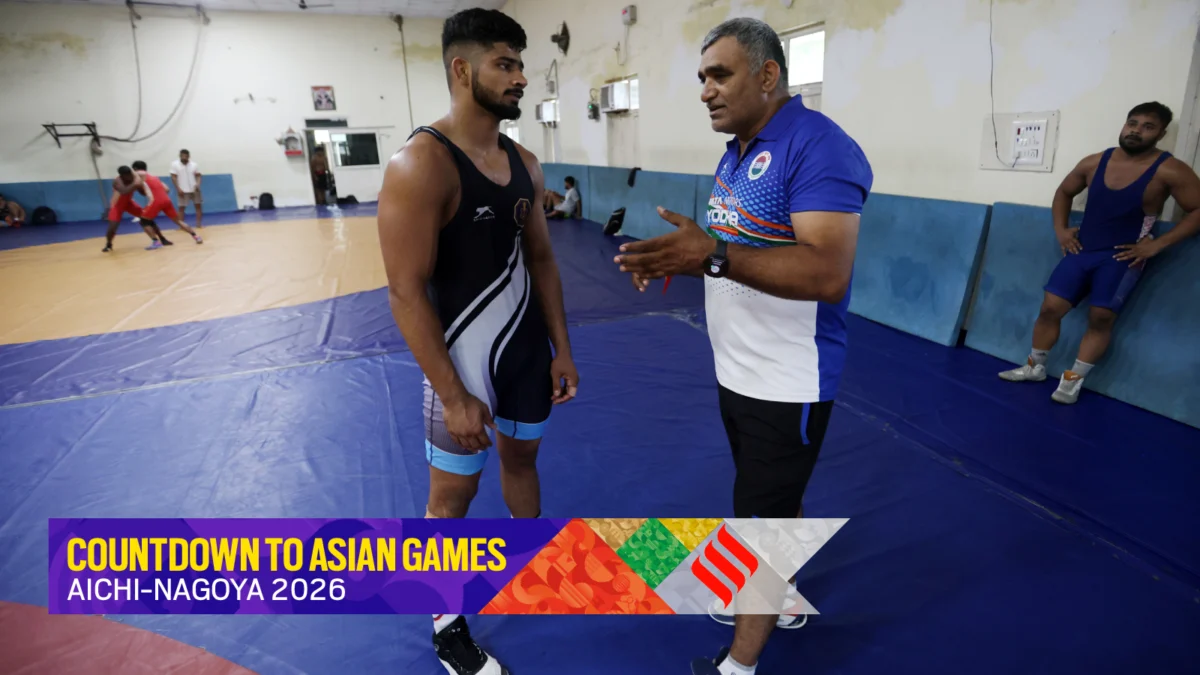
[Image: Greco-Roman coach Kuldeep Singh at the Raipur Akhada in Sonepat. (Express Photo by Gajendra Yadav)]
Sonepat, Haryana – In the pulsating heart of Haryana’s wrestling landscape, where the dust of the akhada settles not just on the mats but on decades of dreams and relentless toil, stands Kuldeep Singh. At the Raipur Akhada in Sonepat, his presence is a constant, guiding force. With a gaze that misses nothing and instructions delivered with the precision of a seasoned strategist, he navigates between two mats, overseeing the rigorous training of Greco-Roman wrestlers. This September, as the Asian Games loom large in Nagoya, Japan, the spotlight falls on a discipline often overshadowed in India, and on the quiet architect behind its recent resurgence.
Kuldeep Singh is not merely a coach; he is a foundational pillar, a mentor whose dedication spans over four decades. His students, Sujeet Kalkal, Aman (77kg), and Nitesh Siwach (97kg), are not just athletes; they are the torchbearers of his vision, making up half of India’s Greco-Roman contingent for the upcoming continental spectacle. Sujeet, a formidable talent and medal favourite, has been meticulously shaped under Kuldeep’s discerning eye at this very akhada. Their journey to Nagoya is a testament to Kuldeep’s unwavering belief in a style of wrestling that has long struggled to gain prominence in a freestyle-dominated nation.
"Coaching is something that came naturally to me," Kuldeep Singh shared with The Indian Express, his voice reflecting a lifetime steeped in the sport. "I have been wrestling since school days, so there is nothing I know better than this. I don’t think there was anything I could have done better than preparing wrestlers." This simple statement encapsulates the profound commitment of a man who found his true calling not just in competing, but in nurturing the next generation of grapplers.
A Wrestler’s Evolution: From Freestyle Mat to Greco-Roman Guru
Kuldeep Singh’s journey into the world of wrestling began in 1982, a time when freestyle wrestling reigned supreme in Indian akhadas. He was a natural, his powerful physique and strategic mind earning him multiple national medals in the discipline. For years, he honed his skills, grappling with the best the country had to offer, his name becoming synonymous with dedication and raw talent. However, a significant pivot in his career came after he turned 28, a period when many athletes consider winding down. Kuldeep chose a different path: he switched to Greco-Roman wrestling.
"Once I was done with freestyle, I thought that let’s try Greco one," he recounted, a hint of curiosity still evident in his eyes. "Once I started it, I enjoyed it a lot. However, there comes a point when one has to take the call. I realized that I can’t play further, so I decided to do the next best thing to competing, that is coaching." This transition was more than just a change in style; it was a profound realization of his true purpose. He saw the nuances, the technical demands, and the untapped potential of Greco-Roman wrestling, a discipline less understood and less celebrated in India.
His decision to move into coaching was not born out of a lack of options, but out of an intrinsic desire to contribute. Having experienced the competitive arena from both freestyle and Greco-Roman perspectives, he possessed a unique insight into the physical and mental demands of the sport. He understood the intricacies of holds, throws, and takedowns in both styles, but it was the upper-body grappling, the intricate dance of strength and technique that defines Greco-Roman, that truly captivated him. He saw a void, a discipline ripe for development, and he stepped in to fill it.
The Raipur Akhada: A Crucible of Dreams
Today, the Raipur Akhada, under Kuldeep Singh’s stewardship, is a bustling hub of wrestling activity, training more than 250 wrestlers. It’s a place where the scent of liniment and sweat mingles with the faint aroma of the soil, a traditional akhada adapted for modern wrestling. The air is thick with the grunts of exertion, the rhythmic thud of bodies hitting the mat, and Kuldeep’s sharp, incisive instructions.
His coaching record is a testament to his expertise, punctuated by historic achievements that have slowly but surely etched Greco-Roman into India’s sporting consciousness. Most notably, he guided Sandeep Tulsi Yadav to a bronze medal at the 2013 World Championships in Budapest – a singular achievement that remains India’s only Greco-Roman medal at that prestigious event. This breakthrough was a beacon of hope, proving that Indian wrestlers, with the right guidance, could compete and win on the global stage in this specialized discipline.
Beyond Greco-Roman, Kuldeep has also shaped the careers of numerous freestyle internationals, showcasing his versatility and deep understanding of wrestling principles that transcend specific styles. More recently, when Sunil Kumar clinched a Greco-Roman bronze at the 2023 Asian Games, ending a 13-year medal drought for the discipline, Kuldeep Singh was there, in the corner, his presence a calming and authoritative force. His contributions are not just about individual medals; they are about building a legacy, piece by painstaking piece.
A Curious Child: The Relentless Pursuit of Innovation
Kuldeep Singh’s students describe a man whose passion for his craft remains as fiery and restless as it was four decades ago. "Coach Sahab is like a curious child," remarked Nitesh Siwach, one of the two Kuldeep-trained wrestlers heading to these Asian Games. "He is still constantly finding new innovations or trying to improve how we train constantly. Every time I play a new opponent, he has all the analysis ready for me." This observation highlights Kuldeep’s defining characteristic: an insatiable hunger for knowledge and an unwavering commitment to staying ahead of the curve.
This restlessness once led him on a solitary pilgrimage to Japan in the early 2010s. With little more than a burning question and an unshakeable resolve, he embarked on the journey. "I did it on my own," Kuldeep stated, reflecting on that pivotal trip. "There was not much technical literature here available. I wanted to understand what Japanese are doing so well." Japan, a powerhouse in wrestling, particularly in its technical aspects, offered the answers he sought.
What he witnessed there profoundly impacted his coaching philosophy. "When I went there, the training processes and their routine amazed me," he recalled. "I came back and tried to implement it here. I always try to stay updated on what the world is doing, as that is where the competition lies for my students." He meticulously observed their drills, their strength and conditioning regimens, their mental preparation techniques, and their tactical approaches. He saw a systematic, scientific method applied to wrestling, a stark contrast to the often-intuitive, strength-based approach prevalent in many Indian akhadas.
Upon his return, Kuldeep didn’t just replicate; he adapted. He integrated elements of Japanese discipline, technical precision, and strategic analysis into the rigorous training environment of the Raipur Akhada. This infusion of international best practices was instrumental in cultivating the technical prowess that would eventually lead to Sandeep Tulsi Yadav’s historic World Championships bronze. It proved that a blend of traditional Indian wrestling grit with advanced global techniques could yield extraordinary results.
Greco-Roman’s Uphill Battle: Addressing Systemic Challenges
Despite these significant breakthroughs, Kuldeep believes the discipline itself hasn’t fully caught up within India. "Freestyle always had the elite status in the country," he lamented, "but Greco-Roman was an afterthought, with a lot of wrestlers taking up Greco-Roman later in the career." This late start, he explained, is the root of a deeper, systemic shortage that plagues Indian Greco-Roman wrestling.
The fundamental issue, as Kuldeep articulates, is the lack of early specialization. Many promising wrestlers, drawn by the greater popularity and perceived pathways of freestyle, only transition to Greco-Roman when their freestyle careers plateau or as a secondary option. This means they miss crucial formative years dedicated to mastering the unique technical demands of Greco-Roman.
"One of the biggest problems is the lack of technical wrestlers," Kuldeep emphasized. "As wrestlers start late, they are not able to become technical. The scoring areas are less in Greco, and that is why more explosive power is needed." Unlike freestyle, which allows attacks on the legs, Greco-Roman focuses exclusively on upper-body holds and throws. This requires a completely different muscular development, core strength, and a highly specialized set of techniques. Wrestlers who begin their training focusing on freestyle often find it difficult to retrain their muscle memory and develop the explosive power and intricate upper-body leverage required for Greco-Roman later in their careers.
This late entry also impacts tactical development. Greco-Roman matches are often decided by subtle shifts in balance, precise timing, and the ability to execute powerful throws from clinch positions. These skills are best developed through years of dedicated practice, starting from a young age. Without a robust grassroots system specifically for Greco-Roman, India continues to play catch-up with nations like Iran, Turkey, Russia, and Japan, where the discipline enjoys equal, if not greater, prominence and dedicated developmental pipelines.
Nagoya’s Hopes: The Students Carrying the Torch
Two of Kuldeep Singh’s brightest students are now poised to carry the fight for Indian Greco-Roman into Nagoya, hoping to translate their mentor’s teachings into continental glory.
Sujeet Kalkal, a reigning Asian and U23 World champion in freestyle’s 65kg category, represents a unique convergence of talent. While primarily a freestyle wrestler, he has benefited immensely from Kuldeep’s rigorous Greco-Roman training alongside his own father, Dayanand Kalkal. "Coach sahab is a thinking coach," Sujeet affirmed. "I am privileged to have my father and Kuldeep sir as the coaches. My endurance and power improved, and once it started improving, I started doing well at the senior level."
Sujeet’s decision to cross-train under Kuldeep highlights the coach’s reputation for developing raw power and mental fortitude, skills transferable across wrestling styles. His presence in the Greco-Roman camp, even as a freestyle champion, speaks volumes about the quality of training offered at Raipur Akhada and Kuldeep’s ability to cater to diverse athletic needs. The blend of his father’s fundamental guidance and Kuldeep’s advanced technical insights has forged a truly formidable athlete in Sujeet. His potential to bring home a medal in Nagoya, regardless of the style, is a source of immense pride for Kuldeep.
Nitesh Siwach, silver medallist at the 2026 Asian Championships in Greco-Roman’s 97kg category, has been a dedicated disciple, waiting patiently for his moment on the Asian Games stage for four long years. "Kuldeep sir has been on my side throughout that," he shared, emphasizing the profound support he received during his journey. "Nobody has done well at the Asian Games in my weight category, but coach sahab has been constantly motivating me apart from the usual training we have."
Nitesh’s experience underscores the mental aspect of Kuldeep’s coaching. Beyond the physical drills and technical corrections, Kuldeep instills belief, especially in categories where India has historically struggled. His constant encouragement, coupled with tailored training plans and detailed opponent analysis, prepares his students not just physically, but also mentally for the immense pressure of international competition. For Nitesh, Kuldeep is more than a coach; he is a confidant and a relentless motivator, pushing him to break barriers in a challenging weight category.
The Eternal Student: Kuldeep’s Unending Pursuit of Knowledge
Kuldeep Singh’s philosophy is simple yet profound: to teach effectively, one must never stop learning. "If I have to train students, I have to be a student of the game," he asserted, articulating the core of his enduring success. "The sport is evolving at a rapid pace and wrestling at world level is very competitive. The sport has moved leaps and bounds from what it was a decade back, and if we don’t learn everyday, we will fall behind."
This commitment to continuous learning is not merely an intellectual exercise; it is a practical necessity in a sport that constantly innovates. New techniques emerge, training methodologies evolve, and opponent strategies become increasingly sophisticated. Kuldeep ensures he stays abreast of these developments, poring over international match footage, analyzing trends, and even consulting with coaches from other nations when opportunities arise. He wants to be the ultimate resource for his students, capable of answering any question, solving any puzzle.
"I want to be ready to answer all the questions my students have, as they are also becoming smart," he added. "If a coach can’t explain to his students why they are doing something, there is no point being a coach." This emphasis on understanding the ‘why’ behind every drill, every exercise, empowers his students. It transforms them from mere practitioners into thinking athletes, capable of adapting and strategizing on the mat. It builds a deeper trust and respect between coach and wrestler, forming a true partnership in the pursuit of excellence.
Implications and The Road Ahead: Nagoya and Beyond
The upcoming Asian Games, with wrestling commencing on September 30 at the Inae Sports Center in Nagoya, represent a crucial juncture for Indian Greco-Roman wrestling and for Kuldeep Singh’s continued legacy. Success for Aman, Nitesh, and Sujeet (who, despite his freestyle prowess, carries the weight of Kuldeep’s influence) will not just be personal triumphs; they will be powerful affirmations of Kuldeep’s vision and the potential of a discipline often overlooked.
A strong showing in Nagoya could catalyze greater interest and investment in Greco-Roman at the grassroots level in India. It could encourage young athletes to specialize earlier, addressing the "late start" problem that Kuldeep has identified. It could attract more resources, leading to better infrastructure, more specialized coaching, and enhanced international exposure for promising Greco-Roman talents.
For Kuldeep Singh, however, the quest remains eternal. He won’t be on the mat in Nagoya, physically grappling with the opponents. But his spirit, his teachings, and his strategic insights will be with his students every step of the way. He will be exactly where he has been for four decades: watching, analyzing, and still looking for the thing he doesn’t yet know. His journey is a testament to the power of relentless dedication, a quiet revolution led by a man who refuses to let a challenging discipline fade into the background, continually pushing its boundaries, one meticulously trained wrestler at a time. The echoes of his guidance will reverberate through the halls of the Inae Sports Center, a silent prayer for the success of his students and the enduring future of Indian Greco-Roman wrestling.
